Researchers Propose Zcash-Style 'Shielded Bitcoin' Protocol for Private BTC Transfers
Key Takeaways
- •A team at Alloc Init, including researchers Clara Shikhelman, Mikhail Komarov and Aleksei Moskvin, proposed Shielded Bitcoin, a metaprotocol for private BTC transfers announced on Sept. 24.
- •The design relies on encrypted notes and zero-knowledge proofs to hide transaction amounts and counterparties while leaving Bitcoin's consensus rules unchanged, separate indexers enforcing the privacy rules.
- •The proposal remains a theoretical research effort that has not been deployed, with transaction identifiability and entry-and-exit mechanics still unresolved and a new paper on those mechanics planned.
- •Existing Bitcoin privacy options include CoinJoin, Silent Payments and PayJoin, but Shielded Bitcoin more closely resembles Zcash's fully shielded transfers, leading some observers to describe it as marketing for Zcash.
- •ZEC is up 192% year to date and trading above $1,500, while Bitcoin is down almost 4% year to date and trading around $84,000.
Bitcoin privacy researchers at Alloc Init have proposed Shielded Bitcoin, a new metaprotocol designed to enable private BTC transfers directly on the Bitcoin network. The team announced the proposal on Sept. 24 in a post on X, describing a system that would hide transaction amounts and counterparties without changing Bitcoin's consensus rules. The design remains a research proposal and has not been deployed on the Bitcoin network.
Researchers Clara Shikhelman, Mikhail Komarov and Aleksei Moskvin developed the system around encrypted notes and zero-knowledge proofs — the same class of cryptography that powers Zcash's shielded transactions. Under the design, Bitcoin would store and order the underlying transaction data without interpreting the private transfer itself, while separate indexers would verify the Shielded Bitcoin rules using data published on Bitcoin.
Shielded Bitcoin Proposal Remains in Theoretical Stage
In the proposal, Alloc Init stated that its implementation will not require any soft fork or bridges — possible because the privacy rules live outside Bitcoin's consensus, enforced by indexers working on data the base chain stores and orders but never interprets. The team framed the proposal as addressing a major issue with Bitcoin: the public nature of transactions, in which every amount and counterparty is visible on an open ledger. The researchers argued that the lack of privacy is a major limitation for the network, both for individuals and institutions, and said Shielded is intended to address it through a privacy architecture built into the network itself.
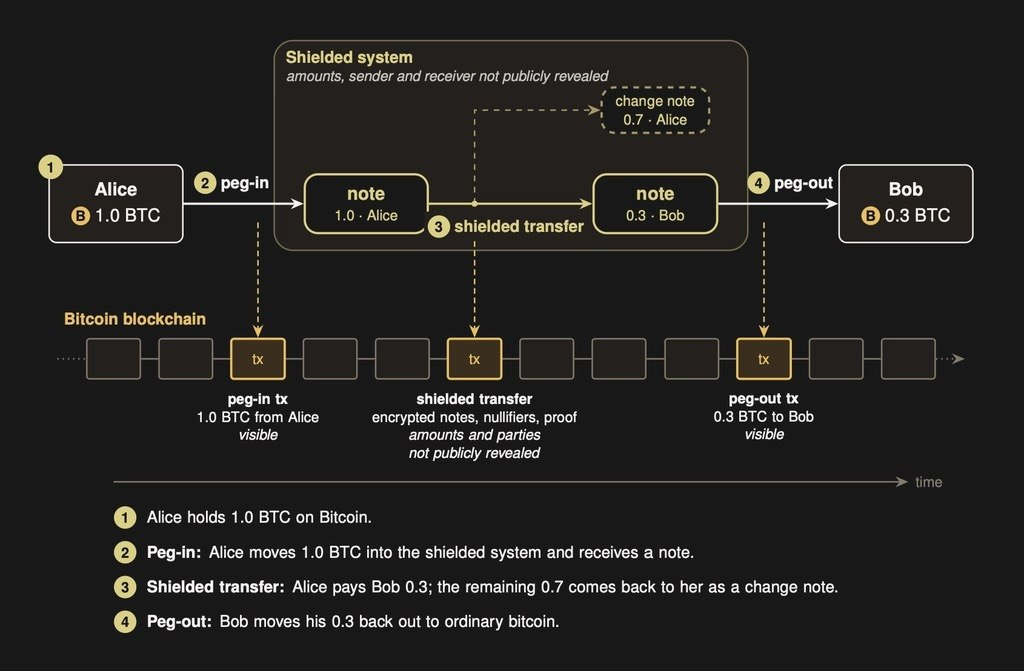
Under the proposed flow, users would deposit BTC into the metaprotocol and receive a private note inside Shielded Bitcoin representing the value of their deposit. A user could then send part of the BTC to a recipient as an encrypted note, while the balance is returned to the sender as another encrypted note. In this way, the Bitcoin network records that a note has been spent, but there is no public record of which note it was.
An accompanying blog post published alongside the technical paper explained that notes are not visible on Bitcoin in a readable form. When someone initiates a transaction, Bitcoin only stores the data and orders it, but cannot read it.
"Think of Bitcoin as a public bulletin board: Bitcoin publishes and orders the data, while anyone can independently apply the Shielded Bitcoin rules to determine the resulting state," the post stated.
The idea remains theoretical. The researchers noted that current limitations could still allow a transaction to be identified, and they are planning to publish another paper on how Bitcoin can enter or exit the shielded protocol. Both issues — transaction identifiability and the mechanics of entering and exiting — remain unresolved, with the planned entry-and-exit paper the next concrete milestone the team has set.
Privacy in Focus as Zcash Rallies
Despite its theoretical nature, the proposal has already attracted interest from the Bitcoin community, with reactions circulating on X. Attempts to introduce privacy to Bitcoin are not new, with existing options including CoinJoin, Silent Payments and PayJoin. However, the paper noted that the Shielded Bitcoin approach is closer to what Zcash currently offers, where transfers can be shielded entirely from the public ledger — a similarity that has led some observers to describe the proposal as marketing for Zcash.
Zcash has enjoyed a surge in interest over the past year, translating into a massive rise in its token value. ZEC is one of the best performers of the year, up 192% year to date. The token is currently trading above $1,500, having risen more than 3% today. By comparison, Bitcoin is down slightly over the last 24 hours: the flagship asset is trading around $84,000 and is down almost 4% year to date.
The full technical paper is available on Notion.
This article is for informational purposes only and does not constitute financial, investment or cybersecurity advice. Shielded Bitcoin remains an experimental research proposal.
Source: The Market Periodical

