Shiba Inu Price Climbs After Weekly SHIB Burn Nears 3 Billion
Key Takeaways
- •Approximately 2.96 billion SHIB tokens were burned over a seven-day period, representing the highest weekly burn rate in roughly a year.
- •The burn milestone coincided with SHIB's sixth anniversary since its August 2020 Ethereum launch, contributing to a surge in trading volume that reached $142 million over 24 hours.
- •Despite the large-sounding burn figures, the removed tokens constitute only a tiny fraction of SHIB's roughly 589 trillion total supply held across more than 3.06 million wallets.
- •SHIB's current valuation near $2.94 billion remains well below its October 2021 all-time high, when the meme-coin sector reached its peak market interest.
- •Developers are advancing Shibarium layer-2 infrastructure alongside LEASH v2 migration and metaverse initiatives, with sustained network adoption considered essential for burns to have lasting economic impact.
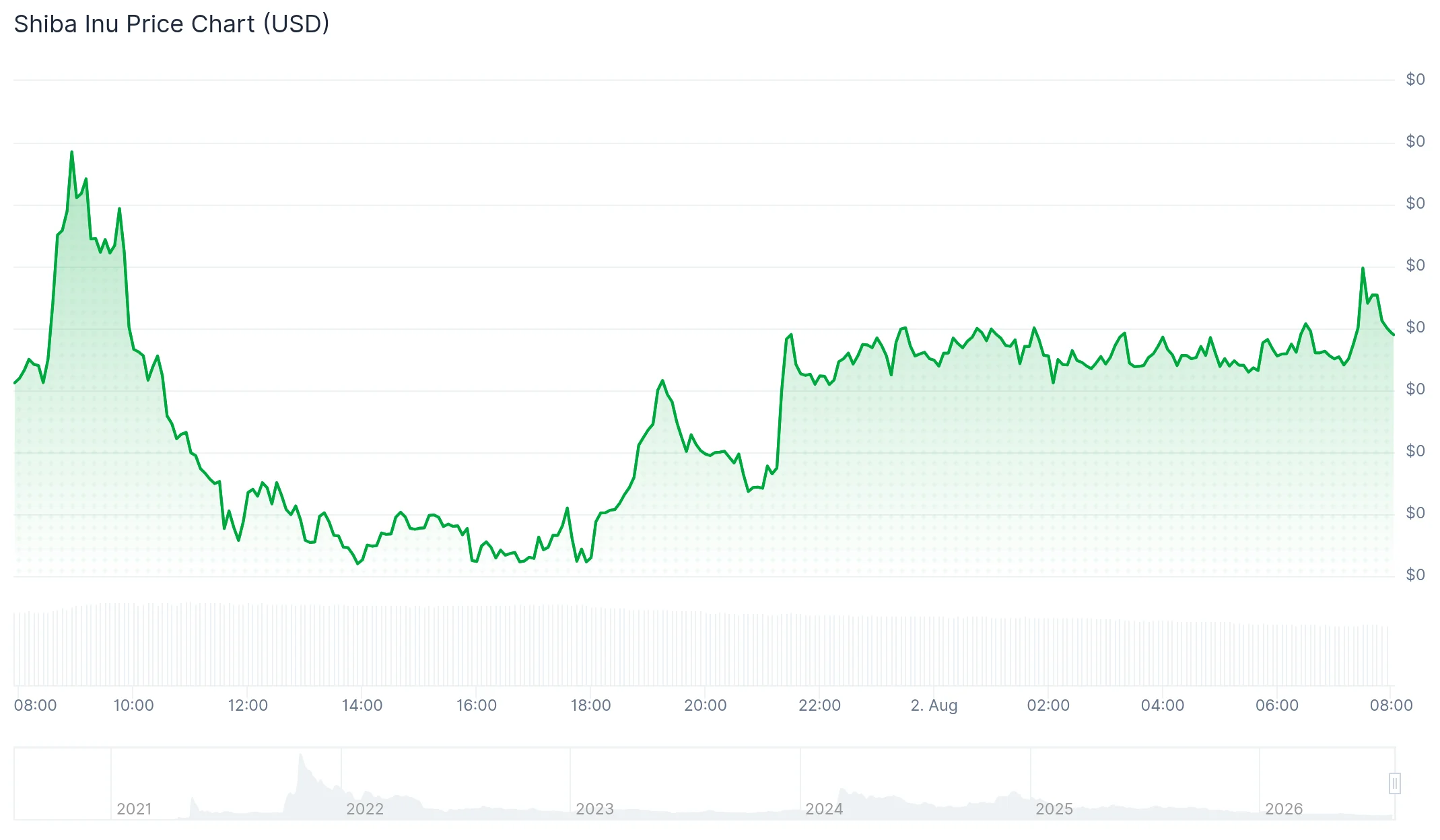
Shiba Inu (SHIB) returned to the spotlight after community trackers reported that approximately 2.96 billion SHIB were burned over the latest seven-day period — the strongest weekly burn in roughly a year. The milestone coincided with the token's sixth anniversary and a surge in trading interest, though SHIB later gave back part of its gains during a broader market pullback. The renewed attention highlights how meme-inspired tokens continue to compete for relevance through community-driven tokenomics rather than traditional utility metrics alone.
According to CoinGecko data, SHIB was trading near $0.000005, up 0.84%, with a market capitalization of approximately $2.94 billion and a 24-hour trading volume of $142 million. SHIB remains one of the most widely held ERC-20 tokens, though its valuation sits well below the meme-coin sector peak recorded in 2021.
Weekly Burn Reaches Highest Level in a Year
The weekly burn included several large transfers to inaccessible wallets, with one transaction alone removing more than 757 million tokens. Ecosystem projects also contributed smaller burns through Ethereum-based activity. Shibburn data indicates the 30-day burn total approached 3.2 billion SHIB, with momentum accelerating through late July. As August began, an additional 124 million tokens reportedly entered dead wallets.
HOURLY SHIB UPDATE $SHIB Price: $0.00000497 (1hr -0.27% ▼ | 24hr 2.71% ▲ ) Market Cap: $2,930,406,001 (2.71% ▲) Total Supply: 589,156,420,211,280 TOKENS BURNT Past 24Hrs: 124,023,282 (405.21% ▲) Past 7 Days: 2,901,334,219 (-92.26% ▼) — Shibburn (@shibburn) August 2, 2026
While the burn figures sound substantial, they represent a tiny fraction of SHIB's total supply. CoinMarketCap lists roughly 589.24 trillion SHIB in circulating supply and 589.49 trillion in total supply, with more than 3.06 million holders recorded. A multi-billion-token burn therefore removes only a minute portion of available coins. By contrast, other major exchange-driven burn models — such as Binance's quarterly BNB destruction — typically remove tokens worth hundreds of millions of dollars per event, underscoring the scale gap between SHIB's meme-driven burns and institutional-grade deflationary mechanisms.
This supply gap explains why traders often treat burn events as sentiment indicators rather than direct price catalysts. Burns can reinforce scarcity expectations, but they rarely generate immediate price pressure on their own. Sustained price movement typically requires buyers to absorb exchange-based selling and support deeper spot liquidity.
Trading volume expanded notably during the anniversary rally, suggesting active market participation rather than a low-liquidity move. However, the subsequent pullback indicated that short-term traders retained significant control over momentum.
SHIB also moved closer to comparable assets in market capitalization rankings. Such positioning can shift rapidly as altcoin prices fluctuate. While improved ranking may draw visibility, it does not inherently alter network usage or token economics.
Sixth Anniversary Marks Six Years Since August 2020 Launch
The Shiba Inu anniversary marks six years since the Ethereum-based token launched in August 2020. CoinMarketCap identifies the project's creation during that month and records its all-time high in October 2021. The milestone underscores SHIB's evolution from a meme-inspired launch into a broader digital asset ecosystem, distinguishing it from many short-lived meme tokens that failed to survive beyond their initial hype cycles.
From zero to a global movement. Six years of holders, builders, believers and one of the strongest communities in crypto. The experiment continues. Happy 6th Birthday ethereum:0x95ad61b0a150d79219dcf64e1e6cc01f0b64c4ce #SHIBTurns6 pic.twitter.com/keddjRljF7 — Shib (@Shibtoken) August 1, 2026
Shibarium, LEASH v2, and Ecosystem Development
Shibarium, the project's layer-2 network, has become a central component of the ecosystem. It supports lower-cost transactions and provides developers with infrastructure for applications, transfers, and community projects. Increased Shibarium usage could generate more durable demand than isolated burn events. The network operates alongside other Ethereum layer-2 solutions such as Polygon, Arbitrum, and Optimism, though Shibarium's adoption metrics remain modest by comparison.
The development pipeline also includes LEASH v2. Official updates describe migration planning, exchange coordination, testing, audits, and community governance processes. Developers have additionally discussed privacy-focused concepts involving Zama, though final designs remain subject to further review and voting.
Metaverse development represents another long-term initiative. The official project describes its virtual world as a community environment connected with SHIB, LEASH, BONE, and Shibarium. BONE serves as the governance and gas token for Shibarium, giving it a functional role distinct from SHIB's primary use as a transferable store of community value.
Burn Narrative Hinges on Sustained Ecosystem Activity
For SHIB's price trajectory, sustained ecosystem activity could make burns more consequential. Tokens removed through regular network usage carry different significance than one-off whale transfers, as recurring usage connects scarcity with actual demand, fees, applications, and user growth.
Whale activity also warrants attention. Large transfers can support accumulation narratives but may increase volatility when tokens move toward exchanges. Market observers typically assess burn activity alongside exchange reserves, large transaction counts, and spot trading volume.
The current SHIB burn narrative rests on three interconnected signals: supply reduction, community engagement, and product delivery. Burn totals may sustain attention, but Shibarium adoption will determine whether that interest translates into lasting network activity. For observers tracking meme-coin sector health, SHIB's ability to maintain burn momentum while expanding layer-2 usage offers a measurable benchmark alongside peer tokens like Dogecoin and Floki.