Hong Kong's SFC Flags Hyperliquid DEX as Suspicious, but HYPE Recovers Quickly
Key Takeaways
- •Hong Kong's SFC added Hyperliquid to its alert list of unlicensed virtual asset trading platforms on November 18, the 14th listing this year and the 69th since 2021.
- •The alert is a warning to investors rather than a ban, and no website block, trading suspension, or public response from Hyperliquid has followed.
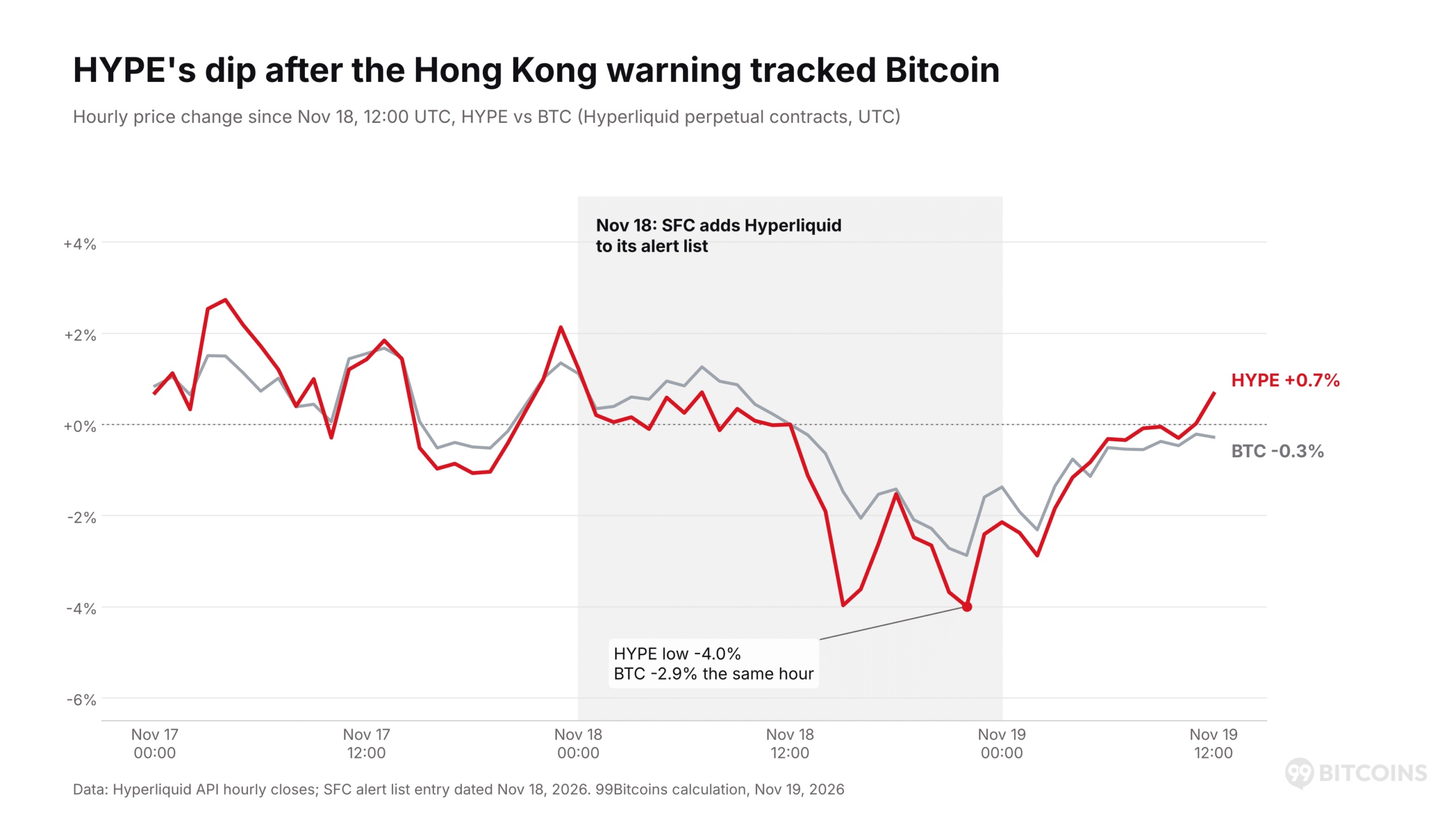
- •HYPE fell about 4% after the listing but returned above its pre-listing price by Thursday, with most of the move tracking Bitcoin's broader decline.
- •Hyperliquid bridge deposits edged up to $5.70 billion after the listing, ending a prior 8% weekly drop and indicating no trader outflows.
- •HYPE trades near $69, close to its 200-day EMA, remains up 171% year-to-date, but sits roughly 30% below its September high of $98.
Hong Kong's Securities and Futures Commission (SFC) added Hyperliquid to its public alert list of suspicious virtual asset trading platforms on Wednesday, November 18. The listing, published under the name “Hyperliquid / Hyperliquid Hong Kong,” identifies the decentralized exchange as unlicensed in the city.
The move places one of the crypto industry's largest derivatives venues — Hyperliquid is among the biggest decentralized exchanges for futures trading — alongside dozens of small, mostly obscure platforms on the regulator's list. It also arrived while HYPE, the platform's token, was already trading roughly 30% below its September high.
The immediate market reaction was muted. HYPE dipped about 4% after the listing appeared but was back above its pre-listing price by Thursday, trading near $69. An hour-by-hour comparison of the token's moves against Bitcoin's, together with a check of whether money left the exchange, points in the same direction: so far, traders have treated the Hong Kong news as noise.
A Warning, Not a Ban
The SFC maintains its alert list to name firms it says are not licensed in Hong Kong but are suspected of serving or marketing to people there. The designation is a warning to investors, not a ban or a lawsuit. Platforms have needed an SFC license to operate in the city, or to actively market their services to its residents, since June 2023, when Hong Kong's licensing regime for virtual asset trading platforms took effect. According to the regulator, users of unlicensed platforms have no protection under its rules and could struggle to recover their funds if something goes wrong.
Hyperliquid works differently from most other names on the list. As a decentralized exchange, its trades settle on its own blockchain, and users connect a crypto wallet rather than opening an account — a setup far from the licensed, custody-based model Hong Kong's regime was designed around. That structure makes it harder for a regulator to shut down, but it also means Hong Kong users receive none of the protections a licensed exchange must provide.
No further measures have accompanied the alert so far. No website block or trading suspension has been announced, and Hyperliquid had not publicly responded as of Thursday.
Reading the Market Data
To separate the Hong Kong effect from broader market moves, hourly prices for HYPE and Bitcoin on Hyperliquid were compared beginning at 12:00 UTC on November 18, the day the listing was published. The goal was to determine whether the SFC action triggered any measurable pullback or outflow.
The dip: HYPE's lowest hourly close was 4.0% below the starting point, recorded late on Wednesday. In the same hour, Bitcoin was down 2.9%.
The recovery: by midday Thursday, HYPE stood 0.7% above where it started, while Bitcoin remained 0.3% lower.
Deposits: the Hyperliquid bridge, where users park dollars to trade, held $5.70 billion on Thursday, up slightly from $5.68 billion on November 17. Deposits had fallen 8% in the week before the listing, but the decline stopped after it.
HYPE did fall somewhat harder than Bitcoin, but most of the move tracked the wider market. If Hong Kong traders were heading for the exits, deposit flows would show it. So far, they do not.
A Crowded List: 14 Platforms Flagged in 2026
Hyperliquid is the 14th platform added to the SFC's suspicious trading platform list this year and the 69th since 2021. The annual counts: 1 in 2021, 3 in 2022, 7 in 2023, 32 in 2024, 12 in 2025, and 14 so far in 2026.
Several recognizable names appear on the list. MEXC was added in February 2024, and BTCC in October 2026. JPEX, flagged in July 2022, collapsed the following year in one of Hong Kong's largest crypto fraud cases. Many other entries are little-known websites, including look-alikes of the licensed exchange HashKey.
Hyperliquid stands out as one of the largest platforms ever placed on the list, with $6.3 billion in futures traded on it over the past 24 hours.
For HYPE, the bigger risk is what comes next. Other regulators could follow Hong Kong's lead, and major exchanges that list HYPE may face questions from their own supervisors. For now, the alert carries no sign of an immediate crackdown.
HYPE Holds Near Its 200-Day Average
On the daily chart, HYPE trades at $68.99, close to its 200-day exponential moving average (EMA) at $69.44 — an average that gives greater weight to recent prices — and below its 50-day EMA at $77.64. The 14-day relative strength index (RSI), a 0-100 gauge of momentum, reads 39.6, below the neutral 50 level.
HYPE remains up 171% this year, from $25.45 on January 1, while Bitcoin is down 28%. Even so, the token has fallen about 30% from its September 23 high of $98.
Key levels on the chart:
- Support: $58.3, where HYPE turned higher in June, July, and August. Last Friday's low of $59.70 came close to that level.
- Resistance: $75.5, a level that held as support in September and October and capped HYPE in June. Above it sits $89, where the token turned in September and October.
For Hyperliquid, the key thing to watch is whether other regulators follow Hong Kong. If none do and bridge deposits keep holding above $5.6 billion, the SFC alert is likely to fade from view. A second warning from a major market, or a drop in deposits, would be a clearer signal that traders are worried.

