Serlzo positions itself as Africa’s Marketing AI company for creators and digital businesses
Key Takeaways
- •Serlzo unifies landing pages, forms, CRM, email, WhatsApp, SMS, payments, checkout, courses, communities and automation in a single platform for creators and digital businesses across Africa and emerging markets.
- •Africa's creator economy was valued at roughly $3 billion in 2023 and $5.1 billion in 2025, with projections suggesting it could approach $17.8 billion by 2030.
- •The 2026 Africa Creator Economy Report found that about 60% of active African creators earn less than $100 per month.
- •Co-founder Joshua Mba previously helped build and led growth at Stakecut, a digital product distribution platform that grew to more than 500,000 users and processed over $2 million in transaction volume.
- •Co-founder Richmond Ohalewe led the design of Serlzo's visual automation experience and the Sio AI agent, which the company says reduced setup time for automated sequences by 70%.
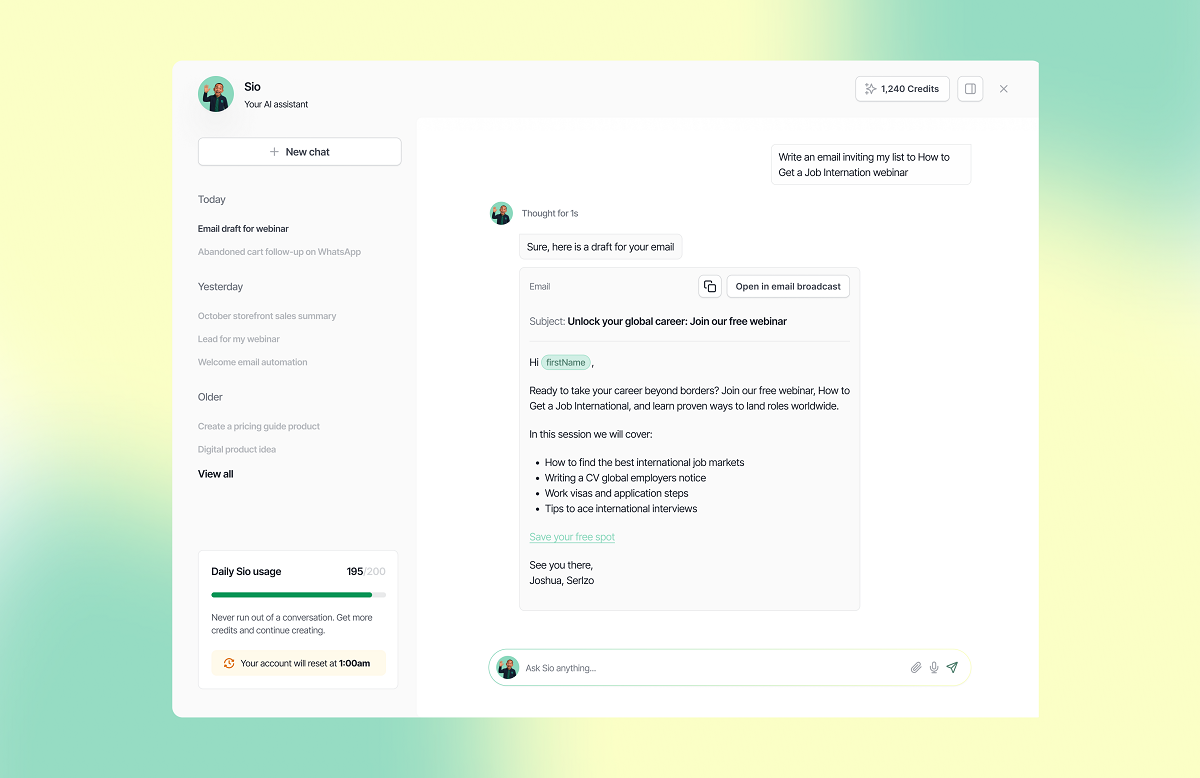
Serlzo is positioning itself at the intersection of artificial intelligence, sales and marketing automation, focusing on creators and digital businesses across Africa and other emerging markets. The company says it is building a unified platform to help these businesses manage customer relationships, automate sales and marketing activity, collect payments, deliver digital products and understand customer behaviour through AI.
Digital businesses often add new tools as they grow. One platform may manage email, another payments, while WhatsApp becomes the sales desk. Customer information may sit elsewhere, with courses and communities operating on separate platforms. Each tool can work independently, but coordinating them becomes difficult when a business needs to manage the full customer journey.
A prospective customer might discover a creator on Instagram, ask a question on WhatsApp, visit a landing page, abandon checkout and disappear without further follow-up. A previous customer may be interested in another product, but the business may have no straightforward way to identify that opportunity. Fragmented data makes marketing harder to coordinate and requires creators and digital business owners to spend more time operating software rather than growing their businesses.
Serlzo was founded by Joshua Mba and product designer Richmond Ohalewe to address this problem. Its platform combines sales, marketing, customer management and automation for creators and digital businesses, particularly those operating in Africa and other emerging markets. At the centre of the platform is Sio, Serlzo’s AI agent, which provides an intelligence layer across its sales and marketing infrastructure.
The company says its ambition extends beyond adding AI features to existing software. It aims to establish a category from Africa that it calls “Marketing AI.”
Africa’s creator economy is growing while its business infrastructure remains fragmented
Africa’s creator economy is becoming a significant commercial market. Recent estimates place its value at roughly $3 billion in 2023 and $5.1 billion in 2025, while projections suggest it could approach $17.8 billion by 2030.
However, the income of individual creators remains comparatively low. The 2026 Africa Creator Economy Report found that about 60% of active African creators earn less than $100 per month.
The challenge is not solely audience size. Creators across Africa are launching courses, communities, consulting services, digital products and other businesses around their expertise. Digital businesses are also becoming more sophisticated in how they acquire customers and distribute products. Turning that activity into consistent revenue remains difficult, especially when the tools supporting it are not connected.
Sales conversations may take place on WhatsApp, leads may be stored in spreadsheets, email campaigns may run on separate platforms and payments may be processed elsewhere. Courses and communities can require additional tools, making it difficult to manage the entire customer journey in one place.
As businesses grow, this fragmentation can lead to missed leads, delayed follow-ups and previous buyers being forgotten. Customer information becomes difficult to connect, leaving founders with limited visibility into where potential revenue may be lost.
Serlzo is addressing this gap with a platform that connects sales, marketing, CRM, automation, customer communication, payments and digital product delivery. Sio is designed to help businesses interpret activity across those functions and act more quickly.
The company’s proposition is that creators and digital businesses should be able to run sophisticated sales and marketing operations without assembling a complicated stack of disconnected software. More information about the platform is available at
Joshua Mba’s experience with digital products and growth
Joshua has sold digital products online since 2016. Before founding Serlzo, he ran a digital marketing consultancy and agency, gaining direct experience in customer acquisition, offers, funnels, advertising and conversion.
He later helped build and led growth at Stakecut, a digital product distribution platform that grew from zero to more than 500,000 users and processed more than $2 million in transaction volume.
That experience shaped his understanding of what happens after a business attracts attention. Bringing more people into a sales funnel is only one part of the process. Businesses also need to know which prospects are interested, who requires follow-up, why customers abandon the buying process and what existing buyers might purchase next.
Joshua’s background as a Product Engineer gave him another perspective. Many of the sales and marketing challenges he encountered were also systems problems. Customer interactions could be connected, repetitive processes could be automated and data could be used to improve decisions.
Artificial intelligence introduced another possibility: the system itself could begin understanding what was happening across a business and help determine the next action. That idea became central to Serlzo’s development.
A platform built around how digital businesses sell
Serlzo’s platform begins with the customer journey. A business captures a lead, communicates with that person by email or WhatsApp, sells a product, delivers a course or community experience and may later make another offer.
Rather than treating these interactions as separate software categories, Serlzo connects them around the same customer relationship. Its platform brings together landing pages, forms, CRM, email, WhatsApp, SMS, payments, checkout, courses, communities and automation in one environment.
This approach reflects the way sales frequently move between channels in African and other emerging markets. For many small businesses, WhatsApp is more than a messaging application. It can function as a sales channel, a customer-service tool and a relationship-management system.
For Serlzo, the objective is not only to connect WhatsApp but also to connect activity on WhatsApp with everything else the business knows about a customer. A prospect asking about pricing may already have visited a landing page, opened an email and started checkout. When these activities exist in one system, the business has more context, and that context can make AI more useful.
Sio extends Serlzo beyond conventional automation
Much of the current AI marketing market focuses on content generation, such as writing emails, producing advertising copy, generating headlines and creating social media posts. Sio is designed to operate across a broader part of the business.
The AI agent operates within Serlzo’s sales and marketing environment. The company says this gives Sio the context needed to help businesses understand customers, identify opportunities and take action. It is intended to help businesses determine what is happening in their operations, decide what steps to take next and receive assistance in carrying them out.
For example, a creator may generate hundreds of leads for a course while converting only a small percentage into customers. The solution may not be another marketing message. The creator may first need to understand where prospects are dropping off by connecting information from campaigns, customer activity, conversations and purchases.
Sio is designed to bring that information together. A creator could ask: “Show me the people who asked about the price but have not purchased and help me follow up with them.”
This example reflects the distinction Serlzo draws between adding AI features to marketing software and building Marketing AI. In Serlzo’s approach, intelligence is connected to the business itself. It extends beyond content creation to understanding customer activity and supporting sales decisions. Details about Sio are available at
Making sophisticated sales operations accessible to smaller businesses
Large companies typically operate growth departments with marketers, salespeople, customer relationship managers, analysts, copywriters, automation specialists, support teams and agencies. Creators and smaller digital businesses often want similar capabilities without having the same operational capacity.
Joshua sees AI as a way to narrow that gap.
“The internet made distribution global, and payments made it easier for businesses to collect money globally. We believe AI can make sophisticated business operations global too,” Joshua says.
That idea is part of Serlzo’s wider vision of reducing the technical knowledge required to manage sales and marketing operations. A business owner should not need to understand every CRM field, automation rule or marketing workflow before running an effective sales operation.
Serlzo instead aims to translate more of that complexity into actions that business owners can understand and execute. A creator launching a programme could use the platform to build an offer, capture prospects, communicate through email or WhatsApp, collect payment, deliver the product and continue managing the customer relationship after the first transaction.
Sio adds intelligence across that process. The intended result is a system that reduces the software expertise an entrepreneur needs rather than simply introducing more software for the entrepreneur to operate. Serlzo’s workflow capabilities are described at
Richmond Ohalewe’s role in reducing complexity
A platform connecting CRM, marketing, sales, commerce, messaging and automation could easily become software understood only by experienced marketers. Making that complexity usable has been a major part of Richmond Ohalewe’s work.
Chiemezie Richmond Ohalewe is Serlzo’s co-founder and leads product and design. He has more than seven years of experience designing SaaS, web3, learning and real estate products, including roles at Genesys Tech Hub, Check and The Thunderclap, where he worked with clients such as Factors AI.
At Serlzo, Richmond directed the integration of components including Workflow, Broadcast, Storefront and the automated WhatsApp assistant. The goal was to unify them around a cohesive customer journey instead of relying on disconnected applications.
This approach was particularly important in redesigning automation capabilities. Traditional workflow platforms often require users to understand complex logic, triggers and parameters. Richmond focused on creating an intuitive visual experience that allows entrepreneurs to design and deploy customer journeys without technical skills. Serlzo says this reduced setup time for automated sequences by 70%.
Richmond also led the design of Sio, the AI agent built natively into Serlzo. The company says he helped turn its capabilities into an experience that any business owner can use, enabling creators to improve productivity while keeping the experience of running a business personal and aligned with their own operations.
“For years, software adoption in Africa meant asking business owners to adapt to tools designed for other markets. AI is changing that,” Richmond says. “When a creator can simply tell Sio what they want, the software adapts to them, and that’s what lets us build for African realities.”
The founders bring complementary experience to Serlzo. Joshua’s background covers digital products, marketing, growth and engineering, while Richmond brings product and design experience focused on reducing complexity for users. Together, they are building around the idea that sophisticated business infrastructure should not require a sophisticated internal team to operate.
Serlzo faces established global competitors
Serlzo is entering a competitive market. HubSpot, Mailchimp, GoHighLevel and several newer AI companies already operate across parts of CRM, marketing automation, sales software and customer intelligence.
Serlzo’s proposed differentiation lies in the businesses it is building for. Creators and digital businesses across Africa and other emerging markets may operate differently from traditional companies. The founder may also be the marketer, WhatsApp may be one of the company’s most important sales channels and a small team may manage customer acquisition, sales, support and product delivery at the same time.
The source describes most creators in Africa as solo founders who want fast execution and delivery. Serlzo’s approach is to bring these activities into one environment and apply AI intelligence across them.
The company is building from African market realities, although its ambition extends beyond the continent. Similar challenges exist across emerging markets where entrepreneurs are building digital businesses faster than they can build the operational teams needed to support them. This gives Serlzo a potential market beyond its initial African focus while it competes with established global software providers.
Using Serlzo to manage a customer journey
Serlzo is available to creators and digital businesses seeking to consolidate sales and marketing operations. Businesses can use the platform to create pages, capture leads, maintain customer information, communicate across multiple channels, automate customer journeys, collect payments, sell products, deliver courses and manage communities.
A business does not need to migrate every part of its operation immediately. It can begin with a single customer journey, such as an Instagram advertisement leading to a landing page, followed by lead capture, WhatsApp or email follow-up, checkout and product delivery.
Instead of managing each stage across separate systems, the business can run the journey inside Serlzo and keep the customer relationship connected throughout. Sio adds an intelligence layer intended to help the business understand what is happening across that journey, identify opportunities and move prospects towards a sale faster.
From fragmented tools to Marketing AI
Serlzo’s opportunity is larger than replacing individual software subscriptions. Creators and digital businesses are becoming more sophisticated, but many still operate with fragmented sales and marketing systems. That fragmentation creates a gap between having an audience and running a scalable business.
Serlzo is building for that gap through a platform that provides an operational layer for sales, marketing, customer relationships and automation, while Sio brings AI intelligence across those operations.
For Joshua and Richmond, the goal is to make advanced sales and marketing capabilities more accessible to businesses driving Africa’s digital economy. The company’s central proposition is that a creator or digital business should not need a large marketing team, several disconnected platforms and deep technical expertise to understand customers and grow revenue.
Serlzo says its approach brings these operations together and uses AI to make them easier to understand and act on. Its broader ambition is to help creators and digital businesses do more than launch online: to build businesses that sell consistently, grow intelligently and receive recognition for their progress.
The company is positioning itself as a Marketing AI company from Africa, helping creators and digital businesses sell faster, understand customers better and build sustainable businesses.
Supporting creators beyond the software
Serlzo is also developing programmes around its platform to support creators as they grow. One initiative is the Serlzo Money Club, a creator growth and recognition programme designed to celebrate business milestones achieved through the platform.
The programme is intended to make growth visible. As creators and digital businesses reach new revenue milestones, Serlzo recognises those achievements through its Money Club and Awards programme, with rewards, recognition and access to opportunities tied to their progress. Further information is available at
The initiative reflects a broader part of Serlzo’s approach to the creator economy. The company is not only providing infrastructure for creators to sell, automate activity and manage customers; it is also creating an ecosystem intended to encourage sustainable businesses and recognise measurable growth.
That support extends into Serlzo’s community infrastructure, where creators can connect, learn and build alongside other entrepreneurs. The company’s public creator ecosystem includes communities focused on digital products, sales systems and business growth.
For Serlzo, this creates a more complete relationship with creators. The platform provides tools and AI intelligence to help them operate, while initiatives such as the Money Club provide additional motivation, recognition and support as those businesses grow.
Serlzo has described the programme publicly as a way to recognise creator milestones with gifts, rewards and new opportunities as users grow their businesses on the platform.

