Seoul's Gangbuk District Expands Multilingual Housing Protections for Foreign Tenants
Key Takeaways
- •Foreign tenants in Gangbuk District will receive automated administrative guidance in nine languages stamped on documents when registering move-in addresses or fixed date status at neighborhood centers.
- •Obtaining an official fixed date grants tenants legal priority to recover security deposits if a landlord faces foreclosure or property auction.
- •QR code stickers link foreign residents to the Seoul Metropolitan Government's "MY SEOUL" app, offering multilingual housing guidelines, safety updates, and multicultural services.
- •Gangbuk District's registered foreign population has nearly doubled over the past decade to roughly 7,000 residents, driven mainly by international students, trainees, and marriage migrants.
- •The expanded program follows widespread Korean rental fraud scandals in which tenants lost large deposits to defaulting landlords.
Korea's residential real estate market is notoriously complex, even for long-time local residents. Much of that complexity stems from the country's distinctive rental systems — including the traditional lump-sum jeonse arrangement, in which tenants deposit a large share of a property's value instead of paying monthly rent — and the recurring two-year lease cycle that governs most contracts. For the country's steadily growing international population, steep language barriers, unfamiliar administrative procedures, and unique tenant laws make securing rental housing a particularly daunting endeavor — and one fraught with potential financial risk.
To bridge this informational divide and protect vulnerable foreign renters, Gangbuk District, a northern administrative district in Seoul, is expanding a comprehensive municipal program designed to safeguard foreign residents throughout the housing lease process.
Under the enhanced initiative, foreign tenants visiting local neighborhood centers to register a move-in address or file for an official "fixed date" status (hwakjeong ilja) will receive automated administrative guidance stamped directly onto their documentation in nine languages. The legal stamp — covering English, Chinese, Vietnamese, Mongolian, Filipino, Uzbek, Japanese, Taiwanese, and Thai — outlines essential protections under Korea's Housing Lease Protection Act.
In the Korean rental market, obtaining an official fixed date is a critical statutory step that grants tenants legal priority to reclaim key security deposits should a landlord face foreclosure or property auction. Tenants can secure this status by having a lease copy notarized or by confirming a move-in date at a community center — which is precisely where Gangbuk's new multilingual guidance is embedded.
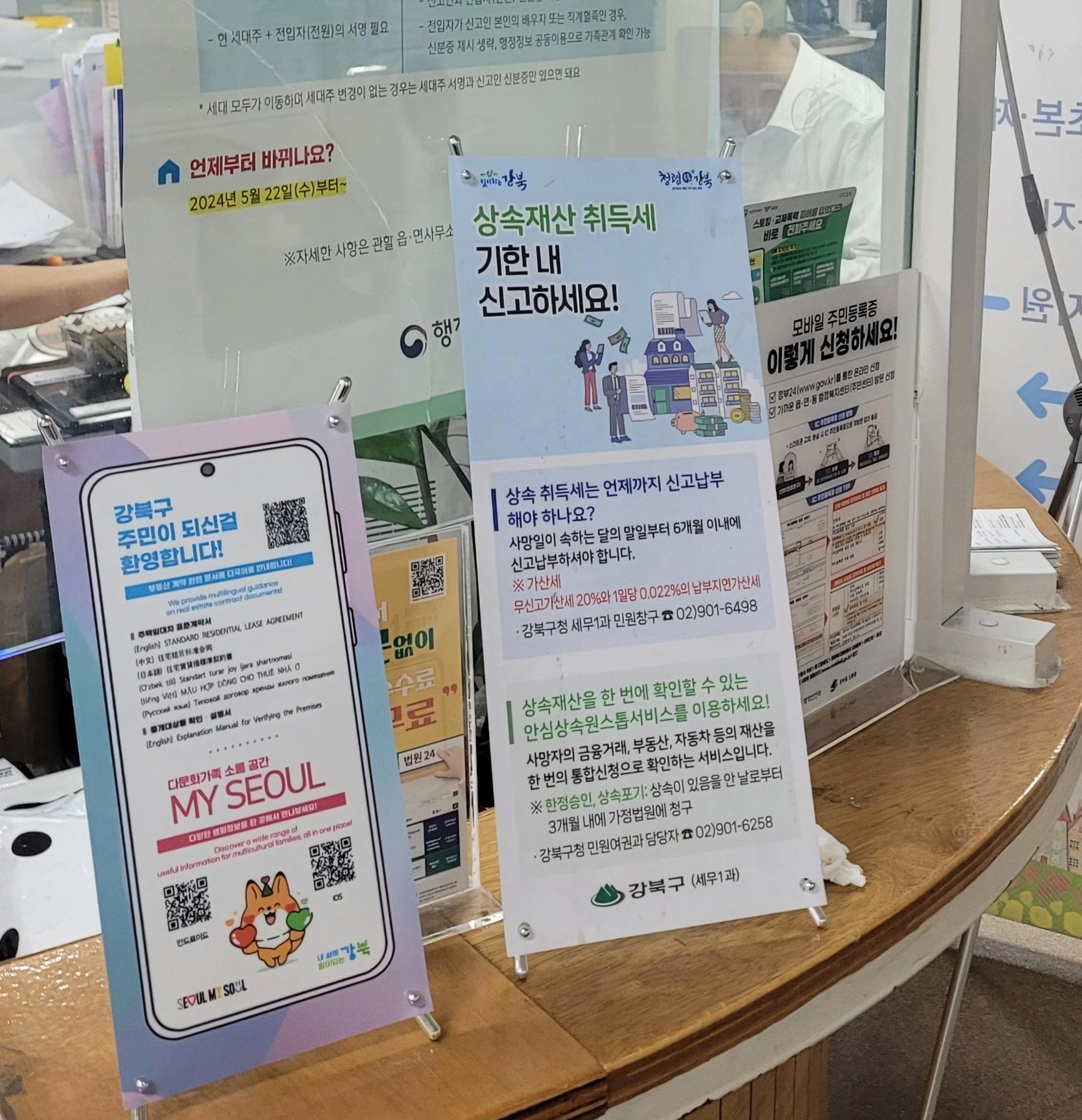
Alongside the multilingual stamps, district offices are distributing QR code stickers linking directly to "MY SEOUL," a dedicated mobile application operated by the Seoul Metropolitan Government. By scanning the code, foreign residents can install the application to access multi-language housing guidelines, municipal safety updates, and multicultural social services.
To eliminate misunderstandings during contractual negotiations, Gangbuk District is also publishing standardized, multilingual housing lease agreement templates on its official district website. Instructional banners featuring QR codes and lease resources have been installed across all neighborhood community centers so that drop-in visitors receive immediate guidance.
The administrative changes reflect a rapidly shifting demographic reality. In Gangbuk District, the registered foreign population has nearly doubled over the past decade to roughly 7,000 residents, driven largely by international students, trainees, and marriage migrants. The trend mirrors Seoul as a whole, where the number of registered foreign residents has climbed steadily in recent years, prompting city government to extend services — from interpretation hotlines to multicultural family support — beyond the capital's most internationally dense districts. Across Korea, lease security has also become a high-stakes civic issue following widespread domestic rental fraud scandals, in which tenants lost large deposits to defaulting landlords, making proactive administrative transparency vital for foreign residents who often lack localized legal support networks.
Launched in January 2025, the district's expanded housing initiative reflects broader municipal efforts across the capital to integrate foreign nationals into urban safety nets. Whether similar multilingual lease protections are adopted by other Seoul districts or scaled nationwide is a point to watch, as local governments increasingly compete to attract and retain international residents.
"We have strengthened on-the-ground administrative support so that foreign residents do not face unfair disadvantages during the housing lease process due to language and information barriers," said Jung Chang-soo, mayor of Gangbuk District. "We will continue expanding multilingual rental assistance and essential lifestyle support so that international residents can settle into our community with stability and peace of mind."
