Free Meal Centers Near Seoul Station Reveal Growing Hunger Amid Inflation and Declining Donations
Key Takeaways
- •Truly Good Friends has reduced its meal service from daily operations spanning 35 years to just once weekly, relying entirely on boxed-meal donations from Bonif to avoid shutting down completely.
- •A 15.1% surge in rice prices during the first half of the year forced House of Thomas to request government-supplied rice from the district office for the first time since 2024.
- •Wongaksa's monthly visitor count has nearly tripled from 3,000 a decade ago to 9,000 today, while new donors dropped from roughly 15 per year to only two.
- •South Korea's relative poverty rate among those aged 65 and older consistently ranks as the highest in the OECD, and the Basic Pension has not kept pace with food-cost increases.
- •Volunteer organizations face a 15% year-over-year rise in operating costs alongside declining donations, with South Korea's social welfare spending remaining below the OECD average.
Free Meal Centers Near Seoul Station Reveal Growing Hunger Amid Inflation and Declining Donations
Published Aug 1, 2026, 12:20 a.m. KST
Volunteer groups struggle to meet surging demand as costs rise and contributions dry up
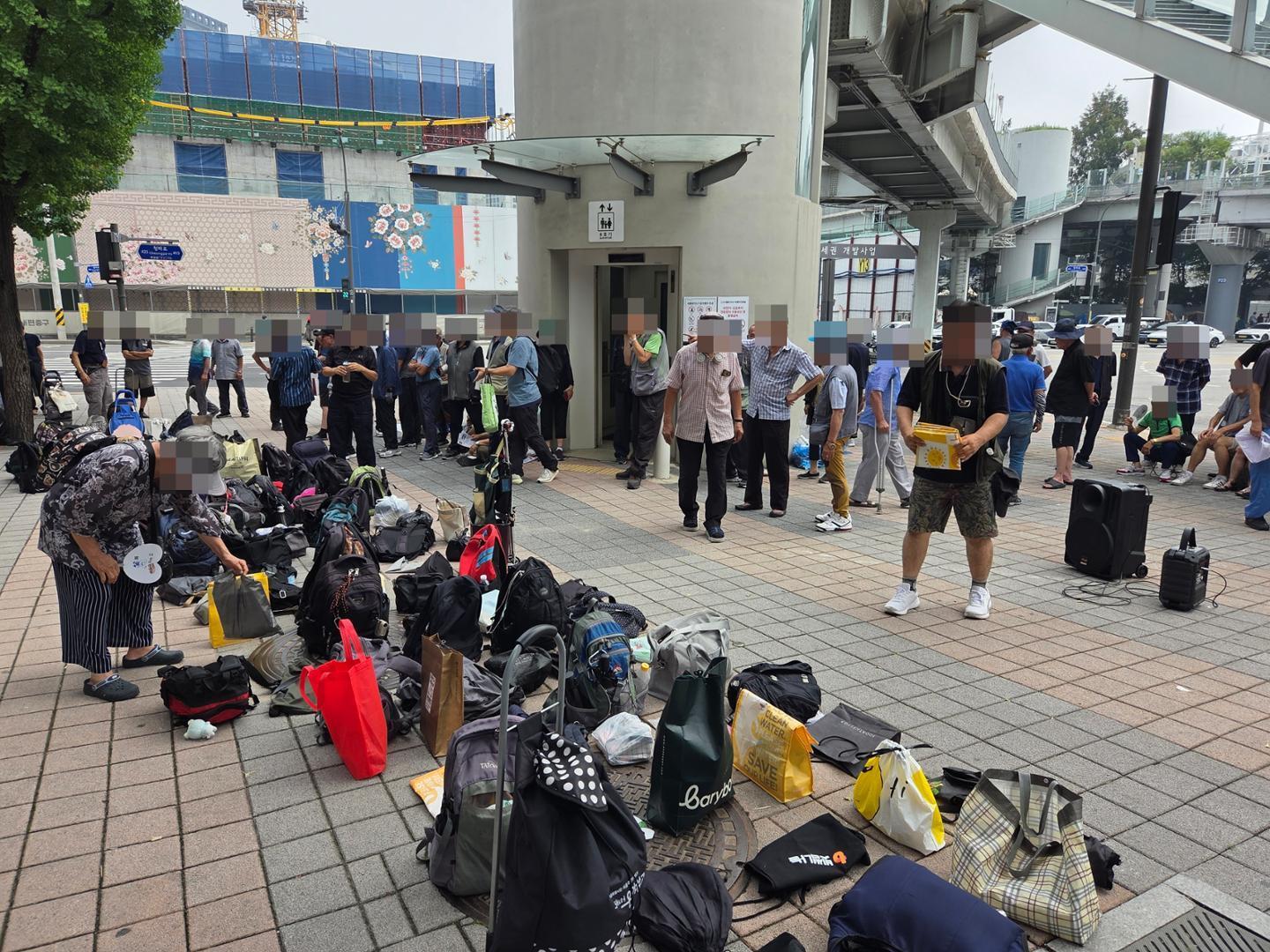
A scuffle erupted outside a free meal distribution center near Seoul Station on a recent afternoon. One elderly man accused another of cutting in line. The other denied it, insisting he had arrived first. Moments later, fists flew and the argument escalated into a brawl.
Bystanders, however, barely reacted. They were far more concerned with ensuring the backpacks they had placed on the pavement to hold their spots were neither disturbed nor mistaken for someone else's.
Each bag marked its owner's place in a line stretching down the street — and the meal service was still three hours away.
At this center, operated by a volunteer group called Truly Good Friends, 200 meals are distributed on a first-come, first-served basis. Competition is fierce, partly because the offerings are unusually generous: grilled short rib patties, stir-fried kimchi, Korean chive pancakes, and purple rice.
Cutting in line is treated as a near-criminal offense. When an elderly woman attempted to slip into the queue, she was met immediately with a chorus of protests and curses. One man marched up to her and began shouting directly in her face.
A staff member at Truly Good Friends said altercations over line positions occur on nearly every distribution day, as roughly 10 people inevitably leave empty-handed.
"We're trying to serve as many people as possible, but we're stretched so thin financially that we can't even offer a bottle of water with the food," the staff member said.
Thirty-five years of service, now scaled back
Truly Good Friends originally served meals to homeless individuals every day for 35 years, beginning in 1987. As its financial situation deteriorated, the organization reduced service to twice a week in 2022 and further to once a week this year.
Even that single weekly distribution is sustained only by boxed-meal donations from Bonif, the company behind the Bon Dosirak chain. Without the company's support, the organization would be forced to shut the meal center down entirely.
The organization's predicament is far from isolated. Behind headlines celebrating record stock market highs and an export surplus driven by a historic semiconductor upcycle, a growing number of people are turning to free meal centers across Seoul. The elderly, who make up a visible share of those in line, are particularly exposed: South Korea's relative poverty rate among those aged 65 and older has consistently ranked as the highest in the OECD, and the Basic Pension paid to lower-income seniors has not kept pace with food-cost increases.
Volunteer groups throughout the city are struggling to maintain their meal programs as persistent inflation and a weakening won push food prices higher, while financial pressure on households leaves fewer people able to donate. South Korea's social welfare spending as a share of GDP remains below the OECD average, a gap that places greater weight on private volunteer organizations when economic conditions deteriorate.
House of Thomas seeks government rice for the first time
The House of Thomas, another volunteer group that serves free meals outside Yeongdeungpo Station four times on weekdays and once on weekends, requested 150 ten-kilogram sacks of government-supplied rice from the district office in May.
The primary catalyst was a 15.1 percent surge in rice prices during the first half of the year alone, which compounded the strain on the group's budget. The increase forced the organization to seek assistance from the district office for the first time since 2024.
Other food items, including instant noodles and fruit, also impose significant costs. The organization spends approximately 4 million won (around $2,700) each month on instant noodles alone. To prevent individuals from collecting food more than once, staff mark the back of each visitor's hand with a red dot.
"We've recently begun serving slightly smaller portions while telling those who are still hungry that they can ask for seconds," a staff member at the House of Thomas said. "We would like to give everyone generous portions, but with so many people coming and not enough food to go around, we have little choice."
Donations dwindle as visitor numbers triple
Meanwhile, donations continue to fall, placing volunteer groups in an increasingly precarious position. Wongaksa, which operates a daily free meal program at Tapgol Park in Seoul, has secured only two new donors this year, compared with roughly 15 in a typical year. Longtime contributors have also begun withdrawing support, even as the monthly number of visitors to the center has nearly tripled — from 3,000 a decade ago to 9,000 today.
"With ordinary people struggling financially, they seem to have little room left to look after neighbors in need," said Ko Young-bae, secretary-general of the Wongaksa free meal center. "Our monthly operating costs have risen 15 percent from last year, while donations have declined. It is a serious concern."
"We will continue serving"
Yet shuttering the centers or cutting back meal services is hardly a viable option for organizers who witness firsthand how early people rise to secure a place in line and how much a single meal means to them.
"I rarely have proper side dishes at home, and I can't afford to eat at restaurants," one visitor said. "I'm grateful that I can at least fill my stomach here."
Ko said the center intends to keep serving meals to those in need, regardless of how dire the situation becomes.
"For now, we hope the government will do more to ease the burden of rising prices so that people have enough breathing room to look around and help neighbors in need," he said.
This article from the Hankook Ilbo, the sister publication of The Korea Times, is translated by a generative AI system and edited by The Korea Times.

