What Happens When Crypto Is Sent to the Wrong Address?
Key Takeaways
- •Recovery of funds sent to a wrong crypto address depends mainly on who controls the destination's private key and which network was used, since confirmed transactions cannot be reversed.
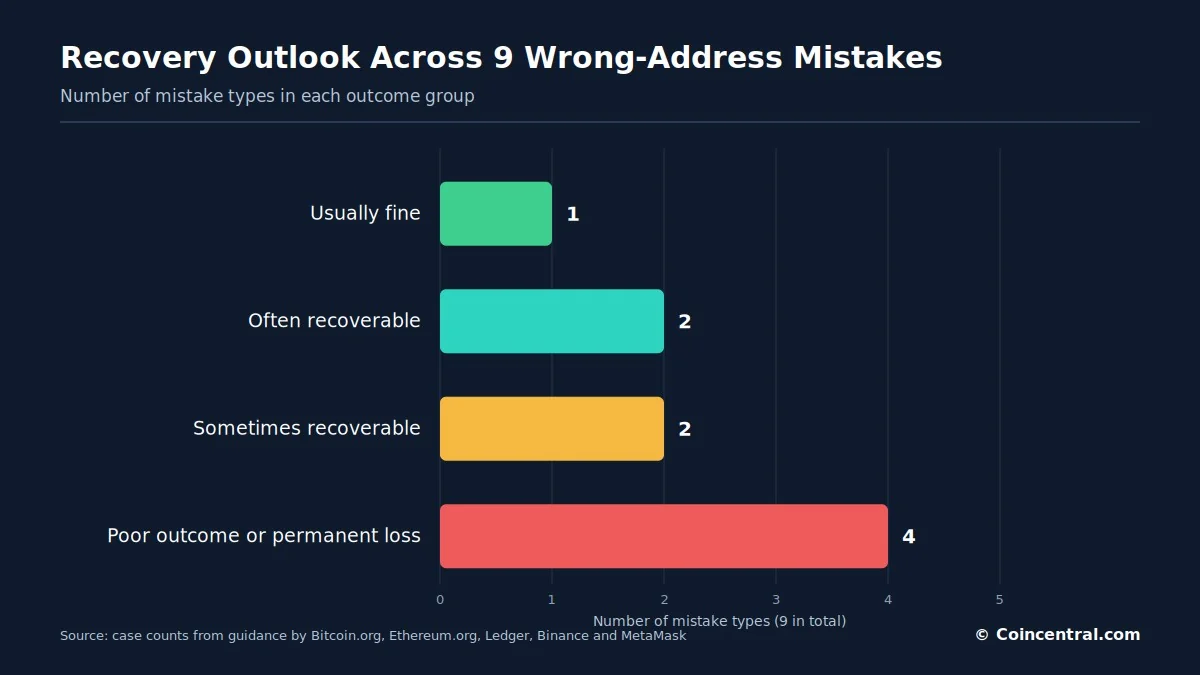
- •Five of the nine mistake types examined are fully or partly fixable, while four lead to poor outcomes or permanent loss, with sending to one's own old address usually being harmless.
- •Errors involving exchanges, such as missing tags or memos and unsupported tokens, can often be resolved because the exchange controls the deposit address, although recovery is not guaranteed.
- •Address poisoning and clipboard malware can redirect valid-looking transfers to attackers, and checksum protection cannot detect them because the destination address is legitimate.
- •Users are advised to verify the asset, network, full address and any memo or tag, and to send a small test transaction before moving large amounts.
Sending cryptocurrency to the wrong address is among the most expensive mistakes in digital finance. Unlike a bank transfer or card payment, most crypto transactions cannot be canceled after confirmation.
Bitcoin's official documentation says confirmed transactions are irreversible. Only the person who controls the receiving address can return the funds. Ethereum follows the same principle, and no central authority can reverse a completed transfer.
However, "wrong address" describes several different situations. Some result in permanent loss, while others can be resolved within minutes. This article examines nine common mistakes, their likely outcomes and who controls the destination in each case.
The guidance from Bitcoin.org, Ethereum.org, Ledger, Binance and MetaMask does not provide totals for losses or recovery rates. The figures below count cases identified in that guidance; they do not show how frequently each mistake occurs.
Key facts
- Nine types of mistakes are covered.
- Four of the nine lead to poor outcomes or permanent loss.
- Three involve an exchange, which is the only party able to attempt recovery.
- Seven EVM networks are listed as using the same
0xaddress format. - Ten steps are recommended after a mistake is discovered.
- The main question in most cases is who controls the destination's private key.
How a wrong-address transfer works
A blockchain transaction is a straightforward instruction to send a specified amount from Address A to Address B.
After the network confirms the transaction, the ledger identifies Address B as the holder of the funds. The blockchain does not know which address the sender intended to enter. It has no support desk and no button for reversing a confirmed transfer.
Bitcoin says a confirmed payment can be returned only by the person who received it. Ethereum applies the same rule to ETH and tokens sent to the wrong wallet. The practical options are to contact the address owner, contact the exchange if the address belongs to one, or determine whether a smart contract includes a recovery function.
The crucial question, therefore, is not simply whether the address was wrong. It is who controls that address and which network was used.
Nine mistakes and their outcomes
The guidance covers nine common situations and provides a recovery outlook for each.
Table 1: Nine wrong-address mistakes and their recovery outlook
Four of the nine mistakes fall into the poor-outcome or lost-funds group. Two are often recoverable and two are sometimes recoverable. Sending funds to your own old Bitcoin address is the only mistake that is usually harmless.
Typing errors are often detected
Crypto addresses commonly include a built-in checksum. Bitcoin notes that its software can detect many typing errors and will generally reject a payment addressed to an invalid destination.
As a result, changing one character does not necessarily send funds to a stranger. In many cases, the wallet rejects the address. The greater danger is when the mistyped address is itself valid.
Control of the destination determines the outcome
The outcome in every case depends largely on whether someone with access to the destination's private key has a technical way to move the asset.
If someone does control the key, recovery may be possible. If no one possesses the required key, the blockchain cannot create one. The guidance groups the mistakes according to who controls the receiving address.
Table 2: Mistake types grouped by the controller of the destination
Another person's valid wallet
This is generally the worst scenario. For example, a sender may intend to transfer 1 ETH to one address but paste another address that differs by only a few characters. If the second address is valid and controlled by someone else, Ethereum processes the transfer normally.
From the network's perspective, nothing went wrong: the sender signed the transaction and sent it to a valid destination. Ledger says the only practical remedy is to contact the owner if that person can be identified. Otherwise, the assets should generally be considered lost.
An address controlled by nobody
A transfer may reach a valid address for which nobody has the private key. The blockchain accepts the transaction, but no one can authorize a payment from that wallet.
Bitcoin.org notes that funds sent in this way become permanently inaccessible. The coins remain recorded on the blockchain, but they cannot be spent.
A smart-contract address
Ethereum addresses may belong to ordinary accounts or smart contracts When tokens are sent to a contract, the contract's code determines what can happen next.
Ethereum.org says recovery is occasionally possible when a contract includes a withdrawal or recovery function, although this is rare. If the code cannot transfer the tokens out, they may remain permanently stuck.
Your own old address
Sending funds to an old address in your own wallet is usually not a problem. Many Bitcoin wallets generate a new receiving address for every payment to improve privacy.
Bitcoin.org explains that earlier addresses remain part of the wallet even after a newer address is displayed. Ledger says the same principle applies to Litecoin, Dogecoin and other UTXO-based coins. An old address does not expire.
Mistakes involving the wrong network
Selecting the wrong network is one of the most common modern crypto errors. An exchange might provide an Ethereum deposit address beginning with 0x. A user could withdraw USDT while selecting BNB Smart Chain instead of Ethereum.
The wallet may send the tokens successfully, but the exchange was expecting an Ethereum deposit. As a result, the funds may not appear in the user's account.
Binance warns that choosing an incompatible network can cause funds to be lost and potentially unrecoverable. Some cases can nevertheless be resolved, particularly when the transfer involves EVM-compatible networks.
Seven EVM networks share one address format
Ethereum-compatible networks often use the same address format. In general, the same private key produces the same 0x address on each network. The guidance lists Ethereum, BNB Smart Chain, Polygon, Arbitrum, Optimism, Base and Avalanche C-Chain.
Ledger explains that a wrong-network transfer may be recoverable when the sender controls the destination wallet. The sender may only need to add the correct network or token to the wallet.
For example, a user may intend to send USDC over Ethereum but send it over Polygon to their own 0x address. The USDC may still belong to that user; it is located at the user's address on Polygon rather than on Ethereum.
Table 3: Four steps to recover funds sent to your own address on another EVM network
In this situation, the transfer itself was not necessarily wrong. The network being viewed was wrong.
Wrong token contracts
Stablecoins can create another source of confusion. Multiple tokens may have similar names or tickers, and a token such as USDT can use a different contract on each network. Scammers also create fake tokens that imitate familiar names.
If the wrong token contract is used, the receiving platform may not recognize the asset even though the address is correct. In a self-custody wallet, adding the correct token contract may reveal the balance. When an exchange is involved, the user may need to request recovery.
Exchange deposit errors
The situation changes when the destination is an exchange. The user does not control the private keys for the exchange's deposit address; the exchange does.
Only the exchange can therefore attempt to recover the funds. The result depends entirely on the exchange's policies and technical tools. Three of the nine mistake types fall into this category.
Missing tags and memos
Some cryptocurrencies require an additional identifier for exchange deposits. The guidance cites XRP destination tags, Stellar XLM memos, TON memos and payment IDs on some networks.
Large exchanges often use a single blockchain wallet for many customers. The tag or memo identifies which customer should receive the deposit. If it is omitted or entered incorrectly, the coins may arrive safely on-chain, but the exchange cannot determine which account should be credited.
Binance says missing or incorrect tags can prevent a deposit from being credited. Affected users may be able to apply through its memo and tag recovery process. Recovery is often possible because the exchange owns the address, the transaction is visible on-chain and the sender can prove which account initiated it.
Table 4: Seven details usually needed for a memo or tag recovery request
Some platforms charge a fee for this service.
Unsupported tokens
An exchange may accept ETH and USDC at its Ethereum address but not a smaller ERC-20 token. If the unsupported token is sent, the transaction can still complete on-chain, while the exchange may simply fail to credit the customer's account.
The tokens may remain in an exchange-controlled address without appearing in the exchange's customer records. Binance says recovery is not guaranteed, although it may assist in some cases. Its Smart Retrieval system covers certain incorrect deposits.
Users should therefore verify both the network and the specific asset supported by the exchange before sending funds.
Can an exchange reverse a withdrawal?
Before an exchange broadcasts a withdrawal, it may still control the process. Once the withdrawal reaches the blockchain, the exchange cannot ask Bitcoin or Ethereum to reverse it.
If the destination belongs to the exchange itself, internal recovery may sometimes be possible. If the destination belongs to an external wallet, Binance says it cannot help and instructs users to contact the address owner or the platform that controls it. Contacting the exchange quickly is still worthwhile, but speed does not guarantee cancellation.
Address poisoning and clipboard malware
A valid address can still be the wrong destination. The guidance identifies five ways this can happen: copying the wrong address, selecting the wrong recipient, malware changing the clipboard contents, using a lookalike address created by an attacker, and reusing an address from transaction history.
Three of these are user errors and two are caused by attackers. Checksum protection cannot prevent any of them because the destination is a legitimate blockchain address.
Address poisoning
In an address-poisoning attack, a scammer creates an address that resembles one the victim frequently uses. The first and last characters match, while the middle characters are different.
The attacker then sends a small transaction involving the victim's wallet, causing the lookalike address to appear in the wallet's transaction history. The victim may later copy the familiar-looking address from that history and send funds to the attacker.
MetaMask warns that funds are generally irretrievable once such a transaction is confirmed. It added warnings that compare a destination with past activity to identify lookalike addresses. Bitcoin.org advises users to check the entire address rather than only the first and last characters.
Clipboard malware
Clipboard-jacking malware monitors a user's clipboard for a crypto address and replaces it with the attacker's address. The user may then paste the substituted address without noticing the change.
Ledger warns that funds sent to the substituted address may be permanently lost. Hardware wallets reduce this risk because the address can be checked on the device's trusted screen. The address should be verified on the hardware wallet, not only on the computer.
Table 5: Address-related threats and the main defense for each
Can a transaction be canceled before confirmation?
Sometimes. Bitcoin transactions do not become final at once because confirmations accumulate as additional blocks are added. Bitcoin.org notes that each confirmation makes a transaction more difficult to reverse.
Pending Ethereum transactions can sometimes be replaced by submitting another transaction with the same nonce and a higher gas fee. Once the original transfer is confirmed, ordinary cancellation is no longer possible. The safer practice is to check the details before signing rather than after broadcasting.
What to do after a mistake
Anyone who has sent crypto to the wrong destination should first remain calm. The guidance recommends ten steps.
Table 6: Ten steps to take after a wrong-address transfer
Check the transaction first
Before assuming the funds are gone, locate the transaction hash, also called a TxID or transaction ID. This unique identifier can be entered into the explorer for the relevant blockchain, including Bitcoin, Ethereum, Solana, XRP Ledger, BNB Smart Chain or Polygon.
Check the transaction status, destination address, network, token and amount. A failed transaction generally means the assets did not move, although some blockchains may still charge fees. A successful transaction means the blockchain carried out the signed instruction.
Beware of recovery scams
Losing crypto creates a second risk. Victims frequently post online asking for help, and scammers respond with offers to recover the funds.
They may claim they can reverse the blockchain, hack the receiving wallet, contact a miner, recover a private key, use special software or retrieve the funds in exchange for an upfront payment. Ethereum.org says nobody can reverse blockchain transactions and that anyone offering paid recovery is very likely running another scam.
Never give a purported recovery service a seed phrase, private key, exchange password or remote access to a computer. Anyone who obtains a seed phrase can control the associated wallet.
How to prevent wrong-address transfers
A small number of habits can prevent most of these mistakes. The guidance lists nine practices: four that reduce address errors, four that help verify transaction details before sending, and one that adds device protection.
Table 7: Nine habits that reduce the risk of a wrong-address transfer
Use a test transaction
For a large transfer, send a small test amount first. Someone planning to move $50,000 in crypto might send $10 to $50, depending on network fees, and wait for the receiving platform to confirm the deposit before sending the remainder.
This requires paying a second network fee, but a few dollars can help verify a $50,000 transfer. A test is particularly useful with a new exchange, a new wallet, a bridge, a network selection, an XRP tag or any large transaction.
Why crypto works this way
Irreversibility can feel like a defect after a mistake, but it is also a core feature of crypto. A bank controls its own ledger and can reverse a payment, freeze funds or correct an entry.
Bitcoin and Ethereum instead use decentralized consensus. Ethereum notes that no company stands behind the network with the power to freeze or recover user funds. This provides final settlement and resistance to censorship while shifting responsibility from an institution to the user.
The bottom line
Sending crypto to the wrong address does not always mean the funds are gone. Of the nine mistake types reviewed here, five are fully or partly fixable, while four lead to poor outcomes or loss.
Mistakes involving the user's own wallet or an exchange are the most recoverable. Mistakes involving a stranger, an unreachable address or an attacker are the least recoverable. Once a signed transaction is confirmed, it generally cannot be reversed.
The safest routine is simple: check the asset, network, complete address and any memo or tag. Then send a small test transaction before moving a large amount.
Sources
- Bitcoin.org: Some Things You Need to Know
- Bitcoin.org: Frequently Asked Questions
- Bitcoin.org: Avoid Scams
- Ethereum.org: Frequently Asked Questions
- Ethereum.org: Security and Scam Prevention
- Ethereum.org: Common Misconceptions
- Ethereum.org: Scam Help and Reporting
- Ledger: I Accidentally Sent Crypto to a Wrong Address
- Binance: Incorrect Deposit FAQs
- Binance: How to Deposit and Withdraw Cryptocurrency
- MetaMask: Address Poisoning Scams
- Blockonomi: What Happens If You Send Crypto to the Wrong Address?

