Senators Tillis and Gallego Said to Draft Tougher Ethics Language for Clarity Act Crypto Limits
Key Takeaways
- •Senators Tillis and Gallego have completed an initial overhaul of the Clarity Act's ethics provisions restricting senior government officials from holding direct ties to cryptocurrency projects.
- •The House has already passed its version of the legislation, but the final bill still requires White House approval and substantial Democratic support to reach a Senate floor vote.
- •The American Bankers Association has resumed lobbying on the stablecoin yield issue, arguing in a letter to Senate leadership that the compromise language does not adequately prevent interest-like payments through alternative arrangements.
- •The bill must pass before the Senate's August recess or face significantly diminished prospects, with September seen as the last realistic window before the November elections.
- •If the Clarity Act fails to pass in September, action during the lame-duck session is considered unlikely, and a potential Democratic House majority could force the legislation back to the drawing board.
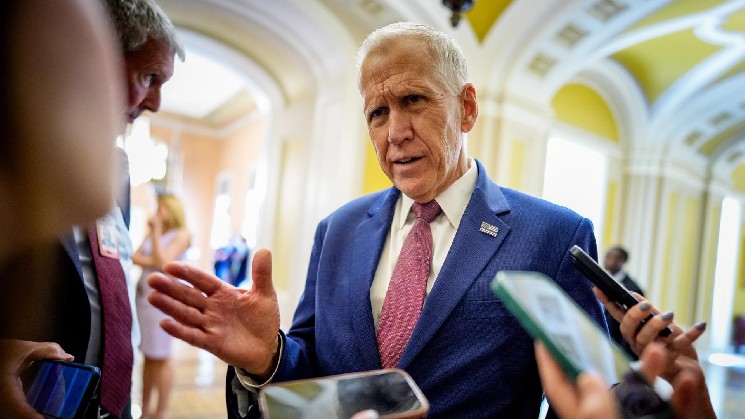
Senators Tillis and Gallego Said to Draft Tougher Ethics Language for Clarity Act Crypto Limits
The fate of the Digital Asset Market Clarity Act — Congress's most advanced attempt to create a comprehensive regulatory framework for cryptocurrencies, delineating oversight authority between the SEC and CFTC — may hinge on the reception of new legislative language crafted by Senators Thom Tillis (R) and Ruben Gallego (D), according to people briefed on the effort. The bipartisan duo has reportedly completed an initial overhaul of the bill's provisions restricting senior government officials from maintaining direct ties to cryptocurrency projects.
The House passed its version of the legislation earlier in the session, but any final version would require approval from the White House and substantial Democratic support before the Clarity Act can clear its remaining procedural hurdles and reach a vote on the U.S. Senate floor.
Ethics Provision Targets Trump's Crypto Business Empire
The ethics section is designed with President Donald Trump's sprawling crypto business interests squarely in mind, seeking to bar senior government officials from holding direct ties to the digital asset industry. Trump recently surprised some crypto insiders by agreeing to accept a narrow version of the concept. The White House subsequently characterized it as an unprecedented ethics constraint that directly applies to the president.
Democratic opponents, however, argue that the provision is structured so that Trump would face minimal — if any — compliance burdens, and that he would have little to fear from enforcement by a Department of Justice led by his own appointees.
Tillis and Gallego agreed to attempt bridging that divide, and sources said the lawmakers have signaled they have found new common ground, though no specifics have been disclosed. Crypto industry lobbyists are watching the outcome closely, mindful that time is running short before the Senate departs for its August recess. They believe that resolving the government conflicts-of-interest section would build momentum to settle the remaining issues.
Spokespeople for the senators and the White House did not immediately respond to requests for comment on the status of the ethics negotiations.
Bill Endures Repeated Setbacks but Continues Advancing
Although the Clarity Act has absorbed blow after blow during congressional deliberations, it continues to progress toward a potential vote. The Senate is now entering its final week of business before the summer recess, making the coming days critical.
While the government conflicts-of-interest provision has attracted the most attention, a separate dispute persists over DeFi advocates' demand that the bill shield software developers from being classified as regulated money transmitters. Some law enforcement organizations have withdrawn their earlier opposition to that point, though Senator Catherine Cortez Masto (D) has continued pushing to strengthen illicit-finance safeguards.
Patrick Witt, the White House's crypto adviser, has made little effort to hide his frustration. He wrote on social media that his team had "made our position abundantly clear to Senator Cortez Masto for weeks."
American Bankers Association Revives Stablecoin Yield Dispute
The American Bankers Association has resumed lobbying on the stablecoin yield issue — the first major disagreement that derailed the Clarity Act's progress earlier this year. The banking group, whose members see yield-bearing stablecoins as a competitive threat to traditional deposit accounts, contends that the compromise language falls short.
In a Tuesday letter to Senate leadership, the association called for the final bill "to ensure that the prohibition on stablecoin interest and yield cannot be evaded through rewards, incentives, or other arrangements that are substantially similar to interest payments."
Witt pushed back in a Wednesday post on X, asserting that the negotiations had already resolved the concern. "Make it make sense," he wrote in evident frustration.
Narrow Window Before August Recess
When Senate leadership predicted the Clarity Act was unlikely to pass before the recess, Witt argued there was still time to finalize it in the remaining days before August 7 — a deadline widely seen as the bill's effective sell-by date, beyond which its prospects dim considerably. Many in the industry, however, are quietly redirecting their expectations toward September.
"Clear rules are almost here," Coinbase CEO Brian Armstrong wrote in a Wednesday post on X. "We're at the one yard line."
If the Clarity Act does not pass in September, the likelihood of action during the lame-duck session between the November elections and the start of the next congressional session is considered remote. Should Democrats capture a majority in the U.S. House of Representatives — and potentially the Senate, a steeper challenge — they are unlikely to embrace a framework shaped predominantly by Republicans, which could send the legislation back to the drawing board.
Source: CryptoNewsNet | CoinDesk

