Senate Delays Clarity Act Vote as Russia Sanctions and Nominations Take Priority
Key Takeaways
- •Senate leaders have shifted immediate floor attention to executive nominations and Russia sanctions legislation rather than the Clarity Act.
- •John Thune filed cloture on a resolution covering 74 executive nominations, and the Senate has scheduled a July 28 vote on Walter Clayton’s DNI nomination.
- •The Russia sanctions measure has support from 62 senators and would target Russian officials, banks, oligarchs, and other supporters of Moscow’s war, while also allowing tariffs of up to 100% on certain goods.
- •The Clarity Act now faces a tight timeline before the August 8 practical deadline and the start of the August 10 state work period.
- •Negotiations continue over ethics provisions, enforcement authority, and stablecoin rewards, with banks and crypto firms still divided on the rules.
The U.S. Senate has paused the Clarity Act as leaders shift attention to Russia sanctions legislation and President Donald Trump’s nominees. The updated schedule places the crypto market structure bill behind two immediate Republican priorities, narrowing the window for a vote before the August 8 recess.
Lawmakers still have time to consider the measure before the August state work period begins. Even so, the remaining floor days leave supporters with a limited path to final action.
Senate Schedule Shifts to Nominations and Russia Sanctions
Senate Majority Leader John Thune filed cloture on S.Res.817, which covers 74 executive nominations. The Senate placed the resolution on its calendar after Republicans pushed for a faster process for pending nominees.
The move would allow the chamber to take up the nominations together instead of spending separate floor time on each one.
Russia sanctions legislation also has momentum, with support from 62 senators. That gives Senate leaders an additional reason to prioritize the bill. The measure would impose primary and secondary sanctions on Russian officials, banks, oligarchs, and other parties supporting Moscow’s war. It would also authorize tariffs of up to 100% on goods from leading buyers of Russian energy.
Senate leaders can frame the proposal as both a national security measure and a bipartisan legislative opportunity as the chamber prepares to leave Washington soon.
The Senate has also scheduled a July 28 vote on Walter Clayton’s nomination as Director of National Intelligence. After that, senators plan to address H.R. 5334, the legislative vehicle for the Lindsey O. Graham Sanctioning Russia Act of 2026. The sanctions bill targets Russia and parties that support its war against Ukraine.
Clarity Act Faces a Tight August Deadline
The revised floor schedule pushes the Clarity Act out of the Senate’s immediate lineup. Republican leaders had considered a procedural vote that could have opened debate and established amendment rules, moving the crypto bill closer to full Senate consideration.
That matters because the Clarity Act is meant to define how digital assets are overseen in the U.S., and the Senate’s calendar now leaves fewer opportunities to settle those rules before lawmakers head into the August break. The Senate’s published calendar begins an August state work period on August 10. Industry supporters have treated August 8 as the practical deadline, since lawmakers may leave Washington before that weekend.
Any additional delay could push debate into September, when other budget and election-year priorities may compete for floor time.
Ethics and Stablecoin Rules Still Under Discussion
Senators are still negotiating an ethics section that would address elected officials and their financial interests in digital assets. Democratic lawmakers want stronger limits and broader enforcement powers.
Some members also oppose giving the Department of Justice sole authority. They want state attorneys general to retain a direct enforcement role.
New York Attorney General Letitia James has urged Congress to strengthen crypto oversight and preserve state enforcement authority. She says the current Clarity Act text could restrict state and local action against fraud. Her office is also calling for stronger transparency, anti-money laundering controls, and consumer protections.
Stablecoin rewards remain another point of disagreement. Banks want tighter language because they fear yield-like rewards could pull deposits away from traditional accounts. Crypto companies support rules that would allow transaction-based rewards and other customer incentives.
Crypto Industry Presses for Senate Action
Crypto companies and industry groups continue to urge Senate leaders to move before the August break. They view the Clarity Act as a framework for dividing oversight between regulators.
Under that framework, the SEC and CFTC would have distinct regulatory roles. Supporters also want clearer rules for exchanges, token issuers, brokers, and decentralized finance services.
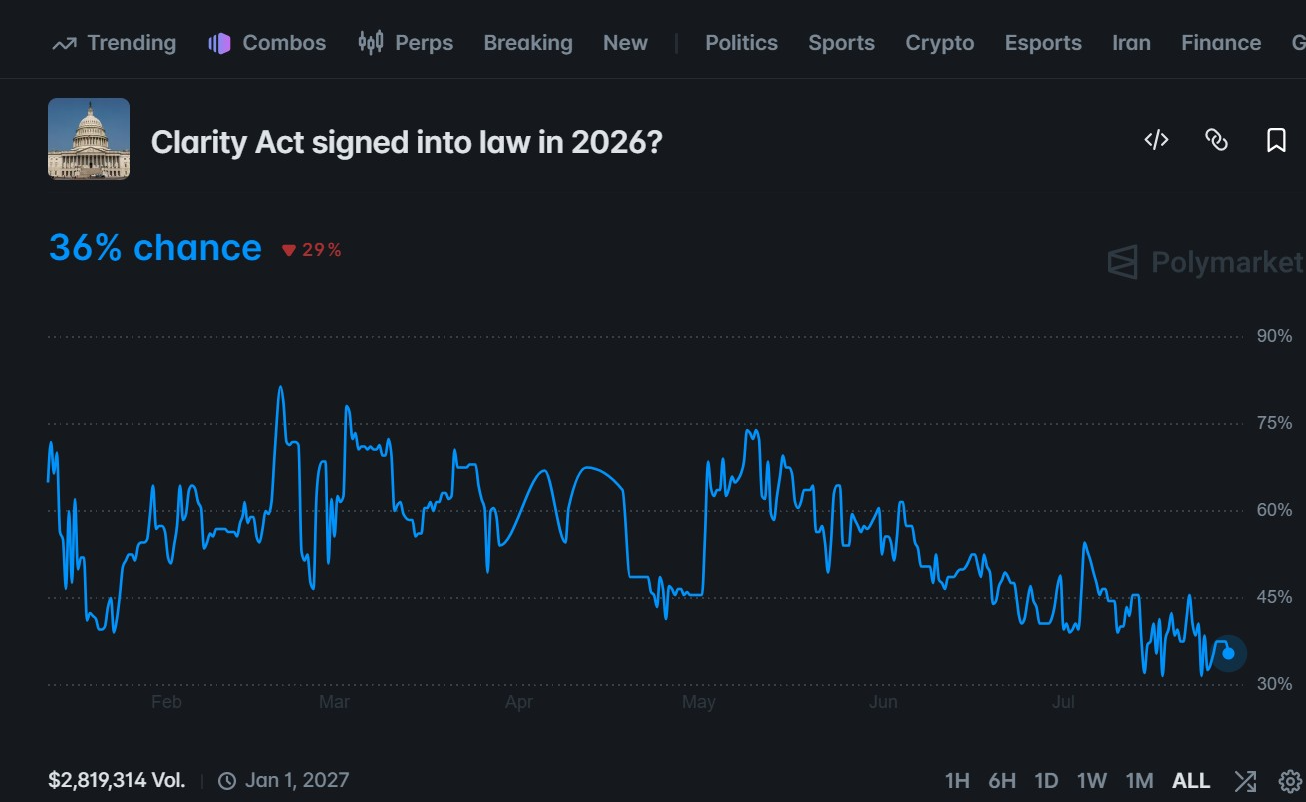
Prediction markets have lowered the bill’s 2026 passage odds after repeated delays and unresolved disputes. According to data from Polymarket, the CLARITY Act has a 36% chance of becoming law in 2026. The odds have fallen 29% amid repeated Senate delays.
The measure still has a route forward because lawmakers have already advanced related language through committee negotiations. For now, Russia sanctions and Trump nominations dominate the Senate’s immediate agenda.

