Senate Democrats Call for Public Hearing on Prediction Markets After Kalshi Meeting
Key Takeaways
- •All 11 Senate Banking Committee Democrats, led by Elizabeth Warren and Catherine Cortez Masto, asked Chair Tim Scott to hold a public, bipartisan hearing on prediction markets rather than rely on private industry meetings.
- •The Democrats' request came on the same day committee Republicans met privately with Kalshi CEO Tarek Mansour, a session Scott described as an effort to better understand securities-linked products.
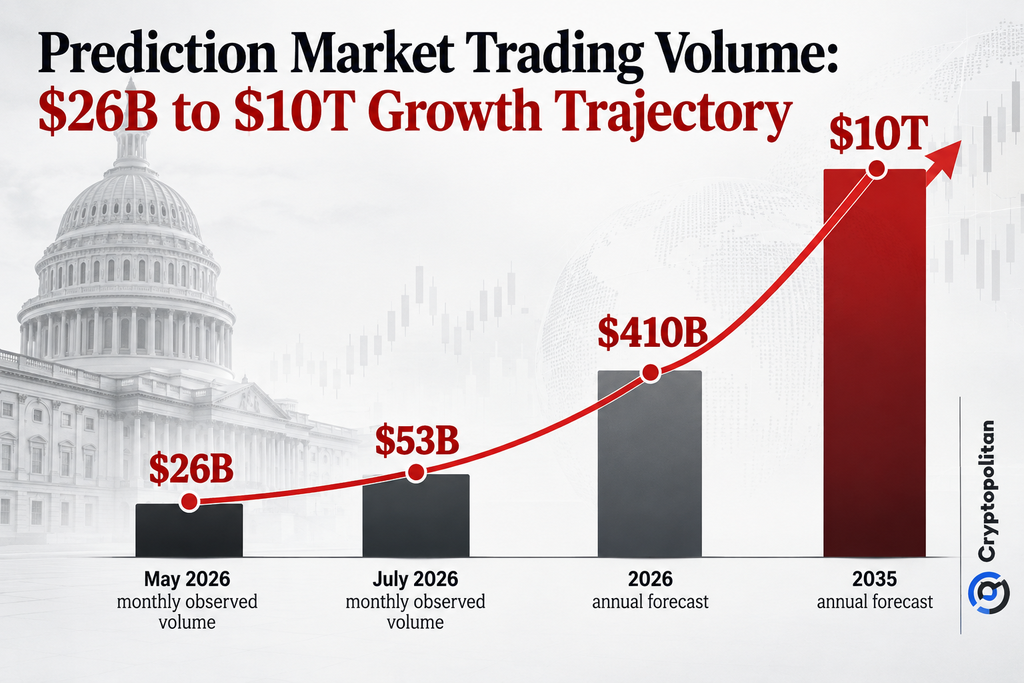
- •Combined monthly trading volume on Kalshi and Polymarket more than doubled from approximately $26 billion in May to $53 billion in July 2026, according to the Pew Research Center.
- •Bernstein projects annual prediction-market volume of about $410 billion in 2026, rising to roughly $10 trillion by 2035, with financial-asset contracts such as crypto, equities, and commodities expected to eventually overtake sports-related contracts.
- •The core regulatory dispute is jurisdictional: Democrats argue that contracts tied to corporate performance indicators could qualify as security-based swaps falling under SEC oversight, while the CFTC currently regulates event contracts and Kalshi operates as the largest federally regulated prediction market under its supervision.
All 11 Democrats on the Senate Banking Committee have called on Republican Chair Tim Scott to hold a public hearing on prediction markets. Their request came on the same day that committee Republicans met privately with Kalshi CEO Tarek Mansour, according to The Block.
The dispute comes as prediction markets — venues where users trade contracts that pay out based on real-world outcomes, from sports results to individual corporate metrics — expand beyond a niche area of trading. Combined monthly volume on Kalshi and Polymarket more than doubled from approximately $26 billion in May to $53 billion in July 2026, according to the Pew Research Center. Bernstein, meanwhile, is forecasting annual activity in the trillions of dollars, increasing the stakes over which regulators will write the rules and which agency will have final authority.
Democrats seek public, bipartisan review
The letter to Scott was led by Ranking Member Elizabeth Warren and Catherine Cortez Masto. The other signatories were Jack Reed, Mark Warner, Chris Van Hollen, Tina Smith, Raphael Warnock, Andy Kim, Ruben Gallego, Lisa Blunt Rochester and Angela Alsobrooks, according to a Senate Banking Committee release.
The senators said security-based prediction markets should be examined publicly and on a bipartisan basis. They also cited concerns about consumer protection, insider trading and market manipulation.
“It is critical that Congress examine prediction markets on a bipartisan basis in a public hearing – not behind closed doors in a Republican-only, industry-friendly roundtable.” — Senate Banking Committee Democrats, committee letter
Scott characterized the private meeting differently. He told The Block that he brought Republicans and Kalshi together “to better understand the opportunities and challenges presented by securities-linked products.”
“My goal is to ensure that America leads in financial innovation while protecting investors and providing the regulatory clarity these emerging markets need.” — Senate Banking Committee Chair Tim Scott, statement to The Block
Dispute centers on CFTC and SEC jurisdiction
The division of regulatory authority is at the center of the disagreement. The Commodity Futures Trading Commission regulates event contracts traded on registered derivatives exchanges and has been developing a clearer framework for prediction markets, according to its prediction-markets guidance. The Senate Agriculture Committee has primary oversight of the CFTC, while the Banking Committee oversees the Securities and Exchange Commission and securities markets.
That gives the Banking Committee a direct interest when prediction contracts begin to resemble securities products. The Democrats’ letter argues that contracts tied to corporate performance indicators could qualify as security-based swaps and therefore fall under SEC regulation.
Kalshi is already part of the federal derivatives system. A February Federal Reserve paper described it as the largest federally regulated prediction market under CFTC oversight.
Forecasts point to rapid expansion
Bernstein projects annual prediction-market trading volume of roughly $410 billion in 2026, rising to about $10 trillion by 2035. Its analysts expect financial-asset contracts, including crypto, equities and commodities, eventually to overtake sports-related contracts, according to TechFlow and The Block.
“We expect new products such as KPI markets, which allow users to trade a single corporate metric…” — Bernstein analysts led by Gautam Chhugani, September 22 client note
Contracts on a single corporate metric are the kind of product the Democrats’ letter argues could qualify as a security-based swap and fall under SEC oversight. Chhugani’s team also found that approximately 80% of Kalshi users had never used a sports-betting application, indicating that the platform is attracting users beyond traditional bettors.
Regulators outside the United States are pursuing different approaches. The European Securities and Markets Authority says event contracts that qualify as financial instruments can fall under existing EU restrictions on binary options, as outlined in its statement. In parts of Asia, gambling laws have also limited access to prediction markets, potentially directing users and liquidity toward offshore or Western platforms, as Cryptopolitan previously reported.
The issue affects crypto as well as traditional finance. Chainalysis has noted that crypto-native prediction markets can settle activity on-chain, while mainstream financial firms are developing regulated distribution channels. The U.S. framework that emerges could help determine where prediction-market platforms, capital and market data are concentrated as the sector grows. The decision on whether to hold the hearing now rests with Scott.

