Semiconductor Sector Back in Bull Market After 21-Day Rebound Led by Credo Technology
Key Takeaways
- •The PHLX Semiconductor Index rose 21% from its late July low to regain bull market status in only 21 days, far faster than the 54-day historical average for such transitions.
- •Credo Technology led the sector rebound with a 59% advance since July 29, narrowly ahead of Coherent's 58%, with both firms supplying AI data center connectivity components.
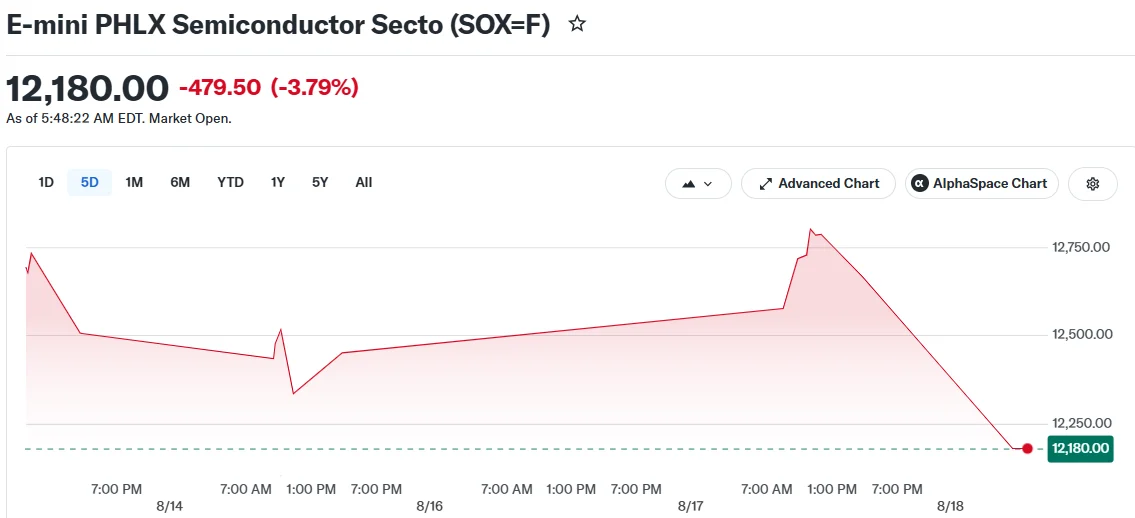
- •Semiconductor stocks retreated in Tuesday's premarket trading, with Intel, Micron, Coherent, and Marvell each falling more than 5% as rising oil prices and Treasury yields pressured technology shares.
- •Apple is still evaluating memory chips from Chinese suppliers despite Trump administration recommendations against such purchases, as inventory constraints and industry-wide memory price increases drive component costs higher.
- •Anthropic reported year-over-year revenue growth exceeding 1,400%, strengthening projections that AI infrastructure-related semiconductor consumption will continue rising.
Key Highlights
- The PHLX Semiconductor Index has officially returned to bull market status with a 21% climb from its late July lows, completing the transition in only 21 days.
- Credo Technology emerged as the sector's strongest performer with a 59% advance since July 29, narrowly ahead of Coherent's 58% rally.
- Tuesday trading saw semiconductor equities retreat as elevated crude oil prices and rising Treasury yields pressured technology shares.
- Apple continues evaluating memory chips from Chinese suppliers despite pushback from Washington, driven by supply shortages and rising costs.
- Anthropic, an AI-focused company, reported revenue expansion exceeding 1,400% on an annual basis, reinforcing optimism around semiconductor consumption.
The PHLX Semiconductor Index crossed into bull market territory this week after a 21% ascent from its late July nadir — clearing the 20% gain from a low that market convention treats as the dividing line between a bear and bull market. The recovery ranks among the swiftest bear-to-bull transitions the sector has witnessed since March 2020, completed in just 21 days — well below the typical 54-day average duration. The index serves as the semiconductor industry's benchmark and underlies widely traded sector exchange-traded funds, making its swings a closely tracked signal for the broader technology trade.
The standout winner of the rebound was not an industry giant like Nvidia or Intel. Credo Technology, which manufactures copper interconnect solutions for AI server infrastructure, claimed the top spot, with shares skyrocketing 59% from the July 29 bottom and narrowly outpacing Coherent's 58% appreciation. Both companies occupy the connectivity layer of AI data centers — Credo in copper cabling, Coherent in optical components — a corner of the market where demand has climbed as cloud providers ramp spending on AI infrastructure.
Leading semiconductor names also delivered strong returns over the same window. Nvidia advanced 18%, Intel jumped 26%, and Micron registered a solid 37% increase.
Sector Faces Tuesday Headwinds
Despite the bull market declaration, semiconductor stocks fell notably in Tuesday's premarket session, as climbing oil prices and rising bond yields dragged down many of the sector's recent outperformers.
Intel, Micron, Coherent, and Marvell each declined more than 5% ahead of Tuesday's opening bell, while Credo Technology shed approximately 5% during early trading hours.
The Philadelphia Semiconductor Index had gained 1.6% in Monday's session alone — the trading day that validated the bull market designation. Tuesday's activity erased a portion of those gains.
Apple Navigates Geopolitical Chip Tensions
Apple is managing a supply chain challenge that places the company squarely within U.S.-China commercial friction. The Trump administration has recommended that Apple avoid procuring memory components from Chinese producers. Despite this guidance, Apple — one of the world's largest buyers of the NAND flash and DRAM that go into iPhones, Macs, and other devices — continues evaluating chips from these sources as inventory constraints drive component costs upward. The squeeze extends beyond Apple: memory prices have firmed industry-wide as manufacturers direct more capacity toward the high-bandwidth memory used in AI accelerators, tightening supply of conventional chips.
Commerce Secretary Howard Lutnick has publicly criticized Apple's strategy. The company's shares currently trade at $305.59, representing an approximately 7.8% premium over GuruFocus's calculated fair value of $283.43.
Apple maintains a GF Score of 96 out of 100, indicating robust profitability indicators and expansion characteristics. Nevertheless, insider dispositions totaling more than $16 million over the preceding three months have prompted concern among some analysts.
Apple's current price-to-earnings multiple sits at 35x, elevated compared with its five-year median level near 30x.
Artificial Intelligence Sustains Semiconductor Momentum
Anthropic, an artificial intelligence venture and the developer of the Claude AI assistant, disclosed revenue expansion surpassing fourteen-fold — more than 1,400% — on a year-over-year basis. This performance has strengthened projections that semiconductor consumption linked to AI infrastructure will maintain its upward trajectory. Because training and running large AI models depend on vast clusters of GPUs and high-bandwidth memory, the commercial traction of AI application providers is watched closely as a demand signal for chipmakers.
Chip manufacturers including Micron and SanDisk also registered Monday gains, illustrating the widespread optimistic sentiment throughout semiconductor markets.
The convergence of AI-fueled consumption patterns and a remarkably swift bull market restoration has repositioned the semiconductor industry at the center of investor attention, despite near-term challenges stemming from energy commodity and fixed-income market fluctuations.

