Solar panel makers and buyers voice mixed reactions to Sec. 232 tariffs
Key Takeaways
- •The Trump administration set a 15% tariff on imported silicon wafers, cells and finished panels and established minimum import prices on polysilicon and its derivatives under Sec. 232.
- •U.S. module makers say the policy raises their input costs and can make domestic panels less competitive against imports priced at the 38¢/W floor.
- •ES Foundry said the tariff structure is unfavorable for standalone cell makers and pushes the industry toward integrated cell-and-module operations.
- •Developers including Arevon said the tariffs will increase module prices, even as they continue to use domestic suppliers to hedge supply risk.
- •Industry executives said the impact will take time to work through, with commercial effects expected in about six months and utility-scale effects possibly taking up to two years.
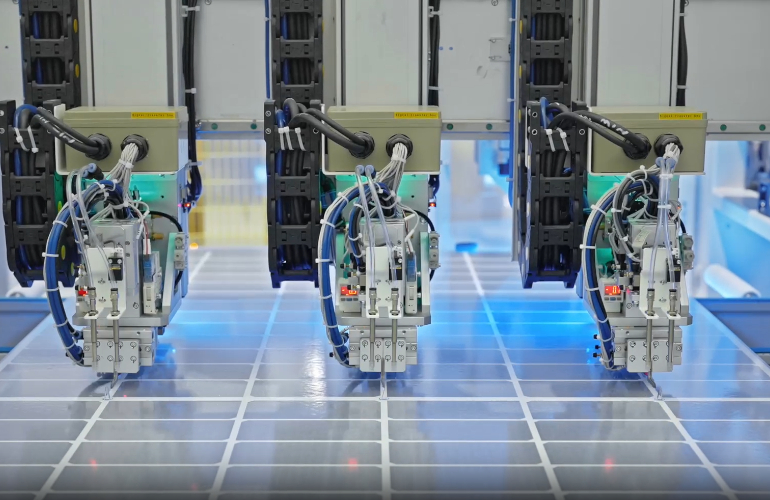
The U.S. solar industry is still working out the effects of the Sec. 232 tariffs on polysilicon and its derivatives. Aside from a handful of manufacturers that would plainly benefit if certain imported and domestic silicon solar products carry higher prices, few industry players have expressed positive feelings to Solar Power World about the situation.
“It’s definitely a negative,” said Jim Wood, CEO of SEG Solar, a module assembler with two Texas factories and a third under construction. “Panels are going to be more expensive. I’m currently quoting at much higher prices than a [month] ago.”
What the tariffs do
The Trump administration placed a general 15% tariff on imported silicon wafers, cells and finished panels, and set minimum import prices on polysilicon and its derivatives under Sec. 232 of the Trade Expansion Act, effective Dec. 4, 2026. Imported products can be subject to Sec. 232 tariffs when the government determines they pose a threat to national security. The general expectation is that if imported products carry both a set floor price and an additional tariff, domestic manufacturing should rise to meet demand for the product.
The problem, many panel manufacturers say, is that they must also pay a higher cost on the upstream components necessary to make the solar panels the domestic industry desperately needs. That pushes the price of domestic panels higher, which may make them more expensive than foreign panels at the minimum import price of 38¢/W.
“It’s a negative for U.S. module makers without domestic cells,” Wood said. “I think it actually makes it harder to compete against imported modules. It feels like a no-win situation for the folks that already have invested in module factories in the United States.”
A lopsided supply chain
Manufacturing incentives in recent policies were advantageous for starting solar panel factories in the United States, with the industry ballooning in just five years from megawatts of manufacturing capacity to over 70 GW of panel-making ability annually. What has been harder to jumpstart is manufacturing of upstream components: silicon ingots, wafers and cells. A few cell manufacturers are starting up, but the country today could maybe count on just 4 GW of cells being made at home. Everything else must be imported.
ES Foundry, one of the independent cell manufacturers operating in the United States today, is also seeing only downsides to the Sec. 232 tariffs.
“It’s not so great for us,” said Alex Zhu, CEO of ES Foundry, which operates a 3-GW cell factory in South Carolina. “We are a smaller player. The economics have really pushed toward integrated facilities. If this [policy framework] doesn’t change too much, then we have to be integrated to be profitable.”
The math of a standalone cell maker
According to Zhu’s calculations, with wafers carrying a $100/kg minimum import price, the PERC wafers he imports to make cells come to about 15¢/W plus another 2¢ for the general 15% tariff. His total cost to buy a wafer is 17¢/W, while the minimum import price on a finished cell is 22¢/W.
“Basically, we only have 5¢ as our margin, and 5¢ is not enough to sell in the United States,” he said. Even including the 4¢/W manufacturing tax incentive (45X) that cell companies can receive, 9¢ cannot cover ES Foundry’s costs to make product, Zhu said.
What could make sense instead is a company that is integrated and produces its own cells for its own modules. At least then the final panel is only competing with the 38¢/W minimum import price and accessing the higher 7¢/W 45X credit.
“A module company covers cost and has an additional 7¢ as their profit. A cell company is negative — 9¢ cannot cover my cost and I’m losing money,” Zhu said. “I have to increase my cell price, and if I do that, then that will cause a domestic-content module price to increase further.
“In my view, it incentivizes us to consider going to the module level because if I only sell a cell, I lose money. If I sell both the cell and module, I’m making money,” Zhu continued.
Unanswered questions on incentives
There is also the question of whether the government will offer domestic manufacturers some aid if they stick with the market. President Donald Trump said companies willing to invest in “building, expanding or refurbishing facilities” could be incentivized in some way — maybe a tariff break or more production tax credits. Zhu said there are still a lot of things in the air.
“If you invest in the United States, [will the government] relieve some of the tariff payment? We already made the investments, will we qualify? Or is the incentive only for additional investment and we get punished? There are many things we don’t know,” he said.
SEG Solar is also wondering about the potential incentive program. Wood said the company is planning to build a cell factory in the United States, but it feels even more important now.
“Hopefully there will be more clarity on how to negotiate with Commerce. Hopefully there are carveouts that are helpful,” he said. “We have three factories and a fourth on the way for cells. I can’t imagine anything more American than three guys starting a panel company, and we’re competing with the big guys.”
The other side of module procurement
For project developers trying to secure module supply, the Sec. 232 tariff is just another task on their list, said Arevon CEO Justin Johnson.
“It’s definitely a negative overall, there’s no doubt about it, because it increases the price for modules,” he said. “This is just the latest issue we’ve dealt with on the panel side. This goes on every year, whether it’s Sec. 301 tariffs or AD/CVD.”
Arevon has gigawatts of solar projects operating across the country, with each in the multi-hundred-megawatt range. Adequate solar panel supply is imperative to the company, and Johnson said Arevon already contracts with thin-film panel company First Solar and other domestic producers to ensure supply.
“[Using] a U.S. manufacturer is a hedge for us that you always have supply lined up,” he said. “The project economics aren’t as good on paper because of the price, but you’re hedging your risk a little bit.”
For the most part, domestic modules were being bought before these Sec. 232 tariffs, regardless of cost. Wood said that SEG Solar is sold out through next year, and Zhu said the same about ES Foundry cells. In certain cases, buying a slightly more expensive American panel was more beneficial than waiting for cheaper imports to arrive in the United States, Johnson said.
Seth Adams, senior VP of EPC at Standard Solar, said the distributed generation project developer has also already been balancing domestic content economics with project energization timelines, and he believes the Sec. 232 tariffs will push people to think beyond price.
“I think with everything that’s evolving now, everyone’s procurement strategy is changing a bit more — less about cost, less about speed and really just what’s the long-term bankability and overall project economics vs. just that first cost perspective,” he said.
While everyone is still sorting out the details of the Sec. 232 tariffs on polysilicon and its derivatives, the effect won’t be felt for six months in the commercial market, Adams said, and maybe not for two years for utility-scale projects, Johnson said.
“Projects that are going to be operational two years from now, we already had supply. It’s been warehoused because of [safe harbor rules] over the years,” Johnson said. “We had some bids we were working on for projects that are 2029 CODs that are stalled right now. It’s probably going to be a couple months before we figure it out, to let the dust settle on this.”

