SEC Crypto Regulation Takes Center Stage After Clarity Act Fails in Congress
Key Takeaways
- •The Clarity Act stalled in Congress, leaving the SEC as the primary near-term source of crypto oversight.
- •The bill was intended to clarify whether digital assets fall under securities or commodity rules and how trading platforms and intermediaries would be regulated.
- •The SEC has scheduled an open meeting with crypto oversight on the agenda.
- •The agency is expected to continue focusing on token classification, exchange and custody oversight, disclosure requirements, and enforcement priorities.
- •For crypto firms and investors, a regulator-led approach keeps compliance and legal boundaries subject to shifting agency interpretation rather than fixed statute.
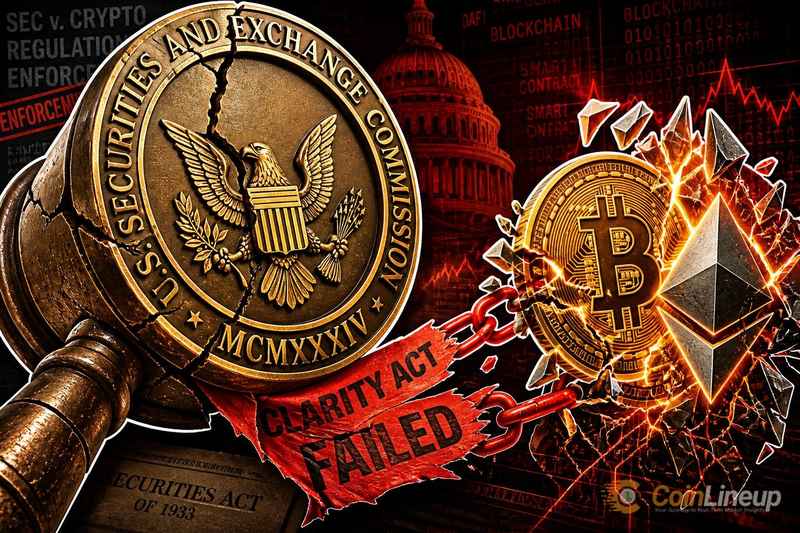
The U.S. Securities and Exchange Commission is poised to reclaim its central role in crypto policy after the Clarity Act stalled in Congress, leaving agency-level regulation as the primary near-term source of direction for digital-asset firms.
Why the Clarity Act's Failure Returns Oversight to the SEC
The Clarity Act, formally titled the Digital Asset Market Clarity Act (H.R. 3633), was designed to establish which digital assets qualify as securities and which fall under commodity rules, while also outlining how exchanges and intermediaries should be supervised. The bill aimed to resolve a jurisdictional overlap that has persisted for years: the SEC and the Commodity Futures Trading Commission both assert authority over digital assets, yet neither agency has a clear statutory mandate covering tokens that don't fit neatly into existing securities or commodities frameworks.
With that market-structure bill now stalled, the statutory framework it promised remains unrealized. In the absence of new legislation, agency action becomes the principal lever for near-term oversight.
The distinction is significant. Congressional legislation establishes durable, statute-level rules, whereas SEC-led regulation operates through guidance, rulemaking, and enforcement—mechanisms that can shift more quickly but carry less permanence. The bill's delay had already attracted criticism ahead of a scheduled vote, and its failure now leaves the regulator to fill the resulting gap.
What the SEC Is Likely to Address Next
The SEC has scheduled an open meeting where crypto oversight is on the agenda, signaling a forward-looking response rather than a settled framework.
The most direct question the agency historically addresses is token classification: whether a given asset constitutes a security and is therefore subject to registration and disclosure obligations. That determination hinges on the framework the SEC derives from SEC v. W.J. Howey Co., a 1946 Supreme Court case establishing that an investment contract exists when money is invested in a common enterprise with an expectation of profits derived from the efforts of others. The agency has applied this standard to digital assets for years, and it shapes nearly every other regulatory decision.
Beyond classification, exchange, broker, and custody oversight represent recurring focus areas, covering how trading venues operate and how customer assets are held. Disclosure requirements, registration obligations, and enforcement priorities round out the areas the SEC typically drives through interpretation rather than statute.
These are informed expectations based on the agency's established operations, not confirmed decisions. The failure of a defined legislative bill means the specifics will now depend on regulatory interpretation.
Implications for Firms and Investors
For crypto companies, a regulator-led path extends compliance uncertainty. Firms that had been planning around the Clarity Act's proposed definitions must now navigate agency guidance that can shift with enforcement posture rather than fixed statutory language. The practical effect is already visible: the SEC has pursued enforcement actions against major trading platforms, token issuers, and lending programs, demonstrating how agency-level oversight translates into concrete legal exposure in the absence of legislation.
Investors face a similar recalibration. A framework built on regulatory interpretation is assessed differently from one anchored in new law, because boundaries can be tested case by case rather than established definitively in statute.
The debate over the bill extended beyond market participants. Coin Center argued that the fight over the Clarity Act reached beyond crypto, framing it as part of a broader contest over control of the internet.
The bill also divided lawmakers who otherwise support federal crypto rules. Senator Elizabeth Warren backed federal crypto regulation while opposing the Clarity Act, underscoring that the legislative path was contested rather than reflecting a clean partisan divide. Warren has also pressed for scrutiny of the administration's crypto ties alongside that push.
With the bill stalled, the SEC's open meeting represents the next concrete step to watch for how digital-asset oversight will take shape.

