SEC Enters Grant Hiatus, Pausing Review of New Crypto ETF
Key Takeaways
- •The SEC has entered a grant hiatus, an internal administrative pause that blocks new approvals and stops the formal disposition clock for a crypto ETF under review.
- •The hiatus is procedural and does not indicate whether the SEC will ultimately approve or reject the pending ETF application.
- •ETF listings move through Form 19b-4 exchange rule filings on statutory deadlines that start at 45 days and can be extended in stages up to a maximum of 240 days.
- •ETF sponsors face delayed review timelines with no confirmed resumption date, and typically monitor SEC notices, watch for amendment requests, and prepare updated filings while awaiting a reopened review window.
- •A change in status would be signaled by an SEC announcement ending or extending the hiatus, a public update from the sponsor or exchange, or a new statutory deadline, amendment request, or formal disposition order on the SEC's EDGAR rule-filing docket.
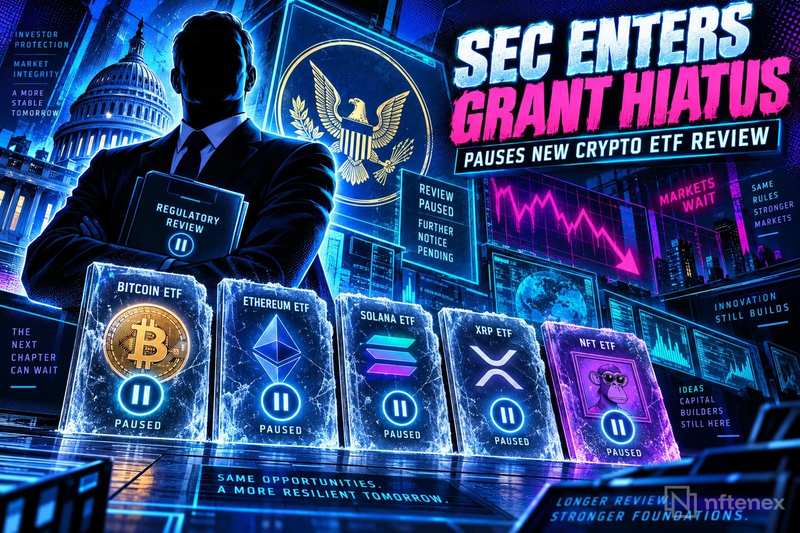
The U.S. Securities and Exchange Commission (SEC) has entered a grant hiatus, an internal administrative pause that stops the agency from issuing new approvals or grants for the duration of the affected period. For a crypto ETF currently under review, the clock on a formal disposition effectively stops, and applicants cannot expect a decision until the hiatus ends. The move leaves pending applications awaiting formal action in limbo for the time being.
A Procedural, Not a Ruling
Importantly, a hiatus does not amount to a substantive ruling. The SEC has not signaled approval or rejection of the product under review; it has paused the machinery that would produce either outcome.
Under the Securities Exchange Act, ETF listings proceed through exchange rule filings — Form 19b-4 submissions that the Commission reviews on statutory deadlines, with an initial window of 45 days from publication that can be extended in stages up to a maximum of 240 days.
Industry groups have long pushed for clearer SEC timelines on novel digital asset products, and crypto organizations have advocated for tailored rules on novel ETFs precisely to reduce this kind of procedural ambiguity. A hiatus compounds that uncertainty by removing even the procedural milestones that applicants rely on to gauge progress, leaving them without a reliable benchmark for where their applications stand.
Practical Implications for Sponsors and Investors
For an ETF sponsor, the immediate consequence is a delayed review timeline with no confirmed resumption date. Sponsors typically monitor the SEC's public calendar for notices ending the hiatus, watch for amendment requests that signal re-engagement, or prepare updated filings in anticipation of a reopened review window.
For investors, the pause is a reminder that regulatory timelines for crypto products remain subject to administrative variables unrelated to the underlying asset or the structure of the product itself. The SEC's evolving framework for digital asset custody, detailed in the agency's crypto custody proposal for investment advisers and funds, adds further layers of procedural complexity to any new ETF pathway. While the review remains on hold, investors can track real-time ETF flow activity across issuers on the CoinGlass Bitcoin ETF dashboard.
No resumption date has been confirmed, and treating the pause as a forward signal in either direction would be premature.
What to Watch While the Review Is Paused
Three specific developments would signal a change in status:
- Any SEC announcement formally ending or extending the hiatus.
- A public update from the ETF sponsor or the exchange involved in the listing application.
- A new statutory review deadline, an amendment request, or a formal order of disposition published on the SEC's EDGAR rule-filing docket.
Until one of those occurs, the application sits in an administrative queue with no active procedural calendar. Investors tracking this space should monitor the SEC's public notices page and the relevant exchange's rule-filing docket rather than relying on secondary reports that may conflate the hiatus with a substantive decision.
Disclaimer: This article is for informational purposes only and does not constitute financial or investment advice. Cryptocurrency and digital asset markets carry significant risk. Always do your own research before making decisions.

