US SEC Staff Clarifies When Crypto Tokens May Fall Outside the Howey Test
Key Takeaways
- •The SEC's Division of Corporation Finance issued FAQs clarifying when crypto asset activities and tokens may fall outside the Howey test, building on the Commission's March 17 interpretive release.
- •SEC staff said activities such as securing, maintaining, improving, or enhancing a functional crypto network would not constitute essential managerial efforts, so promises to continue those services would not satisfy the Howey test.
- •Staking receipt tokens can qualify as digital tools or digital commodities when they represent a deposited digital commodity not subject to an investment contract, without adding financial rights or transferring control of the asset to an issuer.
- •Token buybacks on functional networks would not by themselves amount to essential managerial efforts, while buybacks on networks that are not yet functional could support an investment contract finding if promoted as creating yield or returns.
- •Operating a secondary market does not automatically make a trading platform a promoter, and because the FAQs are staff views rather than Commission rules, they create no new legal obligations and apply on a facts-and-circumstances basis.
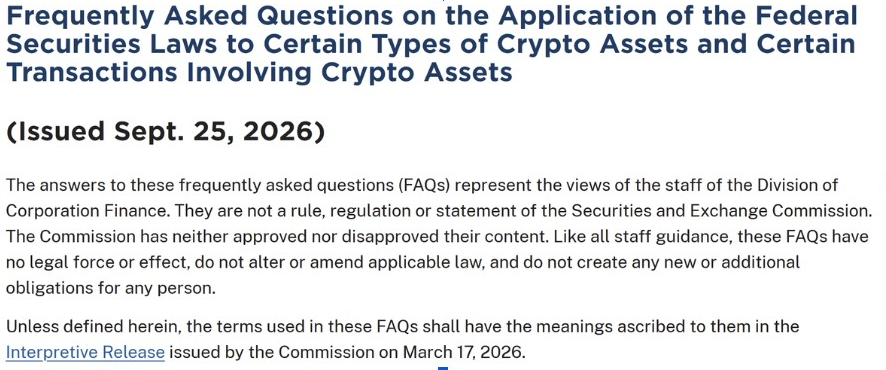
Staff of the U.S. Securities and Exchange Commission has issued new guidance addressing how federal securities laws apply to certain crypto assets, explaining when specific activities and tokens may fall outside the scope of the Howey test, the framework used to determine whether a transaction qualifies as an investment contract. Under that test, derived from the U.S. Supreme Court's 1946 ruling in SEC v. W.J. Howey Co., a transaction is an investment contract when it involves an investment of money in a common enterprise with a reasonable expectation of profits derived from the efforts of others.
The frequently asked questions were published by the SEC's Division of Corporation Finance and build on the Commission's March 17 interpretive release. Staff stressed that the FAQs are not Commission rules and do not create new legal obligations. The classification they address carries weight because assets deemed investment contracts fall under the SEC's securities registration and disclosure regime, while assets outside that definition are generally not subject to it.
The document covers staking receipt tokens, token buybacks, marketing statements, network development, and secondary-market platforms. It focuses on when certain transactions do not meet the elements used to identify an investment contract, and on when that classification can change based on the structure of a network.
Functional Networks Can Fall Outside the Howey Analysis
SEC staff said certain activities on a functional crypto network would not constitute essential managerial efforts. These include securing, maintaining, improving, or enhancing the system after it becomes functional. Under the stated circumstances, promises to continue providing those services would not satisfy the Howey test.
That functional threshold runs throughout the document and serves as the dividing line for how staff approach staking receipts, buybacks, and marketing statements. The position follows the Commission's August proposal, Regulation Crypto Assets, which addressed investment contracts involving crypto assets. The FAQs also addressed networks that operate without a central party. Staff said issuer statements about such functional systems would likely not create a new investment contract, because no person would control the system enough to determine its success or failure.
Staking Receipt Tokens Receive Clearer Classification
Staff said a staking receipt token can qualify as a digital tool under certain conditions, applying when the token represents a digital commodity that is not subject to an investment contract. In that case, the receipt serves as evidence of the holder's ownership of the deposited digital commodity. It does not provide added financial rights or transfer control of the deposited asset to the issuer.
A staking receipt token may instead qualify as a digital commodity when issued by a protocol-based liquid staking provider. In that scenario, its value must be linked to a functional crypto system and to market supply and demand.
Buybacks and Marketing
The staff also addressed token buybacks, saying their treatment depends on whether a crypto network is already functional. A buyback involving a functional network would not, by itself, amount to essential managerial efforts. The analysis can change when a network is not yet functional: a buyback could support an investment contract finding if it is promoted as creating yield or returns for token holders.
On marketing, the staff said promoting a network's existing utility would generally not amount to a promise of essential managerial efforts. Statements about possible future features may receive similar treatment when they do not promote expectations of profit. However, staff emphasized that each case depends on its specific facts and circumstances.
Secondary-Market Platforms
Staff further said that operating a secondary market does not automatically make a trading platform a promoter. The platform must still meet the definition under Securities Act Rule 405.
Under the Howey test, the analysis therefore remains tied to network functionality, issuer promises, and expectations of profit from the managerial efforts of others. Because the FAQs represent staff views rather than binding rules, how these positions apply in practice will depend on the facts of each individual network and offering, the same facts-and-circumstances standard the staff applied throughout the document.
This article is for informational purposes only and does not constitute legal, financial, or investment advice.

