US SEC Charges Mining Automatic and Zan Shaikh Over Alleged $22 Million Crypto Mining Fraud
Key Takeaways
- •The SEC alleges that Mining Automatic and Zan Shaikh collected roughly $22 million from over 380 investors through a fraudulent crypto mining program promising guaranteed monthly returns.
- •According to the complaint, only 13% of the funds raised were used for actual mining operations, with the remainder largely diverted to marketing expenses and Shaikh's personal use.
- •Approximately $7 million of the total raised came from individuals who had previously invested in other failed ventures associated with Shaikh.
- •Shaikh has consented to a partial settlement that includes injunctive relief and an officer-and-director bar, though the agreement still requires court approval.
- •The case exemplifies the SEC's current enforcement posture under Chair Paul Atkins, which prioritizes clear-cut fraud cases such as Ponzi schemes over disputes about whether specific digital assets qualify as securities.
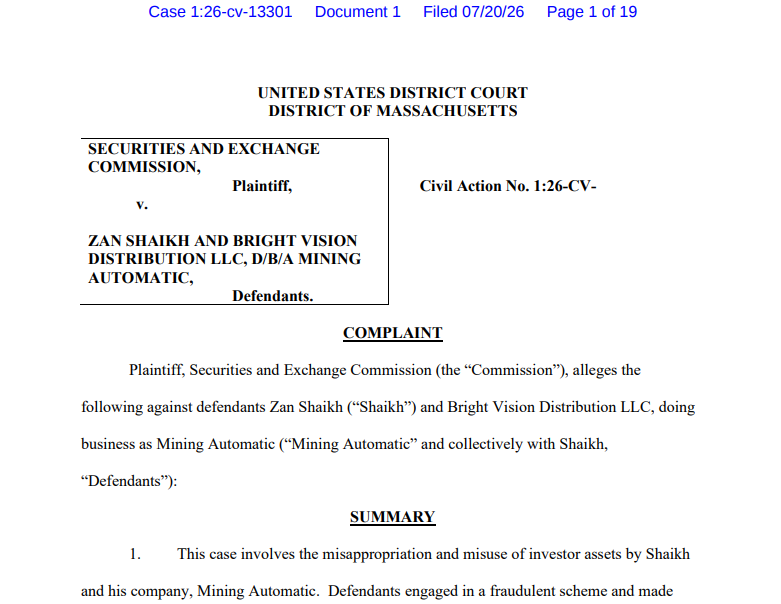
The U.S. Securities and Exchange Commission has charged Florida resident Zan Shaikh and his company, Bright Vision LLC, over an alleged fraudulent crypto mining investment scheme that raised about $22 million from investors.
The SEC said Bright Vision LLC, which operated as Mining Automatic, and Shaikh misappropriated investor funds and made false statements about the business. The agency disclosed the action in a litigation release and filed its complaint in the U.S. District Court for the District of Massachusetts. The charges have been partially settled, according to the regulator.
SEC Says More Than 380 Investors Put Money Into the Scheme
According to the SEC, Shaikh and Mining Automatic raised approximately $22 million from more than 380 investors through a crypto mining investment program. The regulator alleged that the defendants misused and misappropriated the money they collected.
Of the total funds raised, about $16 million came from new investors. Another $7 million came from people who had previously invested in other failed enterprises associated with Shaikh, according to the SEC's allegations.
The SEC said the alleged scheme operated from June 2023 to May 2025. Shaikh allegedly told investors that their money would be used in a crypto mining operation and promised guaranteed monthly returns. The promise of guaranteed returns in crypto mining—where revenue depends on volatile coin prices, network difficulty, and hardware costs—has long been flagged by the SEC's own investor education materials as a hallmark of fraudulent offerings.
The agency alleged that Shaikh and Mining Automatic made multiple misrepresentations to investors, including statements about their experience and track record. The SEC also said the defendants misled investors about how their money would be used.
According to the complaint, only 13% of investor funds were directed toward mining operations. The SEC alleged that most of the money was instead spent on marketing costs to attract additional investors and on Shaikh's personal expenses. The diversion of the bulk of proceeds toward recruiting new investors rather than funding the stated business activity aligns with patterns the SEC has described in prior crypto fraud cases.
In its complaint, the SEC alleged violations of several securities laws. The regulator is seeking an injunction to prevent the defendants from continuing the alleged conduct. It is also seeking to bar Shaikh from serving as an officer or director of certain public companies.
The SEC said the defendant has consented to this judgment, meaning the settlement still requires court approval. The agency is also seeking disgorgement, civil penalties, and prejudgment interest, with the amounts to be determined by the court.
Case Comes as SEC Crypto Enforcement Shifts Under Atkins
The case is among the relatively small number of crypto-related enforcement actions brought since Paul Atkins became SEC chair after being appointed by President Donald Trump.
The matter also reflects a broader change in the SEC's approach to crypto enforcement compared with the agency's posture under former Chair Gary Gensler, when the regulator pursued aggressive enforcement actions against multiple crypto firms.
Under Atkins, the SEC has adopted a more collaborative approach toward the digital asset industry. In 2025, the regulator dropped several cases against crypto companies and shifted more attention toward issuing guidance for the sector.
At the same time, the agency's crypto-related enforcement actions have focused on alleged clear-cut misconduct, including Ponzi schemes, rug pulls, and other investment frauds. The Mining Automatic case fits that profile, as the charges center on alleged misappropriation and misrepresentation rather than disputes over whether a particular digital asset qualifies as a security.
While the SEC's changed approach has been associated with greater regulatory clarity for the industry, the article noted that it has not had a similar effect on crypto market performance. Many stakeholders have argued that the CLARITY Act is needed to codify the regulatory changes and prevent a future administration from reversing the policy direction on crypto.

