India Begins Tokenizing Its $620 Billion Corporate Bond Market as SEBI's Demat 2.0 Pilot Goes Live
Key Takeaways
- •Three companies — REC Limited, L&T Limited, and IIFL — completed the first cohort of tokenized corporate bond issuances totaling ₹1,025 crore under SEBI's sandbox pilot.
- •Settlement runs through atomic delivery-versus-payment on the RBI's wholesale digital rupee via the Unified Market Interface, and SEBI states issuers receive funds on bidding day instead of two to three days afterward.
- •The pilot is currently in Stage I, restricted to institutional participants, while secondary trading and retail access are planned for Stage II with no dated milestones confirmed.
- •Tokenized bonds carry the same ISIN and legal status as conventional securities, so existing ratings, trustees, disclosure requirements, and investor protections remain in force.
- •India's corporate bond market is estimated at roughly $620 billion according to unverified reports, a total addressable base of which the pilot amount represents only a small fraction.
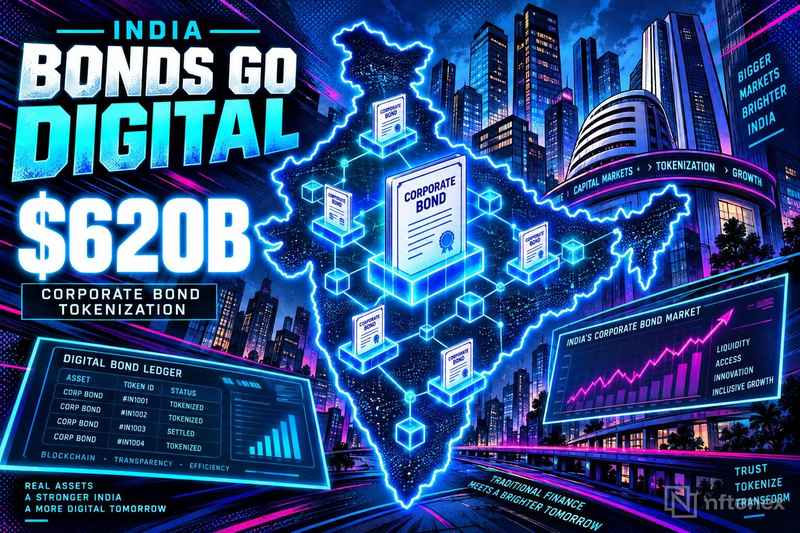
India's move to tokenize its corporate bond market is no longer a whitepaper promise — it is a set of completed issuances. The Securities and Exchange Board of India (SEBI) announced the launch of its Demat 2.0 pilot on September 10, 2026, in PR No. 56/2026, with Reserve Bank of India (RBI) Governor Sanjay Malhotra and SEBI Chairman Tuhin Kanta Pandey jointly presenting the initiative at the Global Fintech Fest in Mumbai, according to the regulator's official release.
Key Points at a Glance
- SEBI's Demat 2.0 pilot has produced live tokenized corporate bond issuances from three companies, settled using the RBI's wholesale digital rupee.
- The pilot total stands at ₹1,25 crore — a fraction of an underlying corporate bond market that unconfirmed reports size at $620 billion.
- Retail access and secondary trading are proposed for later stages, and investor protections under existing securities law remain unchanged.
What Is Beginning in India's Corporate Bond Market?
For readers who follow real-world asset tokenization, this is a debt instrument, not a PFP or a gaming asset. The token here is a corporate bond — in plain terms, a loan to a company that pays periodic coupons and repays principal at redemption — issued natively on a private, permissioned distributed ledger owned by the depositories, carrying the same ISIN and the same legal rights as its paper predecessor.
What Has Been Announced
Three companies had issued tokenized corporate bonds aggregating ₹1,025 crore (a crore equals ten million rupees) as of the September 10, 2026 release, marking the first cohort under the sandbox pilot.
- REC Limited issued first, on September 7, 2026, raising ₹500 crore from 18 investors.
- L&T Limited followed on September 9, 2026, raising ₹500 crore from 4 investors.
- IIFL issued the same day, raising ₹25 crore from a single investor.
The investor counts matter: this is an institutional pilot, not a public drop. Eighteen buyers for REC and a single buyer for IIFL signal a controlled test environment rather than the open, permissionless minting familiar from NFT markets.
What the $620 Billion Figure Represents
India's corporate bond market is worth roughly $620 billion, according to unconfirmed reports — a figure published by Decrypt without the underlying dataset, measurement date, or exchange rate being independently verified. That number describes the total addressable market, not the amount tokenized so far.
The distinction is the whole story. The pilot's ₹1,025 crore represents a sliver of that estimated base, and no nationwide rollout, blanket regulatory approval, or completed market conversion has occurred. This is infrastructure being tested, in the same way early on-chain settlement rails were tested before wider adoption.
How Tokenization Could Change Corporate Bond Investing
From Bond Records to Digital Tokens
Tokenization in this context means the bond exists as a native digital token on the depositories' permissioned ledger, not as a wrapper minted on a public chain. It is a corporate debt claim with coupon and redemption rights, legally distinct from a cryptocurrency or an NFT, even though it shares the token vocabulary.
Custody is deliberately conservative. The depositories hold and manage investors' private keys, and investors use their existing demat account and KYC, link an eligible account to a CBDC wallet — central bank digital currency, the RBI's digital rupee — and provide consent. There are no self-custodied seed phrases in this design.
Settlement, Access and Liquidity
The settlement rail is where Demat 2.0 is genuinely novel. It connects to the RBI's wholesale CBDC through the Unified Market Interface, and atomic delivery-versus-payment links the bond and the payment so that either both settle or neither does. Delivery-versus-payment is a long-standing safeguard in securities settlement, ensuring the asset and cash legs of a trade cannot move without each other; executing it atomically on a central-bank-money rail means both legs land in a single step rather than across multi-day cycles.
SEBI says issuers receive funds on the bidding day, versus the two to three days after bidding generally required previously. That is the regulator's stated operational benefit rather than an independently benchmarked latency result, and it applies to the primary issuance leg.
Liquidity carries a significant caveat. Before secondary-market trading is enabled, depositories may allow requested peer-to-peer, demat-to-demat transfers, with the payment leg occurring outside atomic settlement through CBDC or banking channels. Tokenization alone does not establish fractional ownership, retail access, instant settlement, or an active secondary market, and none of these infrastructure changes alter the underlying bond's credit risk. Until Stage II changes that, moving a position means a requested transfer, not a market trade.
What to Watch as India's Bond Tokenization Develops
Investor Protections and Operational Readiness
The pilot operates under SEBI's Regulatory Sandbox, and the bond remains a security under the Securities Contracts (Regulation) Act, 1956, with the depository's statutory ownership-record role under the Depositories Act, 1996 continuing unchanged. Existing ratings, trustees, disclosure requirements, and investor protections still apply, and freezes and attachments extend to tokenized holdings.
That legal continuity is the key takeaway for issuers exploring tokenization in other sectors: the token inherits the instrument's legal enforceability rather than replacing it with code.
Evidence of Adoption
SEBI's FAQ proposes three stages: Stage I covers issuance and servicing, with initially expected institutional participation; Stage II adds secondary trading and retail access; Stage III contemplates additional regulated nodes, instruments, and corporate actions. The pilot is squarely in Stage I today.
The signals worth tracking are repeat issuance beyond the first three companies, growth past the current ₹1,025 crore total, and any move to enable Stage II secondary trading.
For now, expansion targets and timing remain unconfirmed. SEBI has published a phased design and a verified first cohort, but no dated milestone for retail access or an active secondary market has been set.
Disclaimer: This article is for informational purposes only and does not constitute financial or investment advice. Cryptocurrency and digital asset markets carry significant risk. Always do your own research before making decisions.

