Samsung leans on dividends, SK hynix on buybacks as AI chip boom fuels record returns
Key Takeaways
- •SK hynix announced a 40 trillion won ($28.7 billion) buyback and cancellation program, the largest ever by a Korean-listed company, with purchases to be completed by November, and raised its shareholder return target to 50 percent or more of cumulative free cash flow.
- •Samsung's 90 trillion to 110 trillion won program relies mainly on dividends because cancelling shares would push its insurance affiliates' combined 10 percent stake over a regulatory limit and could weaken the founding family's influence.
- •SK hynix's buyback automatically raises parent SK Square's ownership ratio without additional purchases and offsets dilution from the roughly 40 trillion won Nasdaq ADR share offering, while the strategy lets the company sell equity at a premium in the US and buy it back more cheaply in Korea.
- •Both record programs align with Seoul's Corporate Value-up initiative launched in 2024 to narrow the Korea discount, and shares rose on the news, with Samsung closing 3.87 percent higher and SK hynix up 2.31 percent.
- •Analysts view SK hynix's buyback as an initial deployment, noting that with estimated three-year free cash flow of 491 trillion won, its shareholder return pool could exceed 245 trillion won.
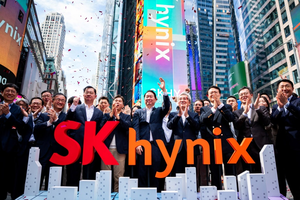
Samsung Electronics and SK hynix have rolled out the largest shareholder return programs in their histories, moving to share more of the windfall from the artificial intelligence chip boom with investors — but the two chipmakers are taking sharply different routes.
Samsung is leaning on dividends, while SK hynix is pursuing a massive share buyback and cancellation program, a contrast shaped by their different ownership and financial structures. The record return plans reflect those structures as both companies seek lasting stock gains.
At the center of the boom is high bandwidth memory, the chips stacked alongside AI processors to feed them data: SK hynix leads the global HBM market as a key supplier to Nvidia's AI accelerators, while Samsung — the world's largest memory chipmaker by revenue — has been working to expand its own HBM sales and narrow the gap with its smaller rival.
SK hynix moved first, announcing a 40 trillion won ($28.7 billion) plan to buy back and cancel shares — the largest such program ever unveiled by a Korean-listed company. The chipmaker plans to complete the purchases by November.
Backed by 69 trillion won in net cash as of end-June, SK hynix also raised its shareholder return target from “within 50 percent of cumulative free cash flow” to “50 percent or more,” without specifying the total payout.
Samsung followed with a shareholder return program worth 90 trillion to 110 trillion won, combining dividends and share buybacks. At the upper end, the package would be more than five times its previous record of 20.3 trillion won set in 2020.
Samsung plans to distribute about 30 trillion won in third-quarter dividends, including its regular payout, and return another 60 trillion to 80 trillion won after finalizing its annual results next January. Separately, it approved a 15 trillion won buyback to offset dilution from employee compensation.
SK hynix bets on buybacks
For SK hynix, the buyback plan supports the group's ownership structure. Parent SK Square must retain at least 20 percent of the chipmaker under Korean rules governing holding companies. Canceling shares automatically raises SK Square's ownership ratio without requiring it to buy additional shares, reinforcing its position as the controlling shareholder.
The approach also aligns with SK Group Chairman Chey Tae-won's indirect control of the chipmaker through SK Inc. and SK Square. Chey directly owns only 3,620 SK hynix shares, recently purchased and worth about 4.8 billion won.
The cancellation also offsets dilution from the 17.79 million new shares issued for SK hynix's recent Nasdaq American depositary receipt offering, which raised about 40 trillion won for domestic investment. The dollar proceeds and related currency hedging were also credited with helping reverse the won's slide.
The strategy effectively allows SK hynix to sell equity at a premium in the US and buy it back more cheaply in Korea.
SK hynix said the decision was aimed at strengthening its competitiveness and supporting long-term growth, while noting that its intrinsic value was not fully reflected in the current share price — a signal that the program was also intended to lift its stock valuation.
Samsung pays out cash
Samsung's preference for dividends came as little surprise, given the regulatory and ownership constraints surrounding the company.
Under Korea's Act on the Structural Improvement of the Financial Industry, financial companies cannot hold a combined stake of 10 percent or more in a nonfinancial affiliate. As of end-June, Samsung Life Insurance and Samsung Fire & Marine Insurance held 8.51 percent and 1.49 percent of Samsung Electronics, respectively — leaving them right at the 10 percent limit.
If Samsung Electronics were to choose share cancellations, the reduction in its outstanding share count would automatically push the insurers' combined ownership above 10 percent, forcing them to sell shares. Although such sales could generate sizable gains on shares acquired long ago at lower prices, they would shrink the group's affiliated-shareholder bloc and potentially weaken the founding family's influence over Samsung Electronics.
Dividends avoid that disruption and come with better tax treatment: 30 percent of the insurers' domestic dividend income is excluded from taxable income. They also directly benefit Samsung Electronics Chairman Lee Jae-yong and other family members, who hold the shares under their own names.
Can record payouts sustain the chip rally?
The record programs also align with Seoul's Corporate Value-up initiative, launched in 2024 to encourage Korean listed companies to lift shareholder returns and help narrow the long-standing “Korea discount” in the market's valuations.
Investors initially welcomed the record shareholder return plans, but their longer-term effect on the stocks will depend on whether the two chipmakers can sustain earnings and cash flow through the AI cycle.
Samsung Electronics closed 3.87 percent higher at 281,500 won on Friday after touching 285,000 won, although it gave up some gains in after-hours trading. SK hynix rose 2.31 percent to 1.73 million won following its buyback announcement.
For Samsung, the large cash payout could strengthen the stock's appeal to dividend-focused investors and help narrow its valuation discount.
“Higher cash returns, including special dividends, could highlight Samsung's dividend yield and help the stock settle above 300,000 won in the near term,” said Kim Dong-won, head of research at KB Securities, who described Samsung as “a deeply undervalued stock offering both earnings growth and dividend appeal.”
For SK hynix, the central question is whether the 40 trillion won buyback marks the start of a longer series of capital returns. Analysts estimate the chipmaker's cumulative free cash flow over three years at 491 trillion won; at its minimum return rate of 50 percent, the shareholder return pool would exceed 245 trillion won.
“This buyback is only an initial deployment,” said Park Jun-young, an analyst at Hanwha Investment & Securities, adding that additional buybacks exceeding 100 trillion won could progressively reduce the number of outstanding shares and increase earnings and value per share.
The immediate direction of both stocks, however, may still be shaped by broader conditions affecting the AI chip rally, including Nvidia's earnings and US Treasury yields.

