Samsung Q2 2026 Revenue Report: Memory Recovery, AI Chip Pressure, and Korea’s Market Reset
Key Takeaways
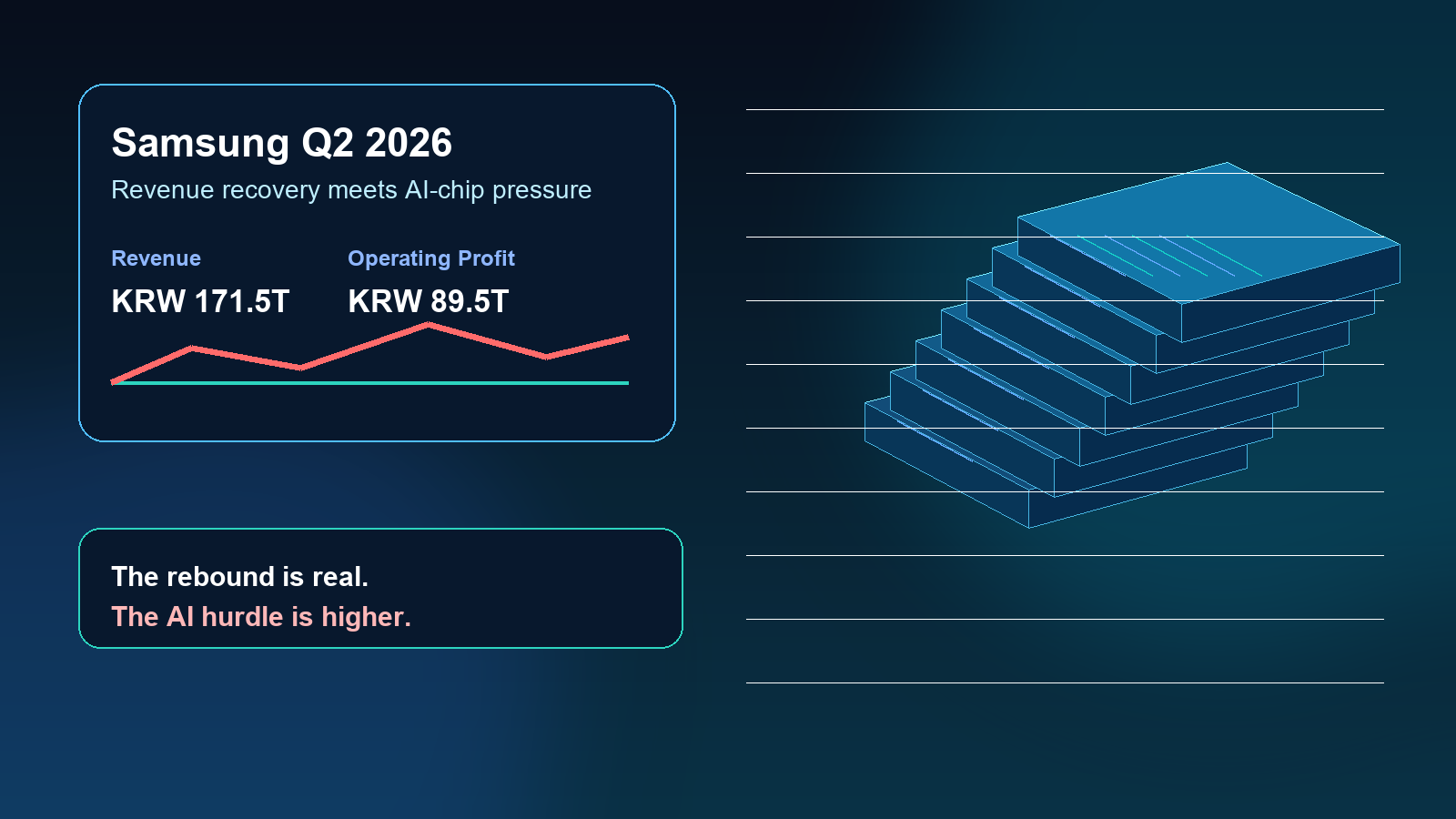
- •Samsung reported Q2 2026 revenue of KRW 171.5 trillion and operating profit of KRW 89.5 trillion, reflecting a decisive turnaround from the severe memory downturn.
- •Investors consider Samsung's high-bandwidth memory competitiveness against SK Hynix to be the central factor in determining whether the stock deserves a higher AI valuation multiple.
- •Samsung's diversified portfolio spanning memory, foundry, mobile devices, and displays provides multiple profit engines but also complicates the investment case compared to more focused competitors.
- •South Korea's Kospi dropped more than 8% on July 29 as investors sold AI-linked stocks, adding valuation pressure on Samsung and SK Hynix despite improving fundamentals.
- •Future investor checkpoints include HBM customer qualifications and shipment ramps, conventional memory pricing trends, foundry yield improvements, and Galaxy AI's contribution to smartphone margins.
Why Samsung’s Q2 Report Matters Now
Samsung Electronics entered Q2 2026 with a different burden from many global technology companies. It was not merely trying to show growth. It was trying to prove that one of the world's largest semiconductor franchises could reclaim investor confidence after a brutal memory downturn and a period of intense AI-chip scrutiny.
The company’s Q2 earnings materials showed revenue of KRW 171.5 trillion and operating profit of KRW 89.5 trillion. Those numbers are large enough to make the basic direction clear: Samsung is no longer trading on the old memory recession story. The cycle has improved, pricing has recovered, and semiconductor profitability is again central to the investment case.
But the market is no longer satisfied with a simple rebound. SK Hynix has become the cleaner high-bandwidth memory story in investors’ minds, while TSMC remains the global foundry benchmark. Samsung has a wider business base, but that breadth cuts both ways. It gives the company multiple profit engines, yet it also forces investors to evaluate several unfinished debates at once.
The Q2 Numbers: A Strong Recovery With a Higher Hurdle
Samsung’s Q2 report lands in a market that has already learned to separate “better” from “good enough.” A recovery in DRAM and NAND can lift earnings, but Samsung stock needs more than proof that the cycle has turned. It needs proof that the company can compete in the most profitable parts of the AI infrastructure chain.
| Metric / Issue | Q2 2026 Context | Investor Read |
|---|---|---|
| Revenue | KRW 171.5 trillion | Confirms scale and recovery momentum |
| Operating profit | KRW 89.5 trillion | Shows the profit base has moved far beyond downturn conditions |
| Main earnings driver | Semiconductor cycle recovery | Positive, but investors still ask how much comes from AI-grade products |
| AI-memory question | HBM competitiveness versus SK Hynix | Central to whether the stock earns a stronger AI multiple |
| Market backdrop | Korean AI-chip stocks under pressure | Good earnings can still face valuation reset risk |
The table captures the central tension. Samsung’s Q2 report was strong in absolute terms, but the stock market is not grading Samsung only against its own past. It is grading Samsung against SK Hynix in HBM, TSMC in foundry, Apple-linked and Android peers in devices, and the entire global AI-capex cycle.
That is why investors should be careful with overly simple readings. A strong Samsung quarter does not automatically mean the stock rerates. A weak market reaction does not automatically mean the business is deteriorating. The stock sits at the intersection of several narratives that do not always move in the same direction.
There is also an accounting-versus-market gap. Earnings statements show what happened during the quarter. Share prices often move on what investors think the next two to four quarters will look like. Samsung’s Q2 figures told the market that the profit engine is alive again. The harder forward-looking question is whether that profit engine can accelerate from here, or whether the easiest part of the memory rebound is already visible in reported numbers.
Memory Recovery Is Real, But HBM Is the Premium Question
The clearest improvement is memory. Samsung’s earnings power is highly sensitive to DRAM and NAND pricing, and a healthier memory cycle can quickly change the company’s profit profile. When utilization improves, inventories normalize, and pricing firms, Samsung's scale becomes an advantage again.
That is the traditional memory-stock case. The newer AI case is narrower and more demanding. Investors are not only asking whether memory is recovering. They are asking whether Samsung can close the gap in high-bandwidth memory, win more AI accelerator attach points, and turn HBM into a higher-quality margin stream.
Why HBM changes the valuation debate
HBM is not ordinary memory in the way investors think about earnings quality. It is tied to AI accelerator demand, advanced packaging, customer qualification, and supply commitments from some of the most important AI hardware buyers in the world. A company that leads in HBM can look less like a pure commodity-cycle stock and more like a strategic infrastructure supplier.
That is why Samsung’s Q2 report has to be read alongside competitive positioning. If Samsung’s memory recovery is mostly conventional DRAM and NAND, the stock may remain tied to the old cycle playbook. If HBM execution improves meaningfully, the market may give Samsung more credit for AI infrastructure exposure.
Why the market still wants proof
The market’s skepticism is not irrational. Samsung has enormous resources, but AI supply chains reward execution timing. Qualification delays, customer concentration, yield challenges, and foundry competition can all matter. In a market that has already rewarded AI winners aggressively, investors want proof before they expand multiples.
That proof will likely come over several quarters, not in a single report. Investors will watch HBM shipment progress, advanced packaging comments, memory margin quality, and whether AI-related demand can offset more ordinary cycle risk.
The distinction matters because AI investors are not paying only for volume. They are paying for scarcity, qualification, and strategic relevance. In ordinary memory, customers can often wait, negotiate, or switch suppliers more easily. In premium AI memory, qualification windows and supply commitments can create stronger relationships, but only for suppliers that execute on time. Samsung has the balance sheet and manufacturing depth to compete. The market wants evidence that those advantages are converting into share where the AI margin pool is richest.
Samsung Is Broader Than Memory
Samsung is not SK Hynix. That is both the opportunity and the complication. The company has memory, logic, foundry, mobile devices, displays, and consumer electronics. A broad base can stabilize earnings, but it can also dilute the purity of the AI-memory story.
For Samsung stock, breadth creates several simultaneous questions. Is the memory recovery strong enough to offset foundry pressure? Can Galaxy AI features support premium smartphone margins? Can the foundry business improve credibility against TSMC? Can Samsung's device ecosystem become a stronger distribution channel for on-device AI?
The answer does not need to be perfect for the stock to work. But investors need at least a coherent path. If memory carries the whole story while foundry remains weak and devices only hold steady, Samsung may be treated as a cyclical recovery name. If memory, AI devices, and foundry improvement begin reinforcing each other, the stock narrative becomes more powerful.
This is where Samsung’s complexity can become an advantage. Few companies can connect memory, processors, displays, smartphones, and manufacturing under one corporate roof. If on-device AI becomes a larger part of the consumer-electronics cycle, Samsung has more ways to participate than a pure memory supplier. The risk is that the same breadth can blur the investment case. Investors may admire the ecosystem but still demand clearer proof that each piece is earning its cost of capital.
Korea Market Pressure Made the Reaction Harder
Samsung’s Q2 report also arrived during a difficult moment for Korean technology shares. AP reported that South Korea's Kospi fell more than 8% on July 29 as investors sold AI-linked stocks, with SK Hynix and Samsung Electronics among the major drags. That matters because Samsung is not just a company. It is a bellwether for Korea's equity market and a core part of the country's technology identity.
When Korean AI-chip sentiment weakens, Samsung's earnings may be judged more harshly. Investors are not only asking whether Samsung had a good quarter. They are asking whether Korea's AI semiconductor premium has become too crowded, too dependent on a small number of global AI customers, or too exposed to changes in U.S. technology spending.
That market pressure does not erase the Q2 recovery. It does change the hurdle. In a calm market, Samsung's reported profit recovery might have been enough to carry the stock narrative. In a de-risking market, investors want a clearer reason to believe the next few quarters can keep improving.
It also affects how foreign investors read the stock. Samsung is often used as a liquid expression of Korean technology exposure. When global investors reduce semiconductor risk, Samsung can move with the basket even if company-specific news is constructive. That is why the right reading of Q2 is not “earnings versus stock price” alone. It is “earnings versus a changing global appetite for AI-chip risk.”
What Investors Should Watch Next
The first checkpoint is HBM progress. Investors should watch whether Samsung gives clearer evidence of customer qualifications, shipment ramp, and margin contribution. The second is conventional memory pricing. DRAM and NAND recovery can still support earnings, but investors will want to know whether the recovery is disciplined or at risk of future oversupply.
The third checkpoint is foundry. Samsung does not need to catch TSMC overnight, but it does need to show that leading-edge manufacturing, yield, and customer trust are moving in the right direction. The fourth is mobile profitability. Galaxy AI can help the premium-device narrative, but software features need to translate into mix, pricing, retention, or ecosystem value.
Finally, investors should watch Korea-market liquidity. Foreign flows, won movement, index pressure, and regional risk appetite can all influence Samsung stock even when company fundamentals improve. For a mega-cap like Samsung, the stock story is always both corporate and macro.
The Q2 report gave Samsung a stronger earnings base. It did not end the debate. The next stage is about whether Samsung can turn recovery into leadership, and whether investors are willing to pay for that possibility before the evidence is fully visible.
For now, the article of faith around Samsung is becoming more demanding. The company has shown recovery. The market is asking for leadership. That difference will shape how every future revenue update, HBM comment, foundry milestone, and Galaxy AI data point is interpreted.
Trade Samsung Stock 24/7 with edgeX
Following Samsung’s market movements doesn’t have to stop when traditional exchanges close. On edgeX, a decentralized exchange built for serious traders, you can go long or short on Samsung Electronics stock around the clock - no brokerage account required.
What is edgeX?
edgeX is a decentralized perpetual futures exchange that gives traders institutional-grade execution with full self-custody. Built on the EDGE chain and settled on Ethereum via Arbitrum, the platform processes up to 200,000 orders per second with matching latency below 10 milliseconds. Deep liquidity, zero counterparty risk, and on-chain settlement - all in one interface.
Why Trade SAMSUNG USDC Perpetual Futures on edgeX?
The SAMSUNG USDC perpetual futures contract on edgeX lets you take a leveraged position on Samsung’s stock price, settled in USDC. Key advantages include:
- 24/7 trading - React to Samsung news, earnings, and macro events the moment they break, not when markets open.
- Up to 10x leverage - Amplify your position with up to 10x leverage on SAMSUNG USDC perpetuals.
- Deep liquidity - $10 million of depth within a one-basis-point spread ensures seamless execution, even in volatile conditions.
- 100% trading fee rewards - Earn back trading fees through edgeX’s Trade to Earn program, putting rewards directly back in your hands.
How to Get Started
Getting started on edgeX takes minutes. Connect your wallet, deposit USDC, and you’re ready to trade. The platform is available via desktop and mobile app on both iOS and Android - so your Samsung position is always within reach.
Ready to trade Samsung stock on your terms? Start trading on edgeX today.
Frequently Asked Questions
Did Samsung report Q2 2026 revenue?
Yes. Samsung’s Q2 2026 earnings materials reported revenue of KRW 171.5 trillion and operating profit of KRW 89.5 trillion.
Why is Samsung’s Q2 report important for investors?
It shows that the memory-cycle recovery is real, but it also raises a harder question: whether Samsung can turn recovery into AI-memory leadership and stronger long-term margins.
Is Samsung stock only a memory-cycle trade?
No. Memory is central, but Samsung also includes foundry, mobile devices, displays, and consumer electronics. That makes the stock broader than SK Hynix, but also more complicated to analyze.
What should investors watch after Samsung’s Q2 report?
Investors should watch HBM progress, DRAM and NAND pricing, foundry execution, Galaxy AI profitability, Korea-market liquidity, and foreign investor flows.
Can investors trade Samsung stock directly on edgeX?
No. edgeX does not provide spot ownership of Samsung shares. It offers SAMSUNG USDC perpetual futures for price exposure, which is structurally different from owning KRX-listed Samsung Electronics common stock.

