Samsung Galaxy Watch 9 Officially Announced: Snapdragon Chip, Bigger Battery, and New Health Features
Key Takeaways
- •The Galaxy Watch 9 is the first model since 2021 to utilize a Qualcomm Snapdragon processor instead of Samsung's in-house Exynos silicon.
- •Samsung has increased the battery capacity of the 40mm model by 20% to 390mAh, enabling up to 30 hours of use with the always-on display.
- •The smartwatch starts at $379.99 in the United States, representing a $30 increase attributed to higher memory and storage costs.
- •Samsung has discontinued the rotating bezel, resulting in the absence of a Classic variant for this generation.
- •The device runs on One UI 9 Watch and comes with a commitment to five years of operating system upgrades.
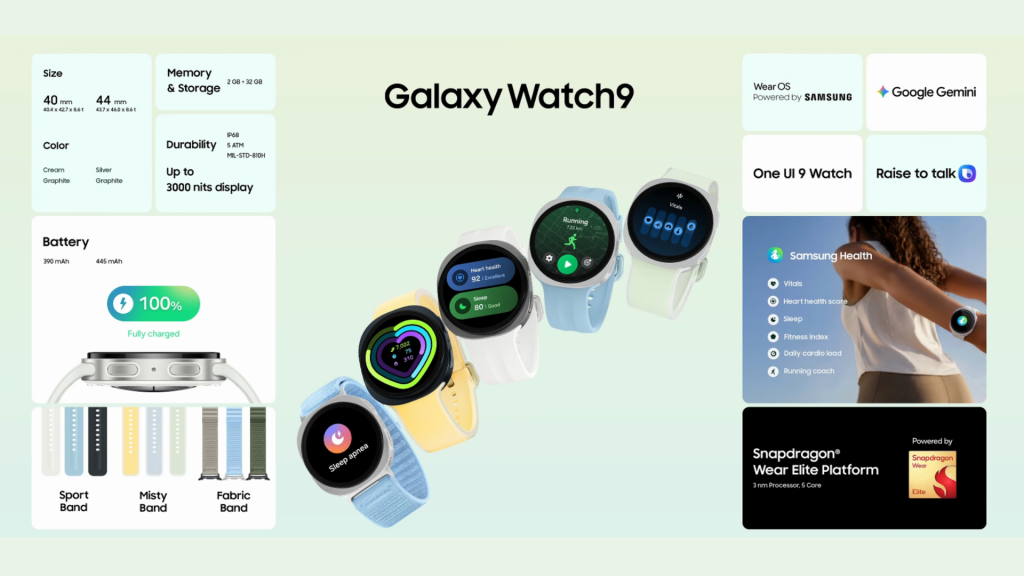
Samsung Galaxy Watch 9 Officially Announced at Galaxy Unpacked in London
Samsung has officially unveiled the Galaxy Watch 9 at its Galaxy Unpacked event held at Old Billingsgate in London on Wednesday, July 22, 2026. The smartwatch was announced alongside the Galaxy Watch Ultra 2, the Galaxy Z Fold 8, the Galaxy Z Flip 8, and Galaxy Glasses.
Pre-orders for the Galaxy Watch 9 opened on the same day as the announcement. Customers who pre-ordered can expect delivery starting August 3, 2026, with general retail availability beginning August 7, 2026. Samsung did not announce a Galaxy Watch 9 Classic model this year, keeping the lineup to the standard 40mm and 44mm sizes.
Pricing
The Galaxy Watch 9 starts at $379.99 in the United States, representing a $30 increase over the Galaxy Watch 8's launch price of $349.99. Samsung attributed the price increase to higher memory and storage costs. An additional band is available for €49.90.
Samsung has not announced an official price for the Nigerian market, as the country is not among Samsung's first wave of launch territories. Buyers in Nigeria will likely acquire the device through importers and online marketplaces such as Jiji and Jumia, or from retailers in hubs like Computer Village. Prices in Nigeria are expected to exceed the US starting price due to exchange rate fluctuations and import duties.
Design and Build
The Galaxy Watch 9 retains a design language similar to the Galaxy Watch 8, featuring an aluminum case with sapphire crystal cover glass. Samsung has discontinued the rotating bezel, resulting in no Classic variant this year.
The 40mm model measures 42.7mm by 40.4mm by 8.6mm and weighs 31.5g, while the 44mm model measures 46.0mm by 43.7mm by 8.6mm and weighs 34g. The watch carries an IP68 rating for dust resistance, a 5ATM rating for water resistance, and MIL-STD-810H certification for durability.
Display
The 40mm Galaxy Watch 9 features a 1.34-inch Super AMOLED display with a resolution of 438 by 438 pixels. The 44mm model is equipped with a 1.47-inch Super AMOLED display at 480 by 480 pixels. Both sizes achieve a peak brightness of 3,000 nits, matching the Galaxy Watch 8.
Battery Life
The 40mm model includes a 390mAh battery, a 20% increase from the Galaxy Watch 8's 325mAh unit. The 44mm model features a 445mAh battery, up slightly from 435mAh. Samsung states the watch can deliver up to 30 hours of battery life with the always-on display enabled—an improvement over its predecessor, though still trailing competitors such as the OnePlus Watch 3, which claims up to 120 hours per charge. Battery endurance remains one of the most scrutinized metrics in the Android smartwatch category, where devices have historically lagged well behind both the OnePlus Watch line and the Apple Watch series.
Processor and Performance
The most significant change in the Galaxy Watch 9 is its processor. Samsung confirmed the device runs on the Qualcomm Snapdragon Wear Elite chip, replacing the Exynos W1000 used in the Galaxy Watch 8. This marks the first Galaxy Watch to completely drop Samsung's in-house Exynos silicon—a notable shift, as Samsung has relied on its Exynos Wear processors across its smartwatch line since the Galaxy Watch 4 series in 2021. The move to Qualcomm aligns Samsung more closely with the broader Wear OS ecosystem, where most competing manufacturers already use Snapdragon platforms.
The Snapdragon Wear Elite is a 5-core, 3nm chip paired with 2GB of RAM and 32GB of storage. Samsung reports 32% faster CPU performance, 19% faster GPU performance, and 15% better power efficiency compared to the Exynos W1000. Connectivity has also been upgraded, with Bluetooth 6.0 replacing Bluetooth 5.3 and Wi-Fi 6 replacing Wi-Fi 4.
Health and Fitness Features
The Galaxy Watch 9 ships with Samsung's Galaxy AI health suite, which includes Vitals, Heart Health Score, Daily Cardio Load, and Fitness Index. Additional features include a Hearing function that alerts users to unsafe noise levels and an upgraded sleep apnea detector.
Many of these health capabilities are not exclusive to the Galaxy Watch 9. Samsung began rolling them out to the Galaxy Watch 7 and Galaxy Watch 8 via a software update in June 2026. The sleep apnea detection feature has received FDA clearance in the United States, placing Samsung among a small group of smartwatch makers offering regulator-cleared sleep health tools.
The watch includes a 60-day trial of Strava and a two-month trial of iFIT. The iFIT trial is available in 23 countries, including the US, UK, and South Africa.
Colors, Bands, and Software
The 40mm model is available in Cream and Graphite, while the 44mm variant comes in Silver and Graphite. Band options include the Sport Band, which is 17% lighter than the previous version, along with the Misty Band and Fabric Band.
The Galaxy Watch 9 runs on One UI 9 Watch, built on Wear OS 7. Samsung has committed to 5 years of OS upgrades, an increase from the 4 years promised for the Galaxy Watch 8. This extended support window brings Samsung closer to the multi-year update policies that have become a competitive benchmark across the wearable and smartphone industries.
Availability
In the United States, the Galaxy Watch 9 is available through Samsung's website, Amazon, and Best Buy. LTE models are offered through AT&T and Verizon. T-Mobile also carries the device and is providing it for free through bill credits on its Watch Plan Plus.
In the United Kingdom, the watch is available via Samsung's website, with click-and-collect options at Samsung KX and Selfridges. Harrods also offers the device.
In Nigeria, where Samsung has not yet included the country among its official launch markets, buyers will need to rely on importers and online marketplaces.
Galaxy Watch 9 vs. Galaxy Watch 8
The Galaxy Watch 9 represents an incremental update rather than a complete redesign. The exterior design and display specifications remain largely unchanged from the Galaxy Watch 8. The principal upgrades include the new Snapdragon Wear Elite processor, improved connectivity standards, a larger battery on the 40mm model, and an extended software support window.
For users coming from a Galaxy Watch 6 or older, or those purchasing their first Android smartwatch, the Galaxy Watch 9 offers meaningful improvements in performance, connectivity, health tracking, and battery life. However, existing Galaxy Watch 8 owners may find the upgrade less compelling, as Samsung has already delivered most of the new health features to that device through a software update. Whether Samsung continues with Snapdragon silicon across future watch generations—or expands it to the Ultra lineup—will be a key signal of the company's long-term wearable chip strategy.
