Samsung shares fall nearly 9% as W110 trillion return plan misses expectations
Key Takeaways
- •Samsung Electronics fell 8.7 percent to 257,000 won after announcing a shareholder return plan of up to 110 trillion won, below the roughly 150 trillion won the market had anticipated.
- •The decline dragged down Samsung Group affiliates, with Samsung Life Insurance dropping 11.34 percent and Samsung C&T falling 7.84 percent.
- •Investor sentiment was hurt by unclear timing for the remaining funds and the lack of a share cancellation plan, though canceling shares would push Samsung's insurance affiliates above a 10 percent regulatory ownership cap.
- •SK hynix shares, which had rallied after its Aug. 19 announcement of a roughly 40 trillion won buyback and cancellation plan, gave back part of those gains on Monday with a 1.73 percent decline.
- •Samsung Electronics plans to disclose additional shareholder return details in October and finalize its next shareholder return policy in January of next year.
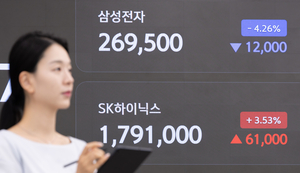
Samsung Electronics shares fell sharply on Monday after the company said it would allocate up to 110 trillion won ($79 billion) for shareholder returns, a plan that came in below market expectations.
As of 2 p.m., Samsung Electronics was trading at 257,000 won on the Korea Exchange, down 8.7 percent from the previous session. Its preferred shares fell 7.83 percent.
The decline in the chipmaker also dragged down other Samsung Group affiliates. Samsung C&T fell 7.84 percent, while Samsung Life Insurance, itself one of the largest shareholders of Samsung Electronics, dropped 11.34 percent.
Monday’s sell-off stood in stark contrast to the previous trading session. On Friday, Samsung Electronics rose 3.87 percent during regular trading, then turned lower in after-hours trading after the chip giant disclosed its shareholder return plan after market close.
Investor disappointment stemmed in part from the smaller-than-expected return. The market had initially expected Samsung Electronics to return as much as 150 trillion won to shareholders. The company’s annual operating profit was projected to reach 380 trillion won this year, while its full-year free cash flow was estimated at 263 trillion won. Investor sensitivity to such announcements has grown across the South Korean market since regulators introduced a corporate value-up program in 2024, an initiative intended to lift corporate value and address the market’s long-standing valuation discount, which has sharpened scrutiny of buybacks, dividends and cancellations among the country’s blue chips.
Sentiment was also pressured by the company’s failure to specify how and when the remaining funds would be returned, as well as the absence of a share cancellation plan.
However, buybacks are not straightforward for Samsung Electronics because of regulatory limits involving ownership by its financial affiliates.
If Samsung Electronics were to cancel shares, the resulting reduction in outstanding shares would automatically push the combined stake held by its insurance units above the 10 percent regulatory cap, forcing them to sell shares. The cap reflects Korean insurance rules that bar insurers from holding more than 10 percent of a single company’s shares.
Still, analysts said the plan leaves room for additional shareholder returns and underscores Samsung Electronics’ ability to generate cash.
"Samsung Electronics's plan could be somewhat disappointing for investors who had expected a large-scale share buyback," Lee Young-gon, research center leader at Toss Securities, said.
"But it should not be viewed entirely negatively it highlights that Samsung Electronics can return up to 110 trillion won in cash to shareholders while continuing to make large-scale investments, demonstrating the strength of its cash-generating capacity."
SK hynix shares had been rising after the chipmaker recently disclosed details of its own share buyback and cancellation plan. The two companies dominate the global memory chip market and rank among the heaviest-weighted stocks on the Korea Exchange, making their capital-return decisions a focal point for the broader Korean market.
On Aug. 19, SK hynix announced plans to spend about 40 trillion won to buy back 24.07 million of its own shares on the open market and cancel all of them.
Following that announcement, the shares surged 12.73 percent in the next trading session and gained another 2.31 percent the day after. On Monday, however, the stock gave back part of those gains, falling 1.73 percent to 1.7 million won as of 2 p.m.
"The latest shareholder return plans can be seen as a positive development for both Samsung Electronics and SK hynix. However, SK hynix is expected to see a greater short-term boost to its share price, as its plan places a stronger emphasis on share buybacks and cancellations," Lee said.
Meanwhile, Samsung Electronics plans to unveil details of additional shareholder returns in October and finalize its next shareholder return policy in January next year.

