Tanzanian Brothers Build SafeSip, an AI-Powered Water Utility Tackling Africa's Infrastructure Gap
Key Takeaways
- •SafeSip deploys solar-powered, AI-enabled water stations called "water banks" that operate around the clock without on-site supervision in underserved rural Tanzanian communities.
- •The startup charges 250 Tanzanian shillings (roughly ten US cents) for a 20-litre container when customers collect water directly, and 500 shillings for delivery service.
- •The founders deliberately rejected the traditional aid-funded development model, arguing that recurring revenue is essential to sustain water infrastructure maintenance over time.
- •SafeSip's AI system predicts maintenance needs by sending alerts when filters begin to clog, enabling technicians to address issues before breakdowns occur.
- •After an earlier failed agriculture venture, the team launched SafeSip with a $10,000 grant from Social Shifters in 2023 and subsequently pivoted from filtration straws to autonomous water bank kiosks.
"Africa doesn't have a water problem," says Constantine Edward. "It has an infrastructure problem."
It is a simple distinction, but one that explains why Constantine and his brother Herman, alongside Faith Kuya, walked away from aid-funded development work to build SafeSip, a Tanzanian startup that treats clean water as a service that must pay for its own survival. The company, which describes itself as an autonomous water utility, deploys solar-powered, AI-enabled water stations called "water banks" in underserved rural communities. The backdrop is stark: according to the WHO/UNICEF Joint Monitoring Programme, hundreds of millions of people in sub-Saharan Africa still lack access to safely managed drinking water, and the gap is widest in precisely the rural areas SafeSip targets.
The brothers' conviction took root in childhood, when they drank from contaminated rivers in rural Tanzania. It hardened during a university internship in Dodoma, where they witnessed children suffering from preventable waterborne diseases. SafeSip grew out of those experiences — not as a charity delivering free water, but as a business designed to sustain itself through revenue.
Before SafeSip, the team ran an agriculture-focused campaign that failed to scale and was eventually shut down. They regrouped, studied the water sector, and in 2023 applied for a grant focused on water filtration straws — their first product concept. They won a $10,000 grant from Social Shifters, which Constantine credits as the moment the project shifted from an idea to a serious business.
From Filtration Straws to "Water Banks"
The company's model evolved significantly from its original filtration concept. After nearly a month of internal debate, the team pivoted to what Constantine calls "kiosk 2.0" — a "water bank" that operates around the clock without on-site supervision.
Traditional water kiosks in rural Africa typically rely on government-built boreholes and manual pumps, which Constantine says break down within one to two years. This is a pattern widely documented across development literature: donor- or government-funded water points frequently fall into disrepair within a few years of installation, often because there is no budget or mechanism for ongoing maintenance. He also notes that government water systems generally do not include desalination, meaning the water is suitable only for washing, not for drinking or cooking.
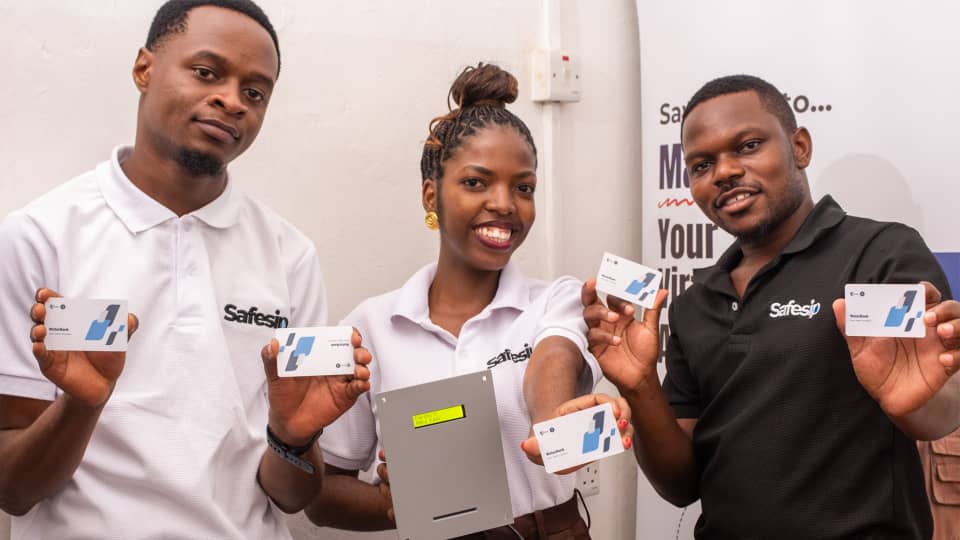
SafeSip's water banks address these shortcomings by incorporating AI. The system predicts maintenance issues — for example, sending an alert when filters begin to clog so a local technician can be dispatched before a breakdown occurs. The stations are solar-powered and equipped with smart meters and a software layer. Community members receive a card that they tap to draw water, generating data for the company while enabling service delivery.
Herman acknowledges that most investors prefer software-only businesses, but argues that the African market demands both hardware and software. "For a while, everyone was obsessed with mobile apps, but many of those aren't scaling anymore because the revenue model isn't there," he says. The observation tracks a broader shift in African startup ecosystems, where companies combining physical infrastructure with digital platforms — from off-grid solar providers to mobility ventures — have increasingly attracted capital by solving tangible service gaps that pure software has struggled to address.
Pricing and Community Trust
One of the founders' biggest internal debates centred on pricing. Some team members argued that a 20-litre jerrycan should sell for 1,000 Tanzanian shillings, positioning it as a premium product. Others pushed for 500 shillings to ensure affordability. After testing, SafeSip settled on 250 shillings for customers who collect water directly from a water bank, and 500 shillings for delivery. At current exchange rates, 250 Tanzanian shillings is roughly ten US cents, placing SafeSip's pricing within reach of low-income rural households while still generating revenue for maintenance.
Earning community trust required more than competitive pricing. Constantine recalls that when the first water bank was deployed, the team put up a poster with a QR code and the phrase "Get clean water, quick quick." People walked past without stopping. One man on a bicycle finally stopped and told them: "I pass here every day, but I thought this was a premium product for rich people." That feedback prompted SafeSip to rebrand its stations with clear signage, create a visible location for purchasing cards, and demonstrate how the service works. Since then, Constantine says, people approach ready to pay without hesitation.
Rejecting the Aid Model
Constantine argues that the reason clean water remains inaccessible across Africa is not a lack of effort by governments, NGOs, or development agencies, but a fundamental flaw in how projects are funded. "Most of these projects are delivered as aid," he says. "The money runs out, and there's no way to maintain the system. For us, we treat it as a business. We earn revenue, and that revenue pays for maintenance. Sustainability has to be built into the model from the start." His critique echoes a long-running debate in development circles about the limitations of grant-funded infrastructure that lacks a recurring revenue stream to cover upkeep.
The founders are explicit about their rejection of charity as a framework. "The simple story is that we want to solve Africa's water problem," Constantine says. "But the deeper truth is that Africa doesn't actually have a water problem; it has an infrastructure problem. That's why we are building a digital water infrastructure for underserved communities."
Personal Sacrifices
Both brothers describe significant personal costs. Constantine says his relationships have suffered — sometimes a month passes without him calling his family, who are always the ones reaching out. He also admits he has effectively lost his hobbies over the past two years, though he occasionally finds time to watch movies.
Herman's sacrifice was defying family expectations. After graduating from university, he was expected to pursue a Master's degree and take over a family campaign. He declined. "They were disappointed," he says. "But now, they are very proud." Outside of SafeSip, Herman is a musician who plays guitar and piano, though he rarely finds time for it. The two brothers live in the same house, and Herman notes that Constantine is invariably at his computer, even late at night.
Constantine also highlights the contributions of CEO Faye, who is still studying but consistently makes time for the company, postponing studies and personal commitments to attend meetings. He does note, however, that last-minute grant pitch deadlines sometimes catch her off guard.
Measuring Impact
When asked what success would look like if SafeSip became Africa's largest rural water utility, both founders point to ripple effects beyond clean water access.
Constantine describes how the presence of a water bank sparks local economic activity. People buy water at 250 shillings and resell it at 500. Others open car washes because the infrastructure now exists. Families save money previously spent on medical bills for waterborne diseases, and the time once spent walking long distances to fetch water becomes available for building businesses.
Herman emphasises social benefits: access to water reduces household tension — such as the strain when a spouse must walk miles before dawn to collect water — and helps children stay in school because they no longer need to wake at 4 a.m. to gather water before class.
On Entrepreneurship in Africa
Herman pushes back against the perception that entrepreneurship is only for those without education or career alternatives. "Many African families believe that if you have skills and an education, you're supposed to get a white-collar job — not start a business," he says.
Constantine addresses investor scepticism directly: "Investors think the businesses won't scale. They see the statistics about failure and get sceptical. The misconception is that we can't build scalable, continent-changing companies — but we can, and we are."
Looking ahead, both brothers say they hope to be remembered for the lives they changed rather than the startup they built. "I hope they remember that we changed lives," Constantine says. "That we gave millions access to safe, clean water. That's what I want on my epitaph."
Herman agrees: "It's about impact. We touched on a fundamental problem in the community. That matters far more than the business itself, though the business is how we make it sustainable."
Source: TechCabal
