The SaaSpocalypse That Wasn’t: Why Salesforce, Booking Holdings and IBM May Benefit From AI
Key Takeaways
- •Salesforce is presented as an AI beneficiary because it holds the customer data and records that AI agents need to operate effectively.
- •Agentforce has expanded quickly, reaching $1.5 billion in annual recurring revenue within 18 months and closing more than 30,000 deals.
- •Booking Holdings is described as a travel transaction platform, not just a search tool, and it remains the merchant of record on roughly three-quarters of bookings.
- •Booking said AI-sourced traffic was still well below 1% of room nights on its August earnings call, while direct traffic remained in the mid-60% range.
- •IBM said AI now represents half of its new consulting signings, and its AI business has more than doubled over the past year.
The apocryphal quip attributed to Mark Twain — “the rumors of my death are greatly exaggerated” — fits certain software companies that have been hit by premature fears of AI-driven obsolescence.
Over the past year, about $2 trillion in software value has been wiped out on concerns that AI will make many software businesses obsolete in the years ahead, a sell-off that has come to be known as the “SaaSpocalypse.” That thesis initially centered on outright “death,” or at least severe disruption, for software-as-a-service companies. More recently, the bearish case has shifted to a less extreme but still negative view: that software companies will have to spend more to acquire customers, lose pricing power, see margins compress and suffer weaker profitability.
As with the 1979 Francis Ford Coppola film Apocalypse Now, the current wave of panic may be built on a kind of fiction. There is no doubt that many fast-growing technology companies will face increasing competition from autonomous AI agents. But the market’s rush to punish software names has also lumped in several companies that may actually be among AI’s clearest beneficiaries. Salesforce, Booking Holdings and IBM are three examples of software businesses that appear positioned to gain greater profitability and pricing power from AI, not less.
Salesforce
The bearish AI case against Salesforce is simple, but misleading.
Salesforce, the leading customer relationship management system, was widely portrayed as vulnerable to obsolescence because LLM companies such as OpenAI and Anthropic could eventually deploy autonomous agents to manage customer relationships from start to finish. Under that view, Salesforce would be reduced from the central command center of a business to a passive database that AI agents occasionally query. The assumption was that the AI models would capture all the value, while Salesforce would become interchangeable, if not redundant. The stock, down roughly 20% this year and 40% from its high, has been priced as though that diagnosis were correct.
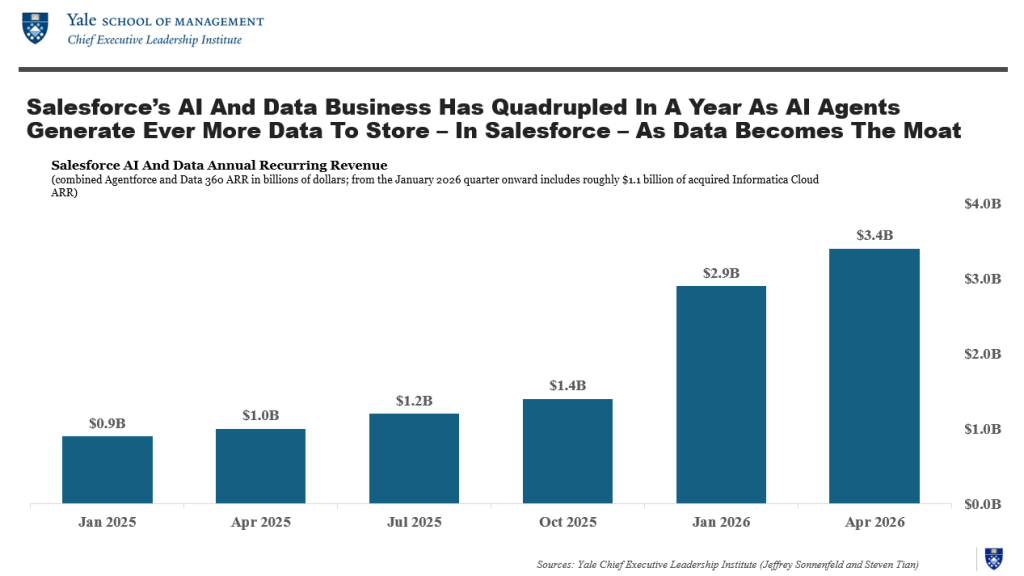
That reading, however, turns the dynamic backwards. Salesforce is not the company being commoditized; the LLMs are. In this environment, data is the new moat, and Salesforce has the data. Wells Fargo analysts put it bluntly: “lower cost of intelligence increases value of incumbent data.”
AI agents are only as effective as the data they use. An AI agent helping close a sale still needs a place to research a customer, record new interactions, store the contract and tailor terms. It also needs years of customer history to understand the context. That is where Salesforce sits: as the primary repository of customer data.
Salesforce has processed more than 216 trillion customer records this year alone, and the number is still rising. Customer contacts, deal histories, support tickets, marketing interactions and similar records already live inside Salesforce for virtually every major company. That data cannot simply be ripped out and moved into a large language model, and no company would want a model serving as the permanent store of proprietary customer information. Clean, unified and trusted data is exactly what AI agents need, and Salesforce has more of it than anyone, along with security and confidentiality protections that exceed those of LLMs.
The company’s results increasingly reflect that position. Agentforce, Salesforce’s AI agent platform, has grown from $100 million to $1.5 billion in annual recurring revenue in 18 months since launch, with more than 30,000 Agentforce deals already closed. Salesforce has also expanded partnerships with Anthropic’s Claude, which is positioned as the primary agent inside Agentforce. Those AI agents are generating more data at an exponential pace, and that data has to be stored somewhere. Salesforce said it ingested 104 trillion records last quarter alone, double the prior quarter.
Slack, once viewed as a less important acquisition, is also increasingly central to Salesforce’s AI strategy. Slack is where key decisions are debated, giving agents context and human insight that cannot be pulled from a database field alone. Slack is growing at a record pace, with its fastest quarterly Net New Annual Order Value growth since acquisition, while Slackbot users grew more than 150% quarter over quarter. When Salesforce opened Slack to outside AI agents, a million users connected within a month.
Founder and CEO Marc Benioff’s decision to spend $25 billion repurchasing stock in a single quarter earlier this year — the largest buyback in company history and roughly a fifth of the company’s market capitalization — is looking increasingly shrewd for what is now the largest repository of customer data on the planet.
The balance of power appears to be shifting toward Salesforce, with more pricing power rather than less. That is one reason frontier LLM companies such as Anthropic are moving quickly to partner with Salesforce, as seen in the launch of “Claudeforce,” Salesforce and Anthropic’s integration that allows Claude to run inside Salesforce. The arrangement is designed to increase usage on both platforms and push customers toward higher-end subscription plans.
Booking Holdings
The bearish AI argument against Booking Holdings is also simple — and also wrong.
Earlier this year, some analysts argued that if travelers could ask a chatbot for a hotel or flight, Booking.com might become unnecessary. Yet Booking Holdings has since rebounded to near all-time highs, as have other online travel agency rivals such as Expedia. The mistake was treating Booking Holdings like a search engine, when in reality it is a differentiated travel transaction platform with a strong competitive moat.
The critical distinction is between the top of the travel funnel, where trips are discovered, and the bottom, where money changes hands and the trip is actually booked and executed. Travelers are indeed turning to AI for recommendations, and that is a real threat to metasearch and referral businesses built around comparison. But it is not a threat to the company that is merchant of record on roughly three-quarters of its bookings — a share that is up four points over the past year and still rising — while handling more than 100 payment methods across 50 currencies and resolving disputes and last-minute cancellations that AI platforms have shown no willingness to manage.
Google’s leadership has said the company has “no intention of becoming an OTA (online travel agency)” and has no interest in acting as merchant of record. OpenAI reached a similar conclusion after a poorly received in-chat checkout rollout this spring.
Booking.com’s inventory is also different from what many people assume. Nearly 90% of its room nights come from independent properties and smaller hotels rather than major chains. Those smaller properties would not be able to handle global payment processing, multi-currency settlement and dispute resolution on their own, even if they could surface through AI search. That infrastructure gap is what Booking fills, and it helps explain why hotel partners remain loyal.
The strength of that moat can be seen elsewhere in travel as well. Airbnb’s stock is up 40% year to date, in part because its inventory of exclusive properties is viewed as a defense against LLM disruption.
Some bearish investors, having moved on from the exaggerated “death” narrative around SaaSpocalypse, now argue that Booking Holdings will face weaker pricing power, higher customer-acquisition costs, less direct loyalty and margin compression. That thesis is also wrong. As AI changes accelerate, Booking Holdings should gain relative power in the market and become even more singular and difficult to replace.
Booking Holdings is well positioned to use AI to take share from less tech-savvy competitors. Its moat as a travel infrastructure provider remains intact, and AI is more likely to send traffic toward Booking’s platform than away from it. For now, AI-driven traffic remains limited across online travel agencies. On its August earnings call, Booking said traffic sourced from large language models was still well below 1% of room nights, with no material change over recent quarters, while direct traffic remained in the mid-60% range and grew in absolute terms.
If AI eventually drives a larger share of discovery, Booking brings two decades of experience bidding for web browser search traffic. That gives it an advantage in bidding for AI-driven traffic and advertising as well, using the same playbook it has long used to turn search clicks into direct, repeat customers. Under CEO Glenn Fogel, widely seen as one of the best capital allocators of his era, Booking Holdings has developed a strategy that may make it the biggest AI beneficiary among its competitors.
IBM
IBM bears were similarly quick to celebrate last month when the stock fell 25% in a single day, the worst decline in company history, after several large clients shifted capital budgets toward memory during a severe memory crunch. About a third of those supposed lost deals were closed again within weeks, and IBM CEO Arvind Krishna was praised for his transparency.
A common bearish view is that AI will disrupt IBM’s $21 billion consulting business and its highly profitable legacy software business, which supports core systems at many banks, insurers and airlines. But critics overlook a crucial point: AI has actually become a tailwind for IBM’s consulting business.
AI now accounts for half of IBM’s new consulting signings and is one of the largest components of its backlog. Those deals carry much higher margins than traditional consulting because IBM can bill based on outcomes and productivity rather than hours worked. Red Hat, meanwhile, the software that allows a company’s AI agents to run across any cloud and any platform, grew 11%. In other words, AI is creating new demand for software that supports the transition, rather than replacing it.
IBM is being paid to build the AI transition, not run over by it. That is why IBM’s AI business has more than doubled over the past year.
Paranoia and panic are different
No one disputes that AI is disrupting legacy technology and software companies. But markets may be throwing out the baby with the bathwater by overlooking software firms that own things AI agents cannot operate without.
The key question is whether a company still owns something AI agents need — and where power in the market now resides. On that measure, power may be shifting back toward software firms that were recently viewed as AI’s biggest losers but are now emerging as some of its biggest winners.
Salesforce owns the data AI agents need. Booking Holdings owns the travel platform AI agents cannot complete bookings without. IBM owns the underlying infrastructure on which AI agents run. Each has a differentiated moat that may be worth more in an AI-driven world, not less.
These are only three examples. ServiceNow, under CEO Bill McDermott, and Snowflake also stand out as companies that could benefit from AI.
As former Intel CEO Andy Grove famously said, “only the paranoid survive.” But paranoia and panic are not the same thing. In the current wave of market anxiety, prudence has often turned into indiscriminate selling, and software bears may be missing the transformation unfolding in front of them as software firms become some of AI’s biggest beneficiaries.
The opinions expressed in Fortune.com commentary pieces are solely the views of their authors and do not necessarily reflect the opinions and beliefs of Fortune.
This story was originally featured on Fortune.com

