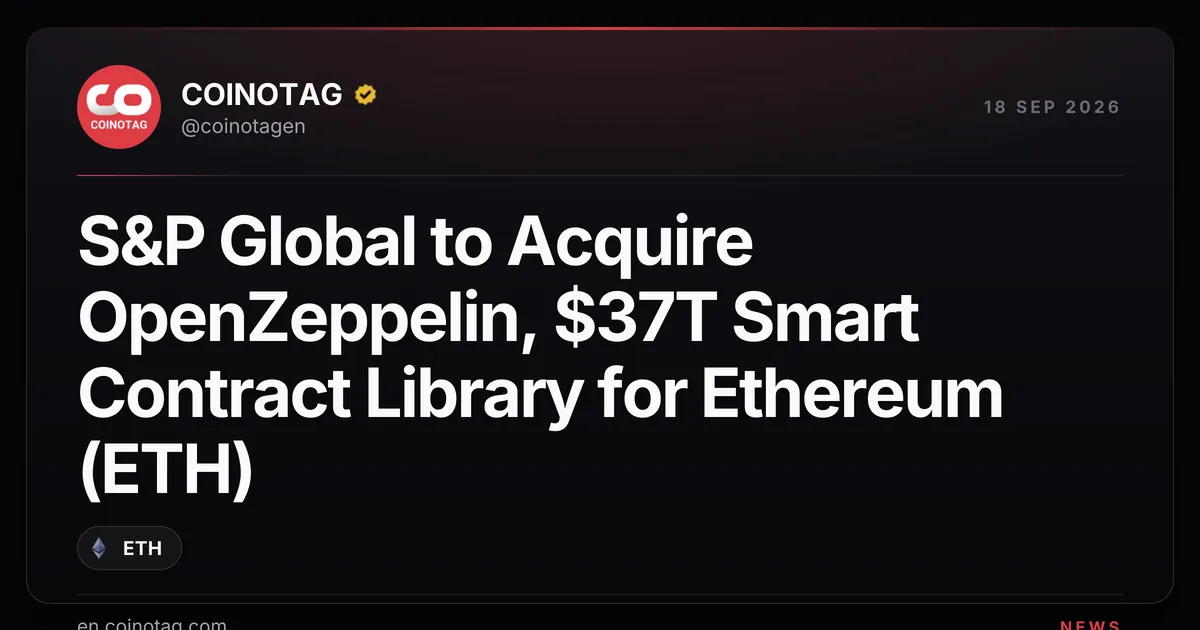
S&P Global to Acquire OpenZeppelin, the Security Firm Behind Ethereum's Core Smart Contract Library
Key Takeaways
- •S&P Global plans to offer digital-asset and smart-contract security evaluations through its proposed OpenZeppelin acquisition.
- •OpenZeppelin’s technology has supported more than $37 trillion in transfers and is used by major stablecoins and tokenized funds.
- •OpenZeppelin will remain an independent S&P Global business with Demián Brener as CEO, subject to closing conditions.
- •Simplex’s JPYC EX API integrates stablecoin issuance and redemption into partner services without changing JPYC’s screening and approval controls.
- •JPYC operates across networks including Polygon and Kaia, leaving users to navigate chain differences during the current transition.
S&P Global Extends Its Risk Franchise Onchain
S&P Global (NYSE: SPGI) has agreed to acquire OpenZeppelin, the blockchain security firm whose open-source smart contract library underpins much of Ethereum (ETH) development, according to the company's official announcement issued on September 17, 2026. The transaction extends the ratings group's core franchise — risk assessment — into smart contract territory, with S&P planning to offer security evaluations and benchmarks spanning digital assets and onchain infrastructure. The target's strategic weight lies in its ubiquity: OpenZeppelin's library supplies reusable, audited components — token standards, access controls, upgradeability patterns — that developers embed rather than rewrite, so it functions as shared infrastructure across a large share of deployed Ethereum applications.
The numbers behind the target explain the urgency. OpenZeppelin, founded in 2015, maintains a contract library that has supported more than $37 trillion in value transfers and is deployed by most major stablecoins and tokenized funds; the firm has completed more than 900 security engagements to date.
Yan Leparec, president of S&P Global Ratings, framed the digital asset strategy around delivering reliable data, benchmarks and transparent risk assessment as markets migrate onchain, adding that OpenZeppelin's technology and expertise complement the firm's capabilities in smart contract and onchain risk evaluation. The combined offering, he indicated, is intended to serve both traditional financial institutions and DeFi-native companies — two audiences that increasingly need a shared standard of trust.
Structure and governance are settled in outline: OpenZeppelin will keep its brand and operate as an independent business unit after closing, with co-founder and CEO Demián Brener continuing to lead the firm and reporting directly to Leparec. The purchase price has not been disclosed, and completion remains subject to closing conditions.
Notably, the agreement lands three days after S&P Global Ventures disclosed a strategic investment in Kaiko's Series B extension round on September 14, extending an existing partnership across market data, indexes and onchain infrastructure. Together, the two moves give S&P positions in both the data layer and the security layer of onchain markets.
Simplex Builds the Issuance Rails for JPYC
While the world's largest ratings provider buys security tooling, Japan's incumbent infrastructure builders are wiring the issuance rails for a fiat-backed stablecoin. Simplex, the Tokyo-based technology partner behind mission-critical systems for Japanese megabanks and major brokerages — including Nomura Securities' asset-management application andui Securities' FX trading platform — built JPYC EX, the platform handling issuance and redemption for JPYC, the yen-denominated stablecoin. That placement matters: issuance and redemption are the ramps between bank money and its tokenized form, and for a fiat-backed stablecoin it is this plumbing where adoption friction tends to concentrate.
In an interview published on September 18 by NFT Media, executive principal Kazuo Miura detailed the company's latest step: a partnership API for JPYC EX, announced in July 2026, that closes a persistent user-experience gap. Until now, a holder wanting to mint or redeem JPYC inside a wallet service had to leave that service, log into JPYC EX separately, complete the transaction and return — a break in the flow that, in Miura's telling, loses users precisely at the adoption moment. The new API smooths screen transitions so that issuance and redemption run inside the partner's interface, with users returning naturally afterward. JPYC itself retains screening, additional authentication and final acceptance of applications, so the compliance perimeter does not shift.
Miura also addressed the multi-chain reality: JPYC is now issued across several networks, including Polygon — a sidechain-style environment — and Kaia. He described the present period as transitional, because users must still track which chain a given service requires. That fragmentation, he argued, is a barrier to remove rather than a permanent feature; as mass adoption matures, chain selection should disappear behind the interface. Whether chain selection actually recedes behind the interface will be one measure of how short that transitional period proves to be.
He was equally direct on the industry's favored narrative: AI agents paired with stablecoins are promising, but bank accounts and card rails still carry most payments, so stablecoins should be treated as one settlement option among several rather than the only answer.
One Stack, Two Fronts
Read together, the two stories trace a single arc: traditional finance is assembling the onchain stack itself rather than waiting for crypto to build it. S&P Global is acquiring the security and risk layer outright — its press release states plainly that OpenZeppelin's library has secured more than $37 trillion in value transfers across 900-plus engagements — while Simplex is building the issuance and experience layer for a fiat-currency stablecoin at the retail edge. The remaining bottleneck, as Miura's account makes clear, is continuity of experience rather than raw technology: the institutional stack now spans everything from testnet deployment to audited production contracts and newer primitives like zero-knowledge proofs, yet a broken handoff mid-payment still costs the user. The near-term checkpoints are concrete rather than rhetorical: the OpenZeppelin transaction clearing its closing conditions, and the first JPYC EX partner services running mint-and-redeem inside their own interfaces.
COINOTAG's editorial takeaway: more incumbents are likely to buy their way onchain, and stablecoin user experience — not chain throughput — may prove decisive in the next phase.

