More Holders, Little Trading: The RWA Liquidity Problem Runs Deeper Than It Looks
Key Takeaways
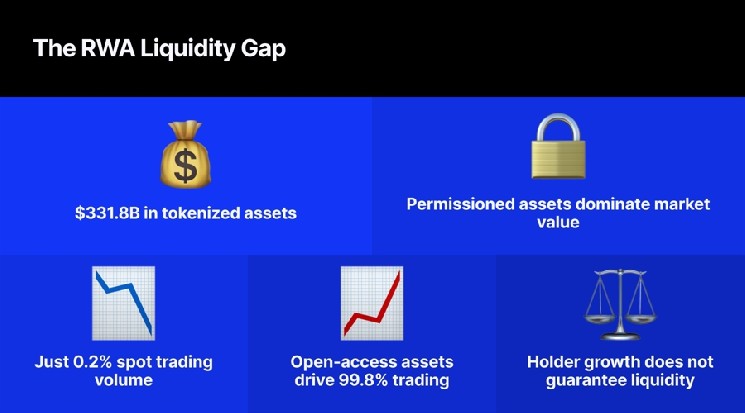
- •Permissioned tokenized products account for 59% of the RWA sector's $331.8 billion market capitalization yet generate only 0.2% of spot trading volume, as whitelisting restricts transfers to a small pool of approved counterparties.
- •BlackRock's BUIDL fund holds $2.77 billion across 10 chains but recorded just 191 transfers in one month, while Franklin Templeton's BENJI fund reported $0 in monthly transfer volume despite 562 holders.
- •The IMF characterized tokenized markets as small, fragmented, illiquid, and roughly 1.5 times more volatile than traditional counterparts, with activity concentrated in repurchase agreements averaging $300-350 billion in daily volume.
- •Holder adoption is expanding quickly—BNB Chain crossed 2 million RWA holders and tokenized stock holders reached 4.3 million—but only 29 of 110 major tokenized products meet basic thresholds for both liquidity and distribution.
- •Tokenized gold proved an exception, with PAXG and XAUT generating $90.7 billion in Q1 2026 spot volume and surpassing their full-year 2025 total of $84.64 billion.
Tokenized real-world assets (RWAs) have attracted millions of holders, yet the bulk of the sector's value rarely changes hands. Data from Pantera Capital's September 2026 report and the International Monetary Fund's October 2026 Global Financial Stability Report point to a widening split between adoption metrics and actual trading depth: permissioned products dominate market capitalization while contributing almost nothing to spot volume, and even flagship institutional funds record only a handful of on-chain transfers per month. The distinction matters because tokenization's institutional pitch depends on these tokens working as tradeable financial instruments, not just digital records of ownership. Taken together, the numbers suggest the RWA sector's liquidity problem is more severe than its headline growth indicates.
The Scale of the Liquidity Gap
Start with the size of the gap. Pantera Capital's September 2026 report surveyed 671 tokenized assets worth a combined $331.8 billion, and its findings divide the sector into two distinct worlds. Permissioned products — the kind that require whitelisting and approval to hold — make up 59% of total market capitalization. They contribute exactly 0.2% of spot trading volume.
The reason is structural: whitelisting restricts transfers to pre-approved wallets, so the pool of eligible counterparties is small by design. In other words, more than half of the sector's value barely moves. Open-access products account for the remaining 41% of market cap and generate 99.8% of all spot trading. One world trades; the other sits still.
BlackRock's BUIDL fund — a tokenized money market product — offers the clearest illustration. The fund holds $2.77 billion across 10 chains, yet it has 106 investors and recorded just 191 transfers in a single month — roughly six transfers per day for a multi-billion-dollar product. Franklin Templeton's BENJI fund, another tokenized money market product, reported 562 holders and $0 in monthly transfer volume.
Turnover — how much of an asset's outstanding supply changes hands in a given period — is where the contrast becomes starkest. Stablecoins turn over roughly 21 times their float every month; BUIDL turns over 0.12 times. That is a 180-fold difference in how much these assets actually move.
IMF: Small, Fragmented and More Volatile
The IMF addressed tokenized markets in its October 2026 Global Financial Stability Report, and its staff described them as small, fragmented, relatively illiquid and roughly 1.5 times more volatile than their traditional counterparts.
Most tokenized activity takes place in repurchase agreements — short-term collateralized loans, typically against government securities — which average $300 billion to $350 billion in daily volume. Everything else — including credit, money market funds and tokenized equities — adds just $65 billion. For perspective, the US repo market alone trades about $13 trillion per day. The entire tokenized universe outside repos represents a rounding error against traditional finance.
Holder Growth Does Not Equal Liquidity
The counterargument has real data behind it. BNB Chain's RWA holder count crossed 2 million in early October 2026, reaching 2,032,387 addresses — up 15.56% in just 30 days. Tokenized stock holders across all chains hit 4.3 million by late September, a 43-fold increase in a single year. BNB Chain alone accounts for 39% of all on-chain RWA holders.
These growth rates look spectacular. They also demand context, because holder counts and trading depth are entirely different things. Only 29 of 110 major tokenized products — those with market caps above $10 million — meet even basic thresholds for both liquidity and distribution. That is roughly 26%. More than 50% of the analyzed market shows no meaningful secondary trading activity.
Why Some Tokenized Assets Trade Better
Tokenized gold stands as the exception that proves the rule. PAXG and XAUT together generated $90.7 billion in Q1 2026 spot volume, surpassing the full-year 2025 total of $84.64 billion. Average monthly spot volumes reached $5.72 billion for PAXG and $5.32 billion for XAUT.
Gold works because it has natural turnover, broad appeal and deep market-maker interest. Tokenized treasuries do not work the same way, because they function as buy-and-hold instruments. The Pantera data shows tokenized stocks achieving 204.6% monthly turnover while rate products languish at 0.1%. The asset class determines the liquidity profile, not the blockchain.
Turnover rates for tokenized stocks hit 204.6% in June, making them the most actively traded RWA category. The market is not uniformly illiquid — the problem is concentrated in the market-cap-dominant products. Tokenized treasuries grew from $13 billion to $16.5 billion between Q1 and Q2 2026, yet they generate almost no secondary trading. Private credit expanded from $4.1 billion to $5.1 billion over the same period, with similarly low turnover. The biggest, most institutional products are precisely the ones that do not trade.
| Metric / Feature | Tokenized Stocks | Tokenized Rate Products |
|---|---|---|
| Monthly Turnover | 204.6% | 0.1% |
| Investor Behaviour | Active trading, speculation, hedging and high velocity. | Buy-and-hold, capital preservation and yield-earning. |
| Liquidity Profile | High velocity; ownership changes hands multiple times a month. | Low velocity; capital sits quietly until maturity or remains in a long-term allocation. |
Issuance Is Easy, but Liquidity Is Not
Issuance has become easy. Wrapping a treasury bill or a stock into a token requires technical work, not a market miracle. Creating a liquid secondary market demands market makers, regulatory clarity, interoperable venues and genuine demand from traders who want to buy and sell continuously. Those pieces do not yet exist for most RWAs.
The Tokenization Preparedness Index, which Pantera introduced to measure how natively an asset operates on-chain, scored just 2.04 across the sample. Most assets are simple wrappers, not native instruments.
Actual trading concentrates elsewhere. Tokenized stock perpetual futures on platforms like Hyperliquid generated $67.8 billion in June volume — 16 times the spot market for the underlying tokens. Traders prefer derivatives because they offer leverage, easier shorting and liquidity from concentrated market-making, while the spot tokens themselves remain thin.
This pattern mirrors how crypto markets developed for native assets, and it suggests the RWA spot market will eventually catch up. It also confirms that the spot market is not where the action is right now.
Adoption Is Real, but Depth Remains Limited
The underlying use case is real. Tokenization solves genuine problems around settlement speed, fractional ownership and 24/7 access. The IMF found that more than 50% of tokenized equity trading occurs outside traditional market hours, and that roughly 80% of the analyzed trades were for fewer than one share — suggesting retail investors are using these products to access opportunities they could not otherwise reach.
That is meaningful adoption. But meaningful adoption of a product does not equal deep, reliable liquidity. A user who buys a fractional share and holds it contributes to the holder count without adding to market depth.
Skepticism is also surfacing among practitioners. At a panel during Token2049 in Singapore, industry figures weighed in on the tokenized stock thesis, and Anndy Lian shared his takeaway on X on October 14, 2026:
I like @chameleon_jeff's reply about tokenized stocks: "Overrated." He is speaking my language. This panel was at Token2049 in Singapore. Panelists include @StaniKulechov, @gdog97_, and @hosseeb. Sharing my article soon. — Anndy Lian (@anndylian) October 14, 2026
What a More Sustainable Sector Would Look Like
The article's author expects a more sustainable version of the sector to emerge within two to three years. In that scenario, open-access tokens dominate trading rather than permissioned ones, and RWAs find routine use as collateral in DeFi lending — a trend already visible on platforms like Morpho, where private credit leads utilization. Market makers build hybrid venues that connect centralized exchange order books with on-chain pools. Clearer regulation in major jurisdictions reduces the friction that currently keeps assets locked behind whitelists, and the Tokenization Preparedness Index rises as products become more native and less wrapper-like.
The Next Run Needs Better Market Structure
The current phase is a beginning, and beginnings are messy. As Jeff Yan from Hyperliquid put it: "Overrated."
In the author's view, the start needs to be better — not because the technology fails, but because the market structure around it has not caught up. When it does, the next run will rest on trading depth rather than holder inflation. That run, the conclusion goes, will last longer and matter more.
Source: Finance Magnates

