Russia Prepares for Regulated Crypto Trading, With Volumes Projected Near $89 Billion
Key Takeaways
- •Regulated crypto trading launches in Russia on September 1, enabling investors to legally purchase digital assets through licensed brokers for the first time.
- •Sberbank Deputy Chairman Anatoly Popov projects regulated crypto trading volumes of roughly $46.3 billion in the first year, potentially growing to $87.06 billion by 2029.
- •Non-qualified investors will be capped at $3,800 in annual crypto purchases through a single licensed intermediary, and only Bitcoin, Ethereum, and USDT are currently approved for trading.
- •Sberbank plans to offer loans collateralized by BTC, ETH, and USDT, while crypto payments within Russia remain prohibited except for certain foreign trade transactions by exporters and importers.
- •USDT poses additional sanctions risk for Sberbank, which has been under full U.S. blocking sanctions since April 2022, as Tether can freeze tokens linked to sanctioned entities.
Key Insights
The Bank of Russia believes regulated crypto trading volume could reach as high as $46 billion in the first year.
Sberbank is considering crypto-backed lending that would allow clients to use Bitcoin, Ethereum, and USDT as collateral.
USDT, however, presents additional sanctions risks for Russian institutions.
Russia's demand for cryptocurrency is accelerating again. According to crypto news reports, the Bank of Russia is set to give investors the green light to purchase digital assets starting September 1 through regulated brokers. The country's regulated crypto trading volume is expected to reach $46.4 billion in the first year, and Sberbank, one of the country's largest banks, is weighing loans against crypto collateral denominated in BTC, ETH, and USDT. The move marks a significant shift for the Bank of Russia, which had long favored restricting retail crypto activity, and brings Russian retail access to digital assets into a licensed framework for the first time.
Russian Crypto Trading Takes Center Stage
One of the most widely discussed stories in recent crypto news is the launch of regulated crypto trading in Russia on September 1, when investors will be able to legally purchase digital assets through regulated brokers.
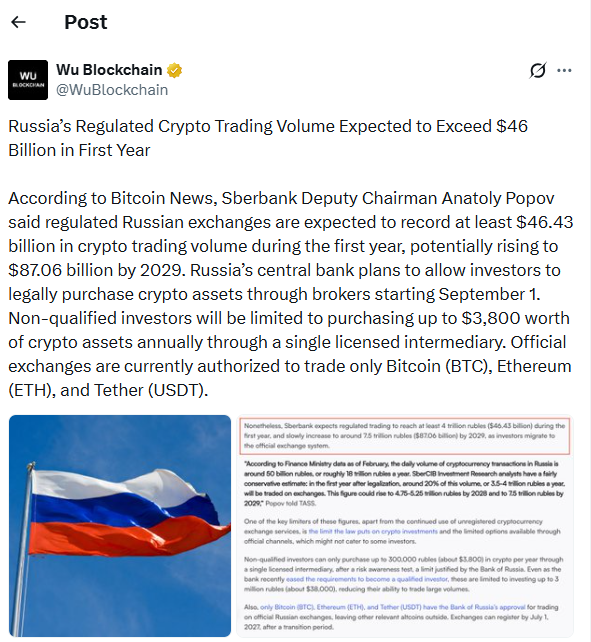
Sberbank Deputy Chairman Anatoly Popov expects regulated Russian crypto exchanges to see strong activity in their first year, projecting trading volumes of $46.3 billion. According to Popov, that figure could rise to $87.06 billion by 2029.
Non-qualified investors would be limited to purchasing up to $3,800 worth of crypto annually through a single licensed intermediary. Regulated exchanges are currently authorized to offer only Bitcoin (BTC), Ethereum (ETH), and Tether (USDT). Such caps mirror the approach Russia has previously applied to other high-risk retail instruments, where non-qualified investors face stricter exposure limits than professional market participants.
"According to Finance Ministry data as of February, the daily volume of cryptocurrency transactions in Russia is around 50 billion rubles, or roughly 18 trillion rubles a year. SberCIB Investment Research analysts have a fairly conservative estimate: in the first year after legalization, around 20% of this volume, or 3.5-4 trillion rubles a year, will be traded on exchanges. This figure could rise to 4.75-5.25 trillion rubles by 2028 and to 7.5 trillion rubles by 2029," Popov told TASS.
Sberbank to Offer Crypto Loans Against BTC, ETH, USDT Collateral
Russia's largest lender wants to allow cryptocurrencies to be used as collateral rather than as money. Once the new law takes effect on September 1, Russian companies will be able to pledge Bitcoin to banks, though they will not be able to use it for everyday purchases. The collateral-based approach is notable because crypto-backed lending is an established practice at major global banks and platforms elsewhere, and Sberbank's plan would adapt that model to Russian regulatory conditions.
Sberbank has already prepared for the regulatory changes and handles digital assets, but its planned expansion remains subject to regulatory conditions.
"We plan to accept not only Bitcoin but also Ethereum and the stablecoin Tether as collateral… after the Central Bank, of course, allows them for public circulation," Popov said.
President Vladimir Putin signed the law on August 4. A week later, the Bank of Russia published its first approved list of eligible cryptocurrencies, which included only Bitcoin, Ether, and USDT. Regulators considered factors including market size, daily trading volumes, and at least five years of price history on foreign exchanges.
Crypto payments will remain prohibited within Russia, though exporters and importers will receive an exception permitting crypto payments for certain foreign trade transactions.
Sberbank Mindful of US Sanctions Risk
Sberbank is aware that USDT carries an additional sanctions risk that Bitcoin and Ethereum do not. The bank has been under full U.S. blocking sanctions since April 2022 and an EU asset freeze since July 2022.
Tether has previously stated that it can freeze USDT linked to sanctioned entities, which could complicate matters for sanctioned Russian financial institutions handling the stablecoin.
The Bank of Russia also warned in June that stablecoin issuers can unilaterally freeze or seize tokens from legitimate holders under sanctions-related restrictions. How regulators and Sberbank reconcile the approved listing of USDT with these issuer-freeze risks remains a key point to watch as the September 1 launch approaches, alongside how much of the existing off-exchange volume actually migrates onto licensed platforms.
Source: The Market Periodical

