Putin Signs Russia's First Comprehensive Crypto Exchange Law
Key Takeaways
- •The law is described as Russia’s first comprehensive framework for cryptocurrency exchanges and digital assets.
- •The legislation was published on Russia’s official legal information portal after passage by the State Duma and presidential signature.
- •Key details remain unverified, including the law’s effective date, enforcement mechanisms, and licensing requirements.
- •The framework builds on Russia’s earlier 2024 steps legalizing crypto mining and experimental cross-border digital asset use.
- •The new statute brings cryptocurrency exchanges under formal regulation, which may affect platform operations and user onboarding procedures.
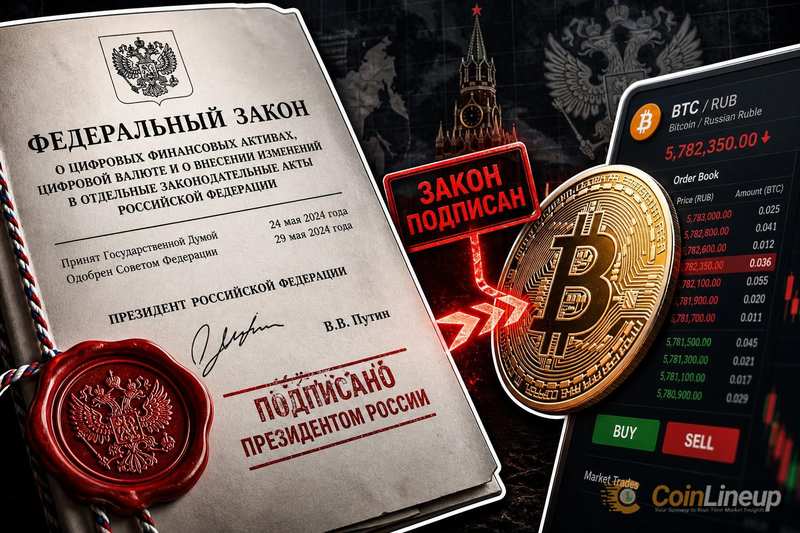
Russian President Vladimir Putin has signed into law what is being described as Russia's first comprehensive statute regulating cryptocurrency exchanges, establishing a formal legal framework for the digital asset sector.
The legislation was published on Russia's official legal information portal as document 0001202608040007, the standard channel for enacted federal legislation. The measure completes a legislative process that began when the State Duma, Russia's lower house of parliament, passed the crypto bill ahead of the presidential signature.
Secondary confirmation has come from state and international news outlets. Xinhua reported that Russia has moved to establish a legal framework for digital assets. Anadolu Agency similarly characterized the measure as a first comprehensive framework for cryptocurrencies and digital assets.
Scope and Significance
In this context, a "comprehensive law" refers to a single statute designed to cover the crypto sector broadly, rather than a narrow rule targeting one specific activity. Cryptocurrency exchanges — platforms where users buy, sell, and trade digital assets such as Bitcoin for other tokens or for traditional currency — will now operate under a defined legal regime rather than in a regulatory gray area.
At a high level, such a statute can shape how exchanges operate, what compliance obligations they must meet, and how users access services. For everyday holders or first-time buyers, the practical consideration is how domestic platforms adjust their onboarding and compliance procedures once the law takes effect.
The move builds on earlier incremental steps Russia has taken. In 2024, the State Duma passed legislation legalizing cryptocurrency mining and authorizing experimental use of digital assets for cross-border payments, signalling a gradual shift from the historically cautious posture of the Bank of Russia, which had long opposed broad domestic crypto circulation. This new law extends that trajectory by bringing the exchange layer — the primary point of user access — under formal regulation. Globally, Russia's framework arrives alongside a wave of comprehensive crypto legislation in major economies, including the EU's Markets in Crypto-Assets (MiCA) regulation, which began phasing into effect in 2024.
Details Still Pending
Several material details about the law remain to be verified from the full text of the legislation. Key open questions include:
- The law's effective date
- How enforcement mechanisms will function
- Exactly which activities fall under the framework
- Whether foreign and domestic exchanges are treated differently
- Specific provisions such as licensing requirements, tax treatment, and enforcement mechanics
Russia's crypto policy has repeatedly intersected with international sanctions pressure. How the new framework interacts with that broader environment is not yet clear from the signed text.
Further confirmation is expected to come from the official publication on the legal portal, Kremlin materials on the presidential acts record, and credible follow-up reporting from major news organizations. The signing itself should be treated as an established fact, while the specific regulatory details remain pending verification.

