Bank of Russia Proposes Regulated Exchange Trading for Bitcoin, Ether, and USDT
Key Takeaways
- •The Bank of Russia has proposed permitting trading of Bitcoin, Ether, and USDT exclusively through regulated exchanges rather than legalizing all cryptocurrencies.
- •This proposal reverses the central bank's January 2022 stance, which called for a complete ban on cryptocurrency mining and trading within Russia.
- •The inclusion of USDT signals an emphasis on practical settlement utility, connecting to Russia's 2024 authorization of experimental digital assets for cross-border payments.
- •The plan builds on recent legislative efforts, including a law enabling regulated crypto trading for retail investors and the 2024 legalization of cryptocurrency mining.
- •The proposal has not yet been enacted into law, leaving key details such as qualifying venues and access conditions to be determined.
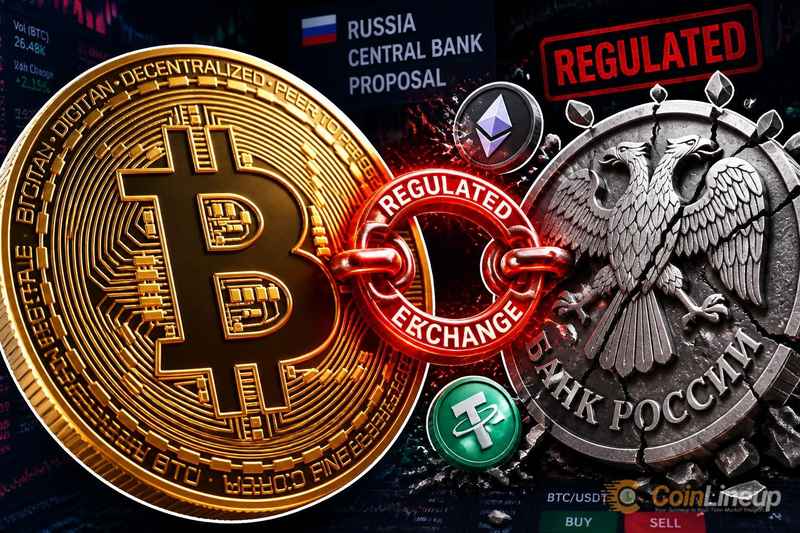
The Bank of Russia has proposed permitting Bitcoin, Ether, and USDT to be traded on regulated exchanges, creating a controlled framework that would allow supervised venues to offer these three specific digital assets rather than opening the market to all cryptocurrencies simultaneously.
The proposal represents a notable evolution for the central bank, which in January 2022 had called for a blanket ban on cryptocurrency mining and trading within Russia. That earlier stance placed the Bank of Russia at odds with the Ministry of Finance, which advocated for regulated access rather than prohibition. The current proposal aligns the central bank with the incremental approach the finance ministry has championed.
According to a Bank of Russia announcement, the proposal centers on routing trades through regulated exchanges, reflecting a controlled market-access model built around named assets and supervised platforms. This approach stops short of blanket legalization of cryptocurrency trading.
As reported by The Moscow Times, the plan singles out Bitcoin, Ether, and USDT rather than the wider token market. The named-asset approach represents a deliberately narrower starting point than open-ended access to any listed token.
Why Bitcoin, Ether, and USDT
Bitcoin and Ether rank as the two largest benchmark crypto assets in global trading, making them natural anchors for a regulated rollout centered on recognizable, highly liquid markets.
USDT's inclusion is particularly significant. As the dominant stablecoin, it underpins trading liquidity and everyday settlement functions. Permitting its use signals that the framework targets practical market utility rather than speculative exposure alone. USDT's role also connects to Russia's 2024 authorization of experimental digital asset use for cross-border settlements, an area where stablecoins have functioned as intermediaries for international payments.
The decision to designate three specific assets rather than a broader category reflects a cautious methodology, enabling regulators to begin with instruments they can closely monitor before considering any expansion of the eligible list.
Implications for Russia's Crypto Market
Directing trades through regulated exchanges would shift activity toward supervised platforms and away from informal channels, providing intermediaries and market participants with clearer access rules.
The proposal follows Russia's broader legislative effort to formalize cryptocurrency access, after a law opening regulated crypto trading to retail investors established the framework for supervised market participation. Russia also legalized cryptocurrency mining in 2024, part of a step-by-step regulatory build-out that has moved the country from one of the more restrictive policy positions among major economies toward structured market integration.
At this stage, the plan remains a proposal rather than enacted law or an active trading launch. Market participants and exchanges will be monitoring which venues qualify, what access conditions apply, and how the central bank intends to balance cryptocurrency demand against its financial oversight mandate. The implementation specifics will be as consequential as the policy announcement itself.

