Democrats Set Sights on Trump Budget Chief Russell Vought Over Power-of-the-Purse Fight
Key Takeaways
- •OMB Director Russell Vought, the architect of Project 2025, may see his position threatened as Democrats plan to challenge his handling of congressionally appropriated funds.
- •Democrats could restore Congress's Article I power of the purse by writing more precise appropriations bills that limit presidential discretion, such as mandating Stafford Act disaster funding eligibility for any storm-affected state.
- •Impoundment of appropriated funds has been sharply restricted since the 1974 Congressional Budget and Impoundment Control Act, which Congress passed after President Nixon refused to spend approved money.
- •Economist Robert J. Shapiro attributes a majority of the $40 trillion debt to Trump's tax changes and increased defense spending, calling postwar deficits of six to seven percent of GDP unprecedented.
- •Debt financing absorbs savings and raises mortgage and credit card costs, pressures Shapiro says contributed to voters turning against Republicans in Tuesday's midterm elections.
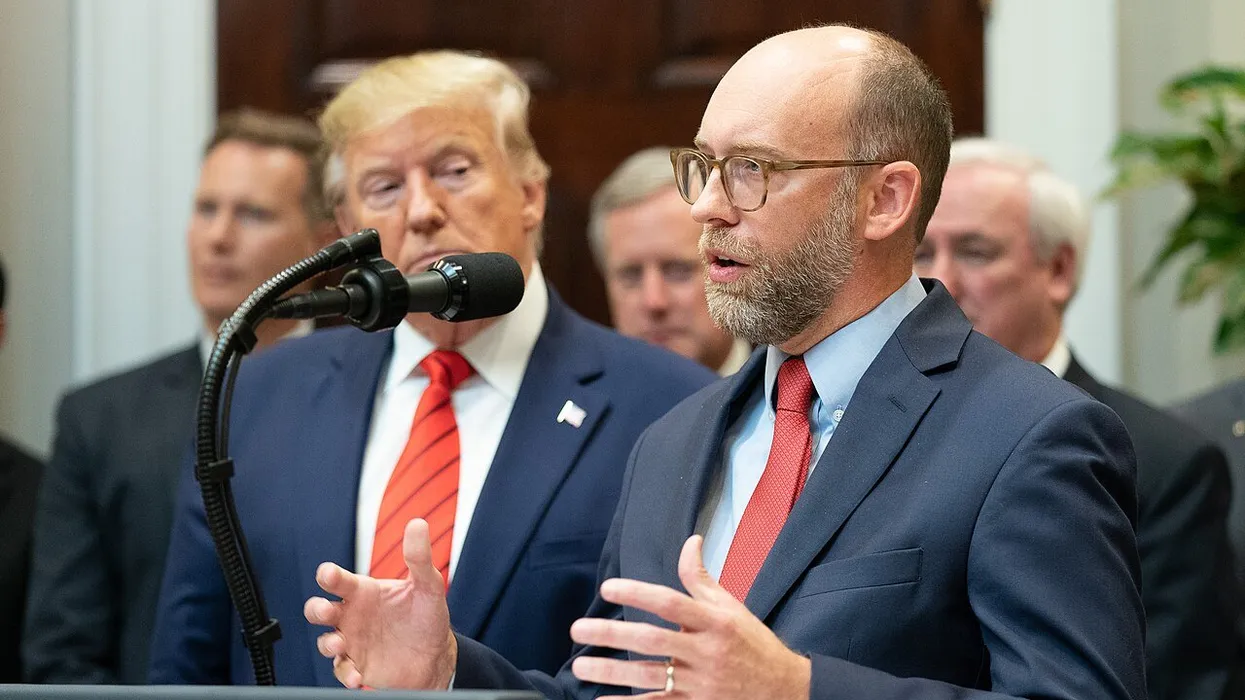
Russell Vought, President Donald Trump's Director of the Office of Management and Budget and the architect of his Project 2025 agenda, has ranked among the most powerful figures in Washington since the Republican began his second term. The OMB drafts the president's budget proposal and oversees how executive agencies spend the money Congress appropriates, which puts its director at the center of any fight over federal spending. Yet according to a new report, Vought may soon find his job in danger.
"Congressional Democrats obviously have lots of things on their to-do list for next year, starting with cost-of-living issues and cracking down on corruption," wrote The Bulwark's Catherine Rampell on Thursday. "But there's another key priority that has gotten less attention but is no less important: restoring the constitutional separation of powers so that Congress actually controls the power of the purse again." The power of the purse is Congress's constitutional authority, rooted in Article I, over how federal money is raised and spent — the authority Rampell argues needs restoring to Congress.
She added, "Or to put it in more colorful terms: Congress is about to reclaim its cojones, and then go after the low-profile cabinet member who sliced them off in the first place."
After breaking down the details of how Vought has stymied Congress and allegedly behaved illegally, Rampell added, "Once back in the majority, Democratic lawmakers have some tools at their disposal to reclaim the power of the purse. Or at the very least, make it harder for Trump and Vought to keep violating the Constitution."
She continued, "A lot of the tools involve more careful writing of appropriations bills, and taking away any plausible claim Trump has for exercising discretion in spending decisions. For example, lawmakers could be more specific in how they lay out the criteria for awards, so Trump has no effective way to favor friends and disfavor perceived enemies (e.g., by specifying that any state that has had landfall of a storm blowing with hurricane-force winds must be treated as eligible for Stafford Act funding, thereby preventing Trump from withholding those funds from blue states). Congress could also make it easier for private parties to bring a lawsuit when funding gets illegally frozen." The Stafford Act she cites is the federal law that authorizes disaster relief funding.
Rampell added, "That'll help prevent future illegal impoundments. But what about damage already done? Democrats could start by subpoenaing documentation of all the ways Vought has helped the administration break the law." Impoundment — the withholding of money Congress has already appropriated — has been sharply restricted since the Congressional Budget and Impoundment Control Act of 1974, which Congress enacted after President Richard Nixon refused to spend approved funds; under that law, presidents cannot permanently cancel spending without Congress's assent.
The fiscal record of the administration has drawn separate scrutiny. In August, economist Dr. Robert J. Shapiro — who advised President Bill Clinton during his balanced budgets and four surpluses — told AlterNet that the current $40 trillion deficit is largely Trump's fault.
"Deficits equal to six or seven percent of GDP, which is unprecedented in the postwar era," Shapiro told AlterNet at the time. "It's a real outlier. And that's driven entirely by his tax changes, which carry enormous budgetary costs, plus a wholesale, large-scale increase in defense spending. So how much of this is Trump? A majority of it — not all of it, but a majority."
On Thursday, Shapiro told AlterNet that the deficits have also compounded the economic problems facing ordinary Americans — the same pressures that played a large role in turning voters against Republicans during the midterm elections on Tuesday.
"The debt does have effects that have exacerbated the economic squeeze on people," Shapiro told AlterNet. "Most clearly, financing the debt absorbs so much available savings that other forms of credit, like mortgages and credit card debt, become more expensive. It's supply and demand. There's less savings left over, because when you have a $40 trillion debt, it's not simply that you have to finance an additional $2 trillion each year, because that's the annual deficit now: $2 trillion. In addition, $10 trillion each year comes up for refinancing. That is, the Treasury securities mature, and so you have to float new Treasury securities to refinance the debt that has now matured. You buy a 10-year bond, or you buy a five-year note. Five years later, it matures. You've got to pay it off, and in order to pay it off, you've got to borrow the money."
None of the countermeasures Rampell outlines is automatic: drafting appropriations bills and issuing subpoenas are majority powers, so how much of her program becomes reality depends on what Democrats actually control when the new Congress convenes in January.

