Rocket Lab agrees to acquire Iridium in $8 billion cash-and-stock deal
Key Takeaways
- •Rocket Lab’s offer values Iridium at $54 per share, comprising $27 in cash and a variable amount of Rocket Lab stock.
- •Iridium generated 72% of its second-quarter 2026 revenue from mostly recurring service revenue and reported 2,627 million billable subscribers, up 6% year over year.
- •The acquisition would add Iridium’s satellite constellation, L-band spectrum and network of more than 500 partners and customers across commercial and government markets.
- •Rocket Lab expects Neutron’s first-flight hardware to reach the launch pad in the fourth quarter of 2026, while the companies project the merger will close in mid-2027 pending required approvals.
- •Iridium shareholders are scheduled to vote on the transaction on September 24, 2026, and the deal remains subject to competition, foreign-investment and communications approvals.
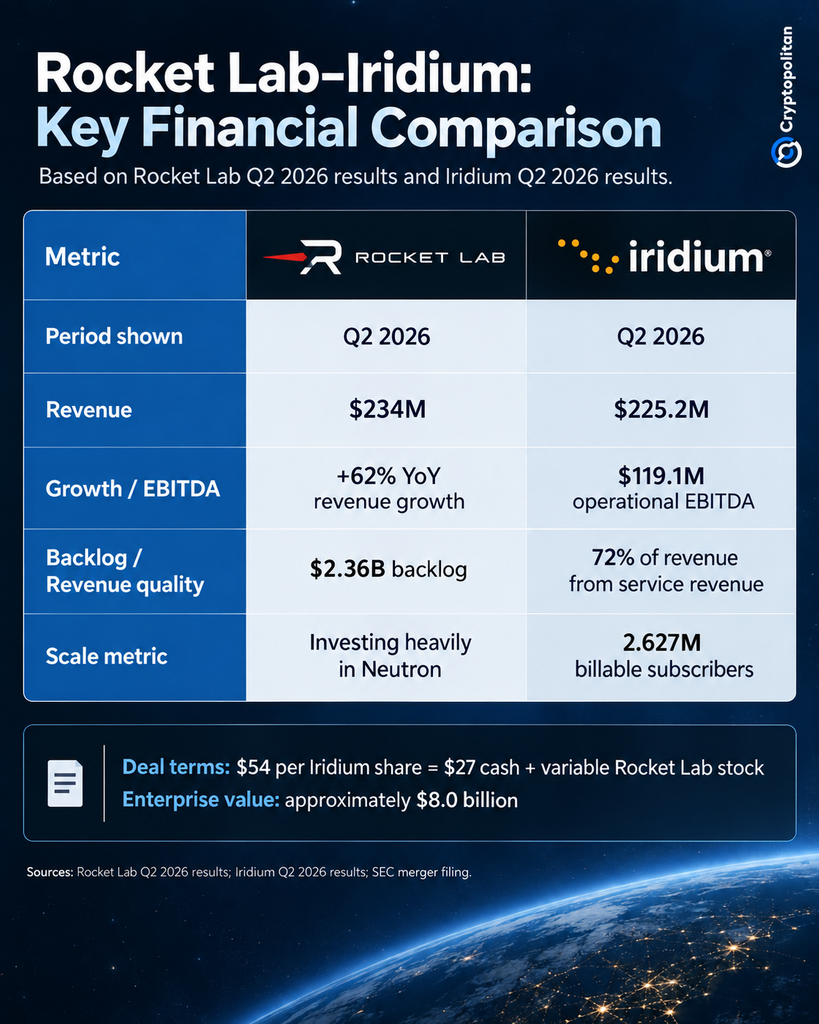
Rocket Lab (Nasdaq: RKLB) has agreed to acquire Iridium Communications (Nasdaq: IRDM) in a cash-and-stock transaction valued at $8 billion, or $54 per Iridium share. The deal would add Iridium’s subscription-based satellite network to Rocket Lab’s spacecraft manufacturing and launch-services businesses, creating a more vertically integrated space company with a recurring-revenue operation.
Rocket Lab announced the transaction in an official update. The $54-per-share consideration consists of $27 in cash and a variable amount of Rocket Lab stock.
A cash-generating network alongside Rocket Lab’s growth
Rocket Lab reported record revenue of $234 million for the second fiscal quarter, up 62% from the same period a year earlier. Its backlog also reached a record $2.36 billion, representing year-on-year growth of 137%, according to the company’s second-quarter 2026 results.
The company continues to spend heavily on Neutron, its reusable medium-lift rocket. Rocket Lab now expects the hardware for Neutron’s first flight to reach the launch pad in the fourth quarter of 2026, without committing to an actual launch date.
Iridium has a different financial profile. For the second quarter of 2026, the satellite operator reported revenue of $225.2 million and operational EBITDA of $119.1 million in its quarterly results. Iridium said 72% of its revenue came from service revenue, which it considers mostly recurring. At the end of the quarter, the company had 2,627 million billable subscribers, an increase of 6% from the previous year.
The transaction would therefore combine Rocket Lab’s rapid growth and substantial backlog with Iridium’s profitability, subscriber growth and recurring service revenue. Rocket Lab would acquire an established cash-generating network rather than build one from the ground up.
What Iridium adds
Rocket Lab is acquiring more than Iridium’s deployed satellites. The company also brings globally synchronized L-band spectrum, a low-Earth-orbit satellite constellation and access to more than 500 partners and customers worldwide across the maritime, aviation, defense and government sectors.
That customer and partner network would give Rocket Lab an asset it does not currently possess. The U.S. government remains Iridium’s largest single customer, accounting for almost 17% of the company’s service revenue in the second quarter. Iridium expects to sign a contract for a new Enhanced Mobile Satellite Service with the U.S. Space Force by March 2027.
Rocket Lab said ownership of the satellite network would allow the combined company to capture more of the economic value associated with the business. Rather than building satellites while relying on another company for launches, the merged organization would be positioned to design, manufacture, launch and operate most of its satellite systems internally.
Comparison with SpaceX
The proposed strategy has drawn comparisons with SpaceX, although the companies are pursuing vertical integration differently. SpaceX built its Starlink network from scratch, while Rocket Lab is seeking to acquire an established network and an existing customer base through the Iridium transaction.
Brian Gesuale, an analyst at Raymond James, rated Rocket Lab Outperform and set an $80 price target for the company. Barron’s reported that Gesuale believes Rocket Lab could reach free-cash-flow break-even by 2028, potentially two years before SpaceX does so. He also identified risks related to Neutron’s deployment and the integration of Iridium.
The broader space market could support Rocket Lab’s expansion into satellite services. The World Economic Forum estimates that the space industry could generate nearly $1.8 trillion in revenue by 2035 as activity shifts from one-time hardware sales toward recurring services such as connectivity, intelligence and monitoring. Iridium would give Rocket Lab an entry into that higher-value segment.
Shareholder and regulatory approval still required
The transaction has not yet cleared all required shareholder and regulatory hurdles. Iridium’s special stockholder meeting is scheduled for September 24, 2026, and its board unanimously recommends that shareholders approve the deal. The companies expect the merger to close in mid-2027, subject to competition, foreign-investment and communications approvals. The transaction is also described in the relevant SEC filing.
The more difficult test would begin after closing. Rocket Lab would need to integrate an $8 billion acquisition while continuing to finance Neutron and its existing launch and space-systems businesses.
Successful integration would give Rocket Lab a large subscriber base and recurring-revenue network layered onto its launch and manufacturing operations. A difficult integration, however, could leave the company with substantially greater financial and operational complexity as Neutron enters one of its most demanding development phases.

