Robinhood Plans 24/7 Weekend Stock Trading as Wall Street Moves Toward Crypto Hours
Key Takeaways
- •Robinhood plans to let customers trade a limited selection of US stocks and ETFs through weekends via a partnership with SEC-regulated venue Bruce ATS, with the offering still undergoing regulatory review.
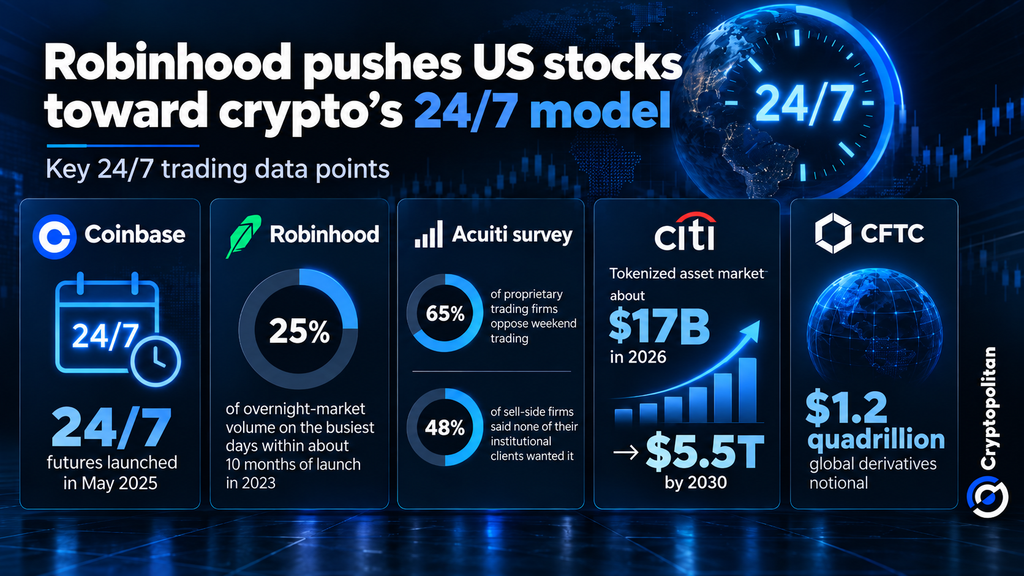
- •Roughly 10 months after its 2023 launch, Robinhood's existing 24-hour weekday market recorded as much as 25% of daily volume outside standard trading hours on its busiest days.
- •The CFTC has issued guidance covering 24/7 trading, clearing, and settlement, while Coinbase reported billion-dollar weekend futures volumes after launching continuous trading in May 2025.
- •Citi's Tokenization 2030 report projects the tokenized asset market growing from $17 billion to $5.5 trillion by 2030, with US equities and Treasuries as leaders.
- •Robinhood has cautioned that off-hours trading can bring lower liquidity, higher volatility, and wider spreads, making liquidity-provider participation a decisive factor for round-the-clock markets.
On September 29, Robinhood announced plans to let customers trade a selection of US stocks and ETFs around the clock through weekends, extending equity trading toward the continuous-operation model that has characterized cryptocurrency markets for years. According to Reuters, the move builds on Robinhood's existing 24-hour weekday market and comes as exchanges, regulators, and clearinghouses reconsider how long traditional markets should operate.
The development cuts both ways for crypto. As nonstop trading loses its status as a distinguishing feature, conventional finance is taking on a market structure popularized by crypto trading — a shift that could prove beneficial or harmful depending on how the landscape evolves.
Weekend stock trading, pending a regulator's sign-off
Robinhood has partnered with Bruce ATS, a provider of overnight trading infrastructure, to power the weekend service. An ATS, or alternative trading system, is an SEC-regulated venue that operates outside the major exchanges. The offering is still undergoing regulatory review, and only a limited number of equities and ETFs will be available at launch — making the regulatory decision and the initial asset list the two milestones to watch.
For readers accustomed to traditional market hours, the change is more significant than it may sound: regular US equity sessions run weekdays only, from 9:30 a.m. to 4:00 p.m. ET, so news breaking on a Saturday has historically been tradable in stocks only at Monday's open. Weekend sessions aim to close that gap — a capability crypto markets have offered by default for years.
The company already operates a 24 Hour Market that runs from Sunday evening through Friday evening. Per Reuters, roughly 10 months after overnight weekday trading launched in 2023, as much as 25% of daily volume on the busiest days was taking place outside standard hours.
"Our focus this year is making Robinhood the best place for active traders by giving them the tools that are typically reserved for hedge funds, quants and a lot of big active trading firms," Abhishek Fatehpuria, Robinhood's vice president of product management, told Reuters.
Wall Street is drifting toward always-on markets
Robinhood joins a growing list of firms pushing markets toward continuous operation. Speaking during an FIA roundtable event, Liz Martin, chief of derivatives at Coinbase, described the firm's experience since launching 24/7 futures trading in May 2025, including a record of trading billion-dollar volumes every weekend during major news events.
According to Thomas Texier of Marex Clearing, large asset management firms and corporates are increasingly looking to hedge over the weekend rather than wait for the working week. Putting the change into practice, however, is easier said than done: a 24/7 marketplace entails higher requirements for clearing, staffing, settlement, and risk management.
The CFTC and the tokenization backdrop
Regulators are preparing for the. The CFTC has issued guidance covering 24/7 trading, clearing, and settlement as more markets extend beyond traditional opening and closing times.
Tokenization adds to the momentum. Citi's Tokenization 2030 report values the tokenized asset market at $17 billion today and forecasts growth to $5.5 trillion by 2030, with US equities and Treasuries emerging as leaders. The report asserts that digital natives expect 24/7 access to markets.
Access is not the same as liquidity
Longer trading hours do not necessarily mean better markets. Robinhood has cautioned that night trading can bring lower liquidity, higher volatility, and wider spreads. Reuters has similarly noted that thinly traded markets can result in unfavorable rates for traders. How many liquidity providers commit to quoting through weekend sessions is therefore a key variable to watch, since spreads and depth hinge on their participation.
Whether the industry moves fully to 24/7 trading will therefore depend not only on the accessibility of capital but also on whether enough suppliers and consumers of liquidity show up on the other side.
Does 24/7 stock trading dull crypto's edge?
For crypto, the impact is mixed. Weekend stock trading makes "markets never close" less unique as a selling point. At the same time, it makes nonstop access feel more normal and could strengthen the case for tokenized securities built on infrastructure designed to operate continuously.
If US equities continue moving toward crypto's clock, the bigger question may be whether traditional markets eventually adopt more than just crypto's trading hours — including parts of its settlement architecture. US equities currently settle on a T+1 cycle, itself only shortened from two business days in 2024, so any deeper convergence would mean reconciling traditional clearing timelines with infrastructure built to run without interruption.
Original reporting via Cryptopolitan.

