Robinhood Chain Crosses $25B in DEX Volume – But Stock Tokens Remain a Single-Digit Share
Key Takeaways
- •Robinhood Chain exceeded $25 billion in cumulative DEX volume, with Stock Tokens accounting for an estimated single-digit share of roughly 6% based on milestones announced one day apart.
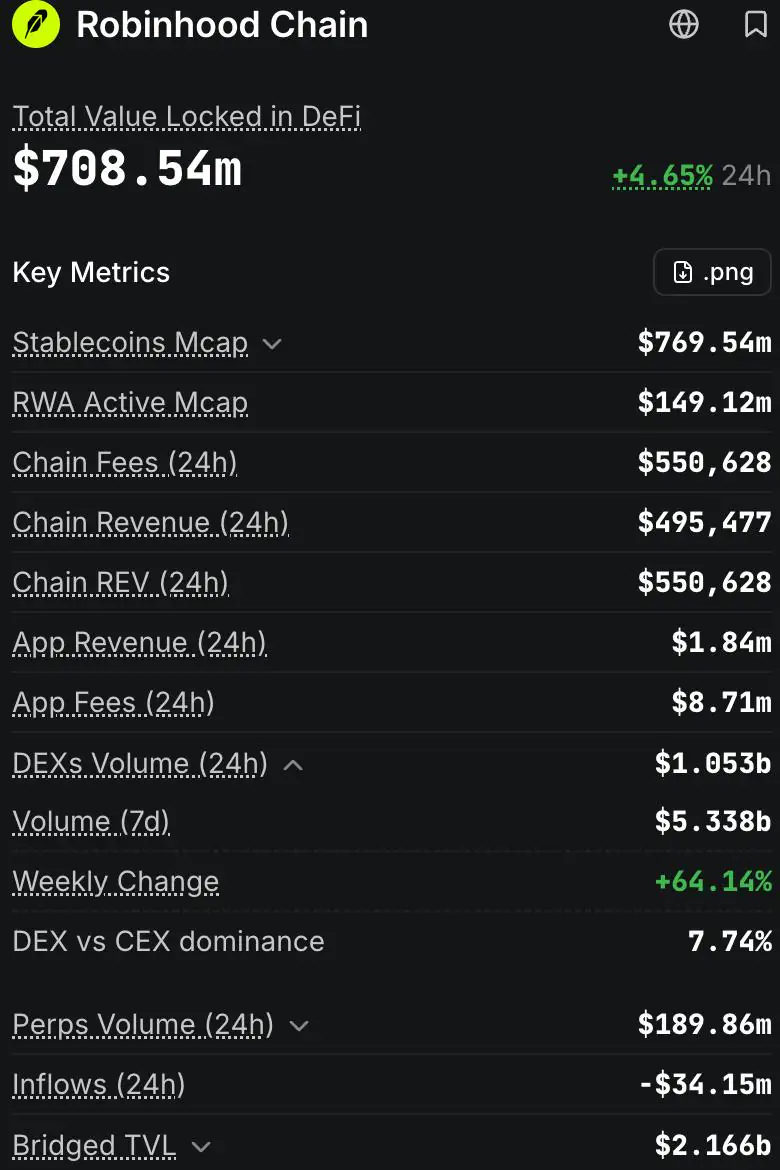
- •DefiLlama data as of August 30 showed roughly $1.05 billion in rolling 24-hour DEX volume, $708.5 million in DeFi TVL, $769.5 million in stablecoin supply, and about $149.1 million in active RWA market capitalization.
- •Robinhood Stock Tokens are tokenized debt securities issued by Robinhood Assets (Jersey) Limited that provide economic exposure but no legal ownership, voting rights, or claims on the underlying companies, and are unavailable to US persons.
- •Most of the chain's early activity came from crypto-native trading such as memecoins and tokenized perpetual positions rather than stock-linked products.
- •Active RWA market capitalization grew about 12.4 times from approximately $12 million near launch to $149 million, though this reflects the broader RWA category rather than Stock Tokens alone.
Milestones Put Stock Tokens Near 6% of Robinhood Chain Volume
Robinhood announced on August 25 that its chain had surpassed $25 billion in cumulative decentralized-exchange (DEX) volume. One day later, the company reported that Stock Token DEX volume had reached $1.5 billion.
Dividing those two figures places Stock Tokens at roughly 6% of cumulative DEX turnover. The percentage is only an estimate, because Robinhood published the milestones one day apart and chain-wide volume kept rising in between. The safer conclusion is that Stock Tokens accounted for a single-digit share at the time.
$1.5 Billion. That's the DEX volume for Robinhood Stock Tokens, all on Robinhood Chain. To the builders, LPs, and everyone in the trenches, thank you. pic.twitter.com/0Cexjvrdy1 — Robinhood Crypto (@RobinhoodCrypto) August 26, 2026 (x.com/RobinhoodCrypto/status/2092628132721262996)
The remaining turnover came from memecoins, stablecoin pairs, ordinary crypto swaps, launchpad tokens and other DeFi products. The aggregate figures do not offer a complete asset-by-asset breakdown. The $25 billion milestone demonstrates that Robinhood Chain can attract trading activity, but it does not establish Stock Tokens as the chain's primary use case.
A $1B Trading Day Does Not Mean $1B Entered
By August 30, DefiLlama data (defillama.com/chain/robinhood-chain) showed $1.053 billion in rolling 24-hour DEX volume and $5.338 billion over seven days. DeFi total value locked (TVL) stood near $708.5 million, stablecoin supply reached $769.5 million, and active real-world asset (RWA) market capitalization was approximately $149.1 million.
DEX volume measures the gross value of swaps, not fresh capital. If a trader swaps $10,000 into another asset and back again ten times, those transactions can generate close to $200,000 in turnover from the same starting funds, before fees and price changes.
Daily DEX volume was about 1.49 times chain-wide DeFi TVL. That ratio offers only a rough comparison of activity. TVL includes lending and other assets outside DEX pools, so it cannot reveal how many times the same deposited capital traded during the day.
Stablecoin supply also includes tokens held outside the protocols counted in TVL. Balances can sit in wallets, bridges or applications that DefiLlama does not include in its DeFi TVL figure.
Robinhood Stock Tokens Are Not Ordinary Shares
A Stock Token tied to Nvidia, Apple or another company is not simply a brokerage share moved onto a blockchain. Robinhood's regulatory filing (investors.robinhood.com) describes the products as tokenized debt securities issued by Robinhood Assets (Jersey) Limited.
The tokens provide economic exposure to the referenced securities but do not grant legal or beneficial ownership of the underlying shares. Holders should not assume they receive voting power, ordinary shareholder rights or a direct claim against the referenced company.
The products are unavailable to US persons and face restrictions in other jurisdictions. The chain itself can be permissionless while access to a regulated financial product remains limited. Robinhood first launched Stock Tokens for EU customers in mid-2025, so the August figures reflect roughly the first months of the product's life on its own chain rather than a mature market.
The adoption case for Stock Tokens therefore rests on concrete advantages such as extended trading hours, fractional exposure, transferable settlement or use as collateral. Those benefits must outweigh jurisdictional limits and the absence of ordinary shareholder rights. Robinhood is not alone in testing this thesis: tokenized-equity products from other issuers have also targeted non-US markets, and regulators in the EU and elsewhere have been weighing how existing securities rules apply to blockchain-based instruments, an unresolved question that shapes where such products can legally operate.
Crypto Markets Created the First Activity
Robinhood describes its Layer 2 as permissionless infrastructure for financial services and tokenized real-world assets. Outside developers can also launch markets with no connection to stocks, which helps explain why crypto-native trading expanded first.
Ten million daily transactions, for example, did not mean ten million stock trades. As Coindoo reported in its examination of Robinhood Chain's transaction surge, memecoins and other crypto products drove much of the network's early use.
Arcus added another source of turnover by turning shares in selected perpetual-futures accounts into transferable tokens, as explained in Coindoo's report on tokenized perpetual positions. That matters because chain-wide volume can keep rising even if Stock Token adoption does not.
Crypto trading can bring stablecoins, users and infrastructure onto the chain, but liquidity remains pair-specific. A deep memecoin pool does not create a deep Stock Token pool. The stock-linked products still need dedicated market makers, sufficiently deep pools and recurring counterparties.
Active RWA Value Grew From $12M to $149M
A DefiLlama post shortly after launch placed the network at approximately $12 million in RWAs, $134 million in TVL and more than $290 million in stablecoins.
Against the August 30 data, active RWA market capitalization increased about 12.4 times. TVL grew by roughly 5.3 times, while stablecoin supply expanded by about 2.7 times. These comparisons use two separate data sets and assume DefiLlama applied consistent classifications.
DefiLlama's RWA category includes more than Robinhood Stock Tokens. The 12.4x increase therefore measures growth across the chain's broader RWA base, not a twelvefold increase in tokenized-stock value.
The expansion still matters. It shows that assets linked to off-chain markets are gaining a larger foothold, even though the available figures do not isolate how much of that growth came from stock-linked products. That trajectory also fits a broader industry push, as banks, exchanges and fintechs have been piloting tokenized funds, bonds and other real-world assets on public blockchains over the past two years.
What Would Prove Lasting Stock Token Demand?
The next useful evidence would be data that separates Stock Token use from the crypto markets surrounding it:
- Period-matched volume share: Stock Token and total DEX volume measured over the same dates would show whether the category is gaining ground.
- Market depth: Larger dedicated pools and tighter spreads would make stock-linked trades easier to execute without sharply moving prices.
- Repeat traders: Returning participants would provide stronger evidence of product demand than a burst of one-time wallets.
- Stock-specific market value: A separate figure would show how much capital remains in Stock Tokens rather than in the broader RWA category.
- Demand without promotions: Sustained activity when users bear ordinary trading costs would make the volume harder to dismiss as temporary.
Robinhood Chain no longer lacks general crypto activity; what remains unproven is whether that activity can develop into deep, repeatable Stock Token markets. Dedicated liquidity, returning traders and continued stock-specific growth might provide exactly that evidence.

