Robinhood Stock Breaks Below Key Support as Death Cross Emerges Amid Crypto Winter
Key Takeaways
- •Robinhood stock fell to about $72 on Monday, its lowest level since May 28, marking a decline of more than 40% from its year-to-date high of $126.
- •The stock has formed a death cross — a crossover between the 50-day and 200-day EMAs — and broken below key support levels at $87.55 and $75.46, with $70 and $65 identified as the next downside targets.
- •Bitcoin dropped below $62,000 and the total crypto market capitalization fell roughly 30% from its peak to $2.1 trillion, accompanied by substantial outflows from Bitcoin, Ethereum, and XRP ETFs.
- •Robinhood's notional crypto volume declined to $49.8 billion in the third quarter from $80.3 billion a year earlier, and October volume of about $17 billion was well below the $32.5 billion recorded in the same month last year.
- •Multiple analysts cut their Robinhood price targets, including Goldman Sachs reducing its target from $128 to $115 and Truist Financial lowering it to $123 from $125.
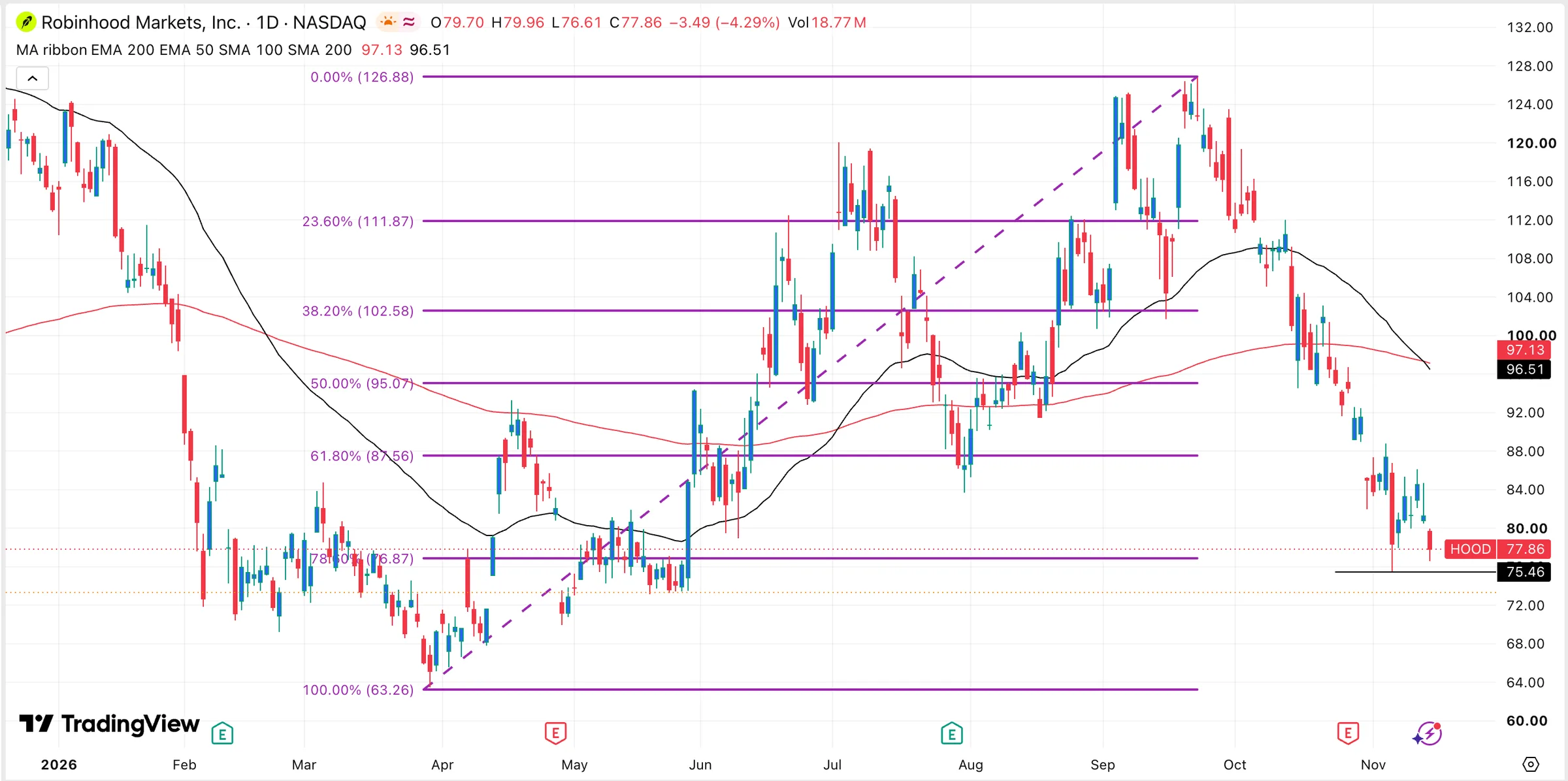
Robinhood (HOOD) extended its sharp downtrend on Monday, hitting its lowest level since May 28 as the crypto winter resumed. The stock dropped to $72, a level last seen on April 30, and has formed a death cross on its daily chart — a pattern that points to further downside as risks persist across both the stock and the cryptocurrency market.
Key points:
- Robinhood stock has formed a death cross pattern on the daily chart.
- The company is struggling as a crypto winter re-emerges.
- Technical indicators suggest the stock may continue falling in the near term.
Robinhood Stock Forms a Death Cross
HOOD has been in a strong sell-off in recent months, sliding from its year-to-date high of $126 to $72.20 — a decline of more than 40%. Along the way, it has broken below several crucial support levels, including the 61.8% Fibonacci retracement level at $87.55. In most cases, a move below that level confirms the bearish outlook.
Robinhood has also flashed the risky death cross pattern, which occurs when the 50-day and 200-day exponential moving averages (EMA) cross each other. This formation often leads to more downside over time.
The stock remains below the Supertrend indicator and has slipped under the key support level of $75.46, invalidating the double-bottom pattern. As a result, the path of least resistance for the stock is lower, with the next key target at $70. A move below that level would point to further downside toward $65.
Crypto Winter Returns
The biggest risk facing Robinhood is the ongoing crypto winter, which has intensified in recent days. Bitcoin plunged below $62,000 over the weekend, and the market capitalization of all coins has fallen from its year-to-date high of more than $3 trillion to $2.1 trillion — a drawdown of roughly 30% from the peak.
The same pressure is visible in the ETF market, with Bitcoin, Ethereum, and XRP ETFs experiencing substantial outflows. Meanwhile, the Crypto Fear and Greed Index has dropped to 12, a level the report describes as the 'extreme greed' zone.
These moves have driven a sharp decline in crypto trading activity. CoinMarketCap data shows that 24-hour volume has fallen 46% over the past day to $65.33 billion.
Crypto Slump Becomes a Drag on Robinhood's Business
That slowdown matters for Robinhood, which has become a major player in the crypto industry, offering cryptocurrencies both on its main platform and on Bitstamp, the exchange it acquired. Because the company discloses trading volumes as a core operating metric with each quarterly report, a market-wide slowdown becomes directly visible in the figures analysts use to model revenue.
Cryptocurrencies have become a major drag on the business. In its latest earnings report, the company said its notional crypto volume stood at more than $49.8 billion in the third quarter, down from $80.3 billion in the same period last year. Bitstamp handled volume worth $29.2 billion, down from $41 billion a year earlier, while crypto volume on the Robinhood app fell from $34 billion to $20.6 billion.
The same trend carried into October. Data released earlier this month showed the company handled more than $17 billion that month, down from $32.5 billion in the same month last year.
Other businesses are also slowing as the stock market declines. The number of options traded stood at 289 million last month, roughly the same as in September and August, while equity notional volume stood at $325 billion, largely unchanged from a month earlier. That leaves crypto as the main moving part in the company's recent operating data.
Analysts Trim Targets as Growth Cools
Yahoo Finance data shows analysts expect the company's growth trajectory to wane this quarter. The average estimate puts fourth-quarter revenue at $1.52 billion, up 18% from a year earlier, which would translate into an annual growth rate of 18.8% to $5.32 billion.
Those figures explain why analysts have slashed their price targets. Goldman Sachs reduced its target from $128 to $115, while Truist Financial lowered it to $123 from the previous $125. Cantor Fitzgerald, Barclays, and Wells Fargo analysts have also cut their targets. The clearest checkpoints from here are Robinhood's monthly volume disclosures, along with Bitcoin's level around $62,000 and the pace of ETF flows, which will show how trading conditions evolve into the fourth-quarter report.
This article first appeared on The Market Periodical.

