Robinhood Stock Slides as Q3 Crypto Revenue Plunges 55% to $120 Million
Key Takeaways
- •Robinhood's cryptocurrency transaction revenue fell 55% to $120 million in the third quarter, even as Bitcoin rallied from $57,300 to $87,300 during the period, because platform fees depend on trading activity rather than asset prices.
- •Total revenue rose 12% to a record $1.42 billion, but net income dropped 14% to $476 million as operating expenses increased 16% to $739 million.
- •The company lowered its full-year spending guidance by $50 million to a range of $2.675 billion to $2.775 billion and expects costs to decline over time.
- •Robinhood is preparing to launch 24/7 stock trading built on tokenization under a five-year SEC innovation exemption, and agentic trading volume has already surpassed $1.6 billion.
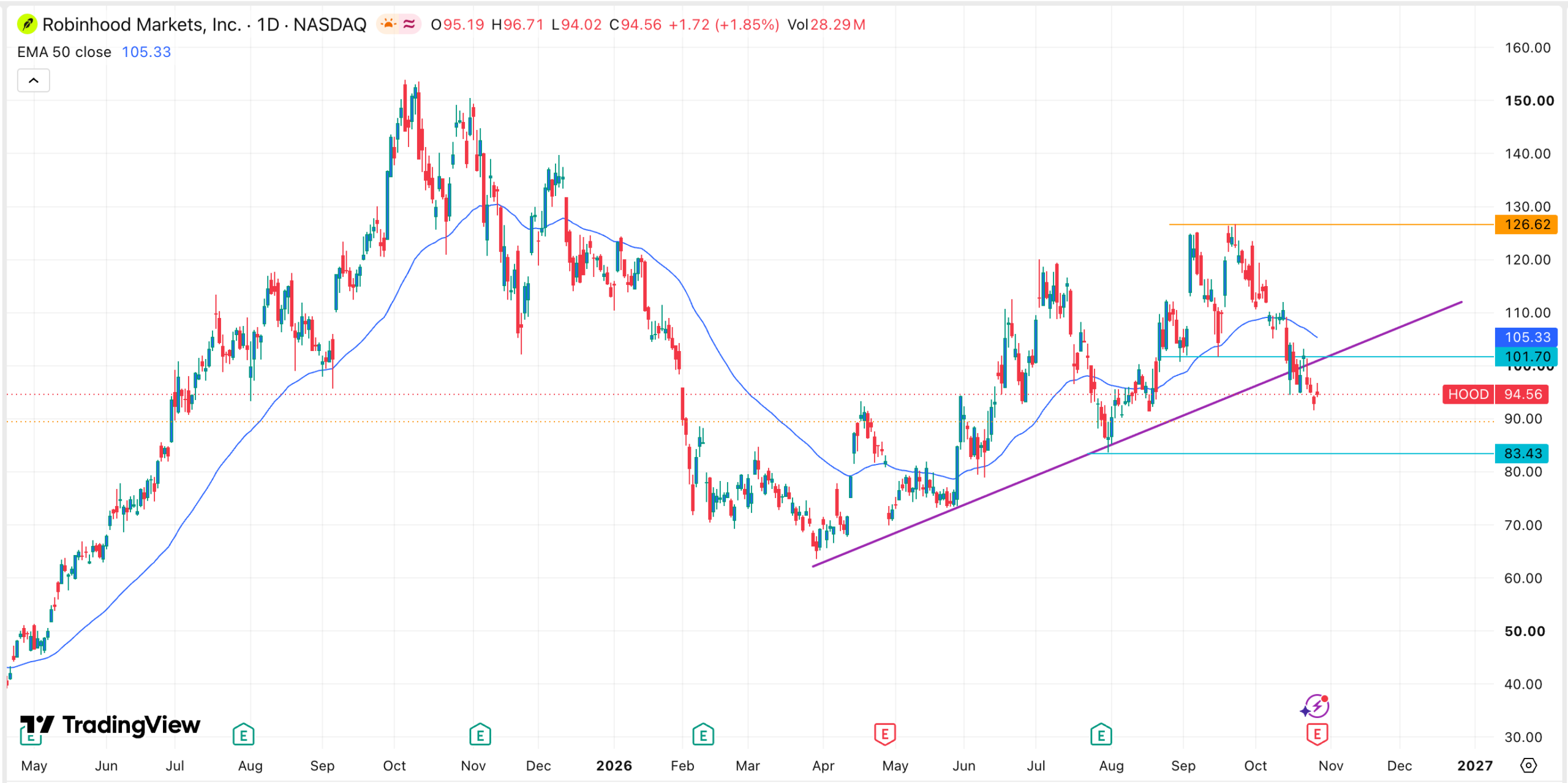
- •The Rothera prediction platform reached $100 million in annualized revenue with 6.4 billion contracts, while technical analysis suggests near-term downside toward $83.43 before a potential longer-term rebound to $100.
Robinhood shares finished lower on Oct. 28 after the retail brokerage reported third-quarter results that showed a steep 55% drop in cryptocurrency transaction revenue, even as the company posted record overall revenue and continued to expand into new products.
The stock, which trades under the ticker HOOD, closed at $91.42, down 3.32%, following the release of the results. Total revenue rose 12% to $1.42 billion, driven by higher transaction volume, while cryptocurrency revenue fell to $120 million. The results highlighted weakening activity in the crypto trading business alongside rising operating expenses, although options trading and the company's prediction markets helped absorb much of the decline in the cryptocurrency segment.
Crypto Slump Weighs on Record Quarter
The slump in crypto revenue came despite a pronounced rebound in digital asset prices during the quarter. After falling to $57,300 in July, Bitcoin rallied to $87,300, and crypto-focused Galaxy Digital recorded a strong recovery over the same period, underscoring the divergence between Robinhood's crypto results and the broader market. The gap reflects how brokerage economics work: transaction revenue is earned on trading activity rather than on price appreciation, so a rally in underlying assets does not automatically lift the fees a platform collects.
Elsewhere in the business, net interest revenue fell 9% during the quarter to $415 million. Other revenue jumped 61% to $142 million, with Trump Accounts serving as the primary driver.
Profitability moved in the opposite direction. Net income dropped 14% to $476 million, a retreat driven by the performance of Robinhood Ventures Fund 1, whose stock has fallen by more than 67% from its all-time high.
Operating Expenses Climb 16%
Operating expenses jumped 16% to $739 million as the company took higher provisions connected to Trump Accounts and to Rothera, its joint venture with Susquehanna.
Robinhood expects those costs to fall over time. The company now expects to spend between $2.675 billion and $2.775 billion, a figure $50 million below its previous guidance.
24/7 Stock Trading and AI Agents in the Pipeline
Robinhood has continued to introduce new products as it works to drive revenue and profitability growth over time. The most notable initiative is the upcoming launch of 24/7 stock trading on its platform, an offering that would allow customers to trade outside traditional market hours and will leverage tokenization, a concept for which the Securities and Exchange Commission (SEC) granted the company a five-year innovation exemption. The schedule would bring equities closer to the around-the-clock format that crypto markets already operate on.
The company is also moving to capitalize on the growing use of AI agents. Customers can now program AI agents that open and close trades on their behalf, and if the technology gains widespread adoption, it could help drive transaction revenue. Agentic trading volume has already jumped to more than $1.6 billion.
Rothera, the company's prediction platform, has reached $100 million in annualized revenue as the number of contracts jumped to 6.4 billion. Robinhood is also serving nearly 70 million children through its Trump Accounts solution. Taken together, these products have positioned the company among the most innovative firms in the financial services industry. How much revenue these newer lines can keep contributing while crypto activity stays subdued is likely to remain a focal point when Robinhood reports its next quarter.
Technical Picture
The stock had already been retreating in the weeks leading into the earnings release, slumping from a high of $126.62, according to the daily chart analysis that accompanied the report. The retreat occurred after the stock formed a double-top pattern with a neckline at $101.70, its lowest level on Sept. 16. A double-top is regarded in technical analysis as one of the most bearish chart patterns.
The stock has since fallen below the ascending trendline that connects its lowest swings since March of this year, and it has also moved below its 50-day moving average. The analysis indicated that the stock will likely continue falling, potentially toward the key support level of $83.43, its lowest level on July 31. Over the longer term, however, the analysis suggested the stock will likely bounce back, potentially to $100.
This article is for informational purposes only and does not constitute financial advice. Stock investments involve market volatility and potential losses. Readers should conduct independent research before making investment decisions.
Source: The Market Periodical

