Robinhood Refuses AMC's Demand to Halt Stock Token Trading, Igniting Issuer-Control Debate
Key Takeaways
- •Robinhood rejected AMC's demand to stop trading Stock Tokens tied to AMC shares, with legal chief Dan Gallagher saying the company will not desist and CEO Vlad Tenev publicly backing the product.
- •AMC CEO Adam Aron claimed Robinhood offers tokens tied to over 190 companies without issuer consent and accused the firm of undermining U.S. securities laws, allegations that do not establish any violation.
- •Robinhood's disclosures state Stock Tokens are tokenized debt securities issued by Robinhood Assets (Jersey) Limited that provide economic exposure but no legal or beneficial ownership, voting rights, or protection if Robinhood goes bankrupt.
- •A January 28, 2026 SEC staff statement said securities offerings should be registered unless exempt, but it carries no binding force and no ruling has settled whether third-party tokenization without issuer consent is unlawful.
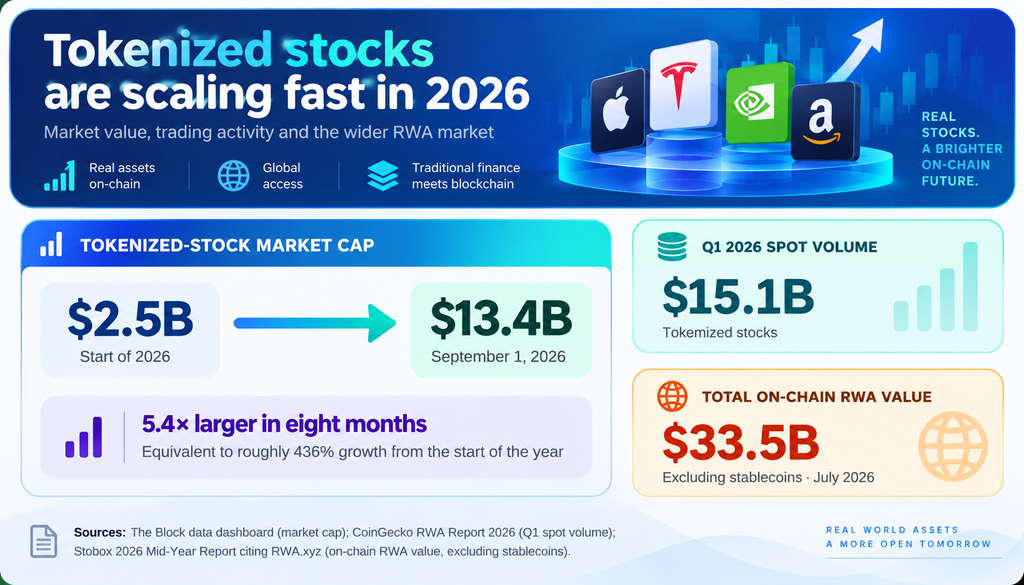
- •The tokenized stock market grew from $2.5 billion at the start of 2026 to $13.4 billion by September 1, while AMC shares rose nearly 21% to $3.07 in overnight trading after Aron's posts.
Robinhood has rejected AMC Entertainment's demand to stop trading in blockchain-linked tokens tied to the movie theater chain's stock, escalating a dispute that raises a broader question: does a publicly traded company have any say over a third party's tokenization of its shares?
The public back-and-forth between Robinhood and AMC on X carries implications well beyond the two companies. It also affects listed companies whose shares may be tokenized without their knowledge, as well as investors who buy products tracking those shares without becoming shareholders. By refusing to halt token trading, Robinhood is testing the limits of what third-party tokenized shares can achieve under current securities law, and the controversy has surfaced concerns about ownership, issuer control, fragmented liquidity, and regulatory oversight. For issuers, the core worry is that tokenized versions of their stock could trade on venues outside the traditional settlement system, potentially splitting trading volume across markets that do not share the same investor protections or reporting obligations. For token holders, the practical question is what happens if the underlying company or the token issuer changes terms, delists, or runs into financial distress.
"Send your lawyers and we'll educate them"
Dan Gallagher, Robinhood's head of legal, compliance, and corporate affairs and a former SEC commissioner, responded directly to AMC CEO Adam Aron. Writing on X, Gallagher said Robinhood knows "a little something about the U.S. securities laws and will not 'DECIST,'" mocking Aron's misspelling in his original post. He added: "send your lawyers and we'll educate them."
Robinhood CEO Vlad Tenev re-shared the message with the caption: "We stand behind Stock Tokens."
Aron's case against the tokens
As previously reported by Cryptopolitan, Aron claimed Robinhood was offering tokens tied to AMC and more than 190 other companies without their knowledge or consent, and that the product does not comply with U.S. securities laws. He contended that AMC neither participates in nor endorses the token in any way, and questioned the investor protections available to token buyers.
Gallagher's reply only intensified the conflict. Aron explained that "DECIST" was intentional wordplay combining "desist" and "de-cyst." He then confronted Robinhood's offshore setup directly, asking why Stock Tokens that cannot legally be offered or sold to U.S. residents are advertised on the company's American website. "If it's not illegal, it should be," Aron wrote. In a further message directed at Tenev, he accused Robinhood of "playing fast and loose with U.S. securities laws" and said the practice jeopardizes market integrity. These allegations reflect Aron's interpretation of the law and do not establish that Robinhood has violated U.S. securities statutes.
What buyers actually own
According to Robinhood's disclosures, Stock Tokens are not equivalent to purchasing stock. The company's documentation describes them as tokenized debt securities issued by Robinhood Assets (Jersey) Limited that provide economic exposure to the underlying security, but neither legal nor beneficial ownership of it. Robinhood's FAQs on Classic Stock Tokens clarify that the European product is a derivative contract: holders receive no voting rights in the underlying company, and Robinhood warns they could lose their entire investment if the firm goes bankrupt.
That structure is central to the dispute. Because token holders are counterparties to Robinhood rather than shareholders of AMC, they cannot exercise the rights that come with direct share ownership, and AMC has no contractual relationship with them or influence over the product bearing its name.
Where the SEC line sits
On January 28, 2026, the SEC released a joint staff statement distinguishing between securities tokenized by their own issuers and those tokenized by unaffiliated third parties. Robinhood's model falls into the latter category.
"The format in which a security is issued … does not affect application of the federal securities laws." — Staff of the SEC Divisions of Corporation Finance, Investment Management, and Trading and Markets
The statement says securities offerings should be registered unless an exemption applies, but it carries no binding legal force since it is a staff statement rather than an SEC rule or formal guidance. How the SEC or other regulators respond to issuer complaints like AMC's is one of the open questions this dispute puts in focus, since no enforcement action or ruling has settled whether third-party tokenization without issuer consent runs afoul of registration requirements.
This is not Robinhood's first clash with an issuer. Cryptopolitan previously reported that OpenAI disowned Robinhood tokens bearing its name last year, while Tenev argued that tokenizing a company's stock does not require the issuer's consent.
A market growing faster than its plumbing
The dispute unfolds as tokenized equities expand rapidly. Tokenized stocks grew from $2.5 billion at the start of 2026 to $13.4 billion by September 1, and CoinGecko's RWA Report 2026 recorded $15.1 billion in first-quarter tokenized-stock spot volume.
Robinhood has helped drive that growth, listing more than 190 Stock Tokens. But infrastructure is still catching up. RWA.xyz found that Robinhood's custom contracts can be misread by platforms expecting standard ERC-20 behavior and may not work cleanly with DeFi protocols built around those standards. The wider real-world asset market faces similar liquidity constraints: Stobox's 2026 Mid-Year Report, citing RWA.xyz data, put onchain RWA value excluding stablecoins at $33.5 billion in July. AMC shares, meanwhile, rose nearly 21% in overnight trading to $3.07 after Aron's posts, according to Cryptopolitan.
