Robinhood Q2 2026 Revenue Report: HOOD’s Record Quarter Still Leaves a Crypto Question
Key Takeaways
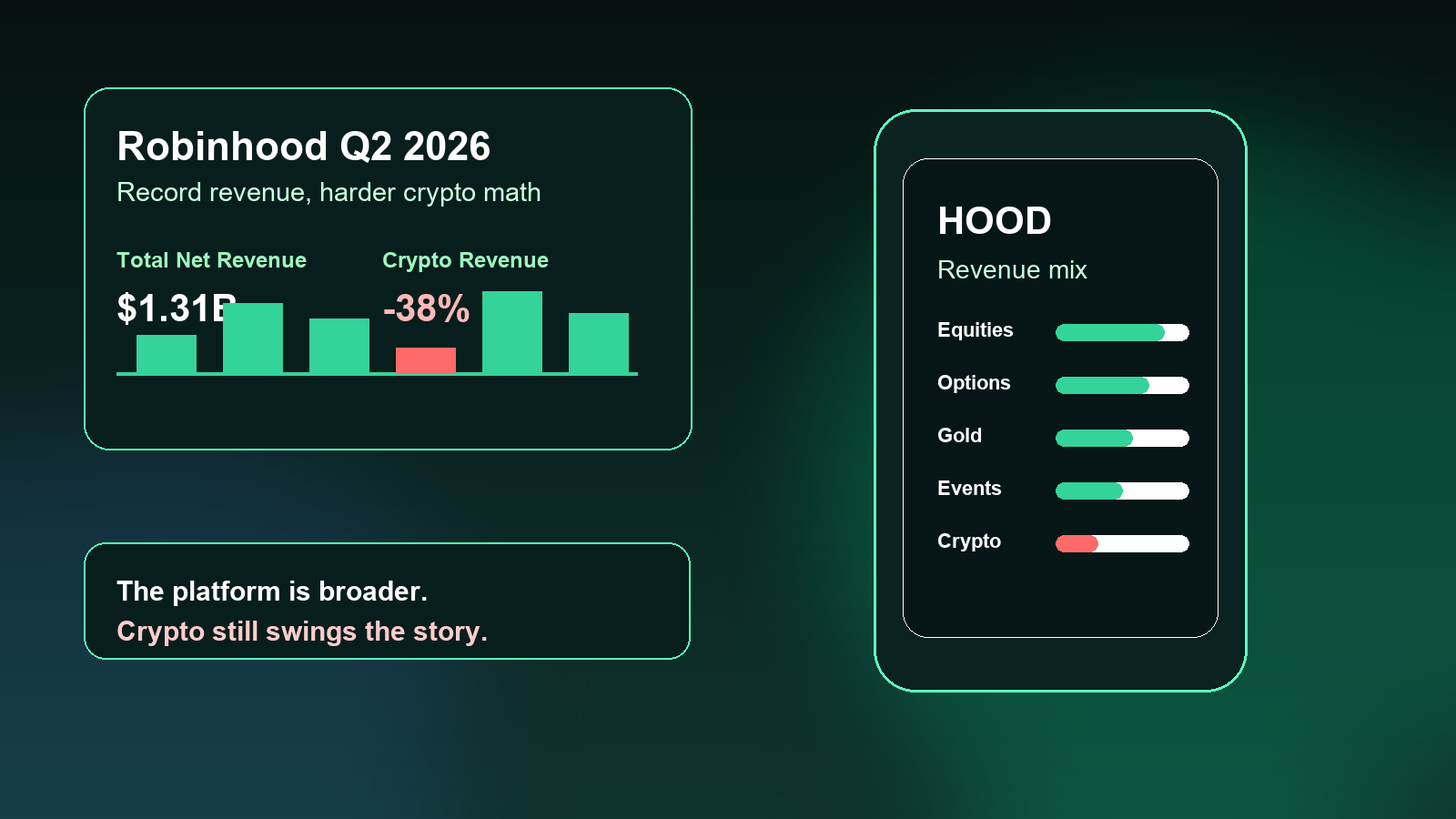
- •Robinhood generated approximately $1.31 billion in total net revenue during Q2 2026, a 32% year-over-year increase that beat market expectations.
- •Crypto revenue fell 38% in the quarter, confirming that growth was driven primarily by non-crypto business segments.
- •Robinhood is diversifying its revenue base through Gold subscriptions, retirement products, options trading, cash management, and event contracts to reduce reliance on speculative trading surges.
- •The company faces continued regulatory uncertainty across key growth areas including payment for order flow, crypto trading, prediction markets, and tokenization.
- •Event contracts represent a new engagement layer for users but carry legal complexity as the broader prediction-market industry navigates unresolved regulatory frameworks.
Why Robinhood’s Q2 Report Landed Differently
Robinhood used to be easy to describe and hard to value. It was the retail-trading app that became famous during a speculative market cycle. That description is now too small. The company’s Q2 2026 report showed a platform that is still sensitive to trading behavior, but no longer dependent on a single market story.
Investor’s Business Daily reported that Robinhood beat Q2 expectations, posted record revenue, and generated total net revenue of $1.31 billion. The company also showed a sharper contrast inside the revenue mix: crypto revenue fell 38%, while other parts of the business carried more of the growth.
That contrast is the reason the quarter matters. If Robinhood can grow even when crypto revenue falls, the company becomes a more durable fintech platform. If crypto weakness eventually drags user activity, trading engagement, or investor enthusiasm lower, HOOD may still trade like a high-beta market-cycle stock.
The better way to read Q2 is as a test of habit formation. Robinhood wants customers to open the app for more than one speculative moment. A user who trades options, keeps cash on the platform, subscribes to Gold, uses retirement products, follows event contracts, and occasionally trades crypto is more valuable than a user who appears only during a token rally. The Q2 report suggested that Robinhood is making progress on that broader relationship, even though the digital-asset line was weaker.
The Q2 Numbers: Record Revenue, But Not a Simple Crypto Story
Robinhood’s Q2 revenue report was strong enough to support the platform-growth narrative. It also made the crypto question more visible. Investors often treat Robinhood as a beneficiary of rising retail risk appetite, but the quarter suggests the company is trying to build multiple engines.
| Metric / Issue | Q2 2026 Context | Investor Read |
|---|---|---|
| Total net revenue | About $1.31 billion, up 32% year over year | Confirms record scale and strong platform momentum |
| Earnings result | Beat market expectations, according to IBD | Supports operating leverage and investor confidence |
| Crypto revenue | Down 38% | Shows digital-asset trading was not the main growth driver |
| Growth mix | Equities, options, subscriptions, and event contracts gained importance | Suggests a broader revenue base |
| Stock narrative | Fintech platform versus trading-cycle stock | The key valuation debate after Q2 |
The table shows why HOOD is a more interesting stock than a simple earnings-beat headline suggests. A weaker crypto line would normally raise questions for a platform associated with digital assets. Instead, the company still produced record revenue. That tells investors Robinhood’s business model has widened.
But widening is not the same as becoming low risk. Robinhood remains exposed to retail trading activity, market volatility, interest rates, product regulation, and trust. The Q2 report made the business look more balanced, but it did not make the stock defensive.
That distinction is important for valuation. A diversified financial platform can deserve more credit than a single-product trading app, but only if the revenue streams behave differently under stress. If equities, options, cash balances, subscriptions, and event contracts all weaken at the same time when market sentiment cools, diversification will look less protective. If some lines keep growing while others slow, the platform story becomes more credible.
The Revenue Mix Is the Real Story
For HOOD investors, the most important development is not just the revenue number. It is the composition of revenue. Robinhood's long-term valuation depends on whether it can turn episodic trading booms into a more repeatable financial relationship with customers.
That is where Gold subscriptions, retirement products, margin, cash balances, options activity, and event contracts matter. Each product adds another reason for users to keep assets on the platform. The more services Robinhood attaches to a user, the less the company depends on one burst of speculative trading.
This is the shift investors should care about. Robinhood is trying to move from transaction moments to account ownership. A transaction moment is a trade. Account ownership is a relationship that can produce interest income, subscription revenue, securities lending, retirement engagement, card usage, or repeat trading over time. The second model is harder to build, but it can be more valuable if users trust the platform and keep more of their financial life inside it.
Crypto is still important, even when it is weaker
Crypto revenue falling 38% does not mean crypto has stopped mattering. It means crypto was not the main source of Q2 growth. For investors, that is both reassuring and uncomfortable.
It is reassuring because Robinhood can now show growth without needing crypto trading to explode every quarter. It is uncomfortable because crypto is still one of the biggest swing factors for user attention and valuation sentiment. If Bitcoin, Ethereum, and altcoin markets reaccelerate, HOOD can benefit quickly. If digital-asset trading cools, the stock may lose one of its most visible upside narratives.
Crypto also affects Robinhood in a way that is partly financial and partly cultural. The revenue line matters, but so does the brand association. Robinhood's audience expects fast access to new market stories. If crypto becomes active again and Robinhood captures the flow, the platform can look current and competitive. If crypto activity moves elsewhere, investors may question whether Robinhood is keeping the most active users engaged.
Event contracts add a new but unsettled engine
Event contracts are a newer part of the Robinhood story. They fit the company’s broader ambition to turn market participation into a more accessible, always-on experience. They may also attract active users who like fast-moving, event-driven products.
But the category remains regulatory-sensitive. Prediction markets and event contracts are still evolving in the U.S. legal and market-structure landscape. That means investors may reward the growth option, but they will also watch enforcement, state-level restrictions, exchange approvals, and product disclosures.
This is why event contracts can be both attractive and uncomfortable. They may increase daily engagement because users can trade around elections, sports, economics, and other real-world outcomes. They also pull Robinhood deeper into a policy debate that is not settled. A product can be popular and still face legal complexity. For HOOD, the upside is a new engagement layer. The risk is that growth arrives with a higher regulatory discount.
HOOD Is Becoming a Financial Super-App, But the Bar Is Rising
The bullish case for Robinhood is that it is becoming a financial super-app for younger and more active investors. Brokerage, crypto, cash management, retirement, subscriptions, credit, tokenization, and event contracts can all sit inside one account relationship. If that strategy works, Robinhood becomes more than a trading venue. It becomes a high-engagement consumer finance platform.
The challenge is that the market has already learned to separate user growth from revenue quality. A platform can add products and still disappoint if customer balances do not grow, if active usage weakens, if regulatory costs rise, or if product adoption depends too heavily on speculative periods.
That is why Q2 matters. It gave investors evidence that Robinhood can produce record revenue with a broader mix. The next question is whether that mix can hold when market conditions are less favorable.
Why the Stock Can Still Be Volatile
Robinhood’s business is broader than it used to be, but HOOD is still not a quiet stock. The company sits at the intersection of retail trading, crypto, fintech regulation, rates, payment-for-order-flow debates, and market sentiment. That creates upside when risk appetite is strong, and vulnerability when investors rotate away from high-beta platforms.
The Q2 report helps the bull case because it shows operating momentum. But it does not remove three major risks. First, trading revenue can still move with volatility and user engagement. Second, crypto revenue can swing sharply from quarter to quarter. Third, regulators may keep examining order routing, prediction markets, digital assets, and consumer-finance products.
Investors should also avoid using stale price data. HOOD can move quickly after earnings, guidance, analyst revisions, and crypto-market swings. If a live price is needed for publication, it should be checked immediately through Nasdaq, a broker, or real-time market-data pages.
What Investors Should Watch Next
The first checkpoint is whether Robinhood can keep growing revenue without relying on a crypto rebound. If equities, options, Gold, retirement, cash, and event contracts continue to scale, investors may treat the platform as more durable.
The second checkpoint is crypto. A 38% crypto revenue decline makes the next few quarters important. Investors should watch whether lower crypto revenue reflects temporary market conditions, changing user behavior, or a more competitive trading environment.
The third checkpoint is regulation. Robinhood’s best growth areas often sit close to policy debates: crypto trading, tokenization, prediction markets, order routing, and consumer finance. A clean regulatory path would support a higher-quality growth story. A messy path could keep the stock volatile even if revenue grows.
The fourth checkpoint is profitability. Revenue growth matters, but the stock will ultimately depend on how much of that growth turns into sustainable earnings and cash generation. The more Robinhood can show disciplined cost control while expanding products, the more credible the platform story becomes.
Q2 strengthened the case that Robinhood is no longer just a pandemic-era trading story. It also showed why the stock remains so closely watched. HOOD is trying to become a diversified financial platform while still keeping the energy of a trading-first brand. That combination can be powerful, but it demands consistent execution.
The next few quarters will show whether Q2 was a durable step forward or simply a strong print in a favorable market. If Robinhood keeps broadening revenue while controlling risk, the stock story can become less dependent on any single asset class. If growth narrows back toward trading booms, investors may keep treating HOOD as a momentum vehicle rather than a compounder.
Unlock HOOD Perpetuals Trading on edgeX
The stock market closes. Your edge doesn’t have to.
Robinhood Markets (HOOD) moves fast: earnings surprises, regulatory headlines, and broader market sentiment can shift the price well outside of traditional trading hours. That’s why traders looking to stay ahead are turning to edgeX, a high-performance decentralized exchange that lets you act on HOOD price movements 24 hours a day, 7 days a week.
Through HOOD USDC perpetual futures on edgeX, you can take leveraged long or short positions on HOOD without waiting for the opening bell and without giving up custody of your funds. edgeX is a fully self-custody platform, meaning your assets stay in your control at every step.
Why traders choose edgeX for HOOD perpetuals:
- 24/7 trading: React to HOOD news and price action at any hour, not just during market open
- 10X leverage: Amplify your exposure with up to 10x leverage on HOOD USDC perpetual futures
- Deep liquidity: edgeX maintains $10 million of depth within a one-basis-point spread, with sub-0.1-basis-point slippage on trades exceeding $100,000
- 140% trading fee rewards: Earn rewards on your trading activity, putting money back in your pocket as you trade
- Institutional-grade infrastructure: Up to 200,000 orders per second with matching latency below 10 milliseconds, so your orders execute without delay
Whether you’re hedging an existing HOOD position or looking to capitalize on short-term price swings, edgeX gives you the tools to trade with precision and confidence.
Start trading HOOD perpetuals on edgeX and take full advantage of a decentralized exchange built for serious traders.
Frequently Asked Questions
Did Robinhood report Q2 2026 revenue?
Yes. Robinhood reported Q2 2026 total net revenue of about $1.31 billion, up 32% year over year, according to company and market coverage.
Why did Robinhood’s Q2 report matter for HOOD stock?
The report showed record revenue and stronger-than-expected earnings, but it also showed that crypto revenue fell. That makes the revenue mix, not just the headline number, the key investor issue.
Is Robinhood still dependent on crypto?
Robinhood is less dependent on crypto than before, but crypto remains an important swing factor for trading activity, user attention, and investor sentiment.
What should investors watch after Robinhood’s Q2 report?
Investors should watch crypto revenue, event-contract growth, Gold subscriptions, options activity, regulatory developments, customer assets, and whether revenue growth translates into durable earnings.
Can investors trade HOOD directly on edgeX?
No. edgeX does not provide spot ownership of Robinhood shares. It offers HOOD USDC perpetual futures for price exposure, which is structurally different from owning Nasdaq-listed HOOD common stock.