Robinhood Ventures Fund Bets $25 Million on Crusoe's Shift From Bitcoin Mining to AI Data Centers
Key Takeaways
- •RVI's roughly $25 million investment in Crusoe closed on August 31 as part of a $3.9 billion Series F round co-led by Atreides Management, Mubadala Capital, and Valor Equity Partners, with participation from Nvidia, Founders Fund, and the Qatar Investment Authority, valuing Crusoe at $30.9 billion post-money.
- •The NYSE-listed RVI closed-end fund requires no accredited-investor status or minimum investment, allowing customers to invest from $1 in fractional shares and gain exposure to private companies including OpenAI, SpaceX, Stripe, Databricks, Canva, and now Crusoe.
- •Crusoe, founded in 2018 to convert flared natural gas into electricity for Bitcoin mining data centers, sold its mining operations and Digital Flare Mitigation subsidiary to NYDIG and now reports more than $140 billion in total contracted value with 6 GW of gross contracted capacity, of which 1 GW is delivered and operational.
- •According to CoinShares, listed mining companies with contracted AI or high-performance computing capacity trade at an average of 12.9 times forward sales, compared with 3.7 times for those without such contracts.
- •Galaxy Research found that investors committed $5.683 billion across 384 crypto and blockchain deals in the second quarter, a 31% increase from the prior quarter, even as AI now competes with crypto for the same capital, power supplies, and sites.
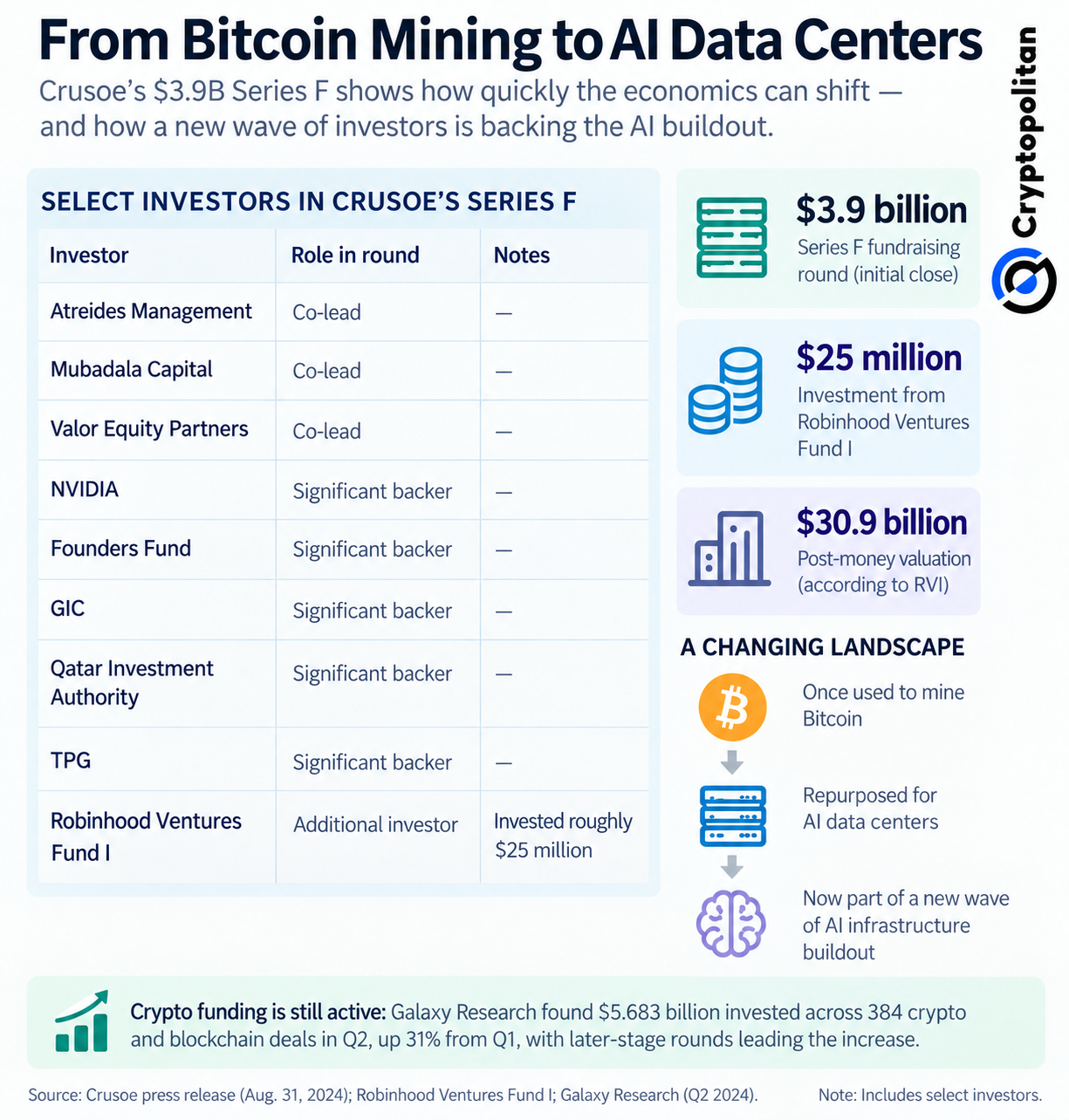
Robinhood Ventures Fund I (RVI) has invested approximately $25 million in Crusoe, the energy and data-center company that began as a Bitcoin miner and has since reoriented its business around artificial intelligence infrastructure. The transaction, which closed on August 31, forms part of Crusoe's $3.9 billion Series F fundraising round and gives retail investors a route to exposure to the company without a direct stake. It also underscores a broader reallocation of power and computing capacity once devoted to crypto mining toward AI workloads.
What Robinhood actually bought
According to RVI, the deal values Crusoe at $30.9 billion post-money. Crusoe has described the financing as the initial closing of a prospective $3.9 billion Series F round co-led by Atreides Management, Mubadala Capital and Valor Equity Partners, per the company's announcement. Nvidia, Founders Fund and the Qatar Investment Authority also participated, alongside RVI.
Sarah Pinto, president of RVI, said her focus lies more with the infrastructure layer than with AI models alone. She described Crusoe as “building a unique, vertically-integrated AI infrastructure asset that uses new energy sources to run data centers,” calling its energy-first approach characteristic of a frontier company to which investors should have access.
Robinhood chairman Vlad Tenev made a similar point on X, writing that the infrastructure underlying AI “matters as much as the models themselves.”
Retail access is the whole pitch
RVI began trading on the NYSE on 6. The closed-end fund requires neither accredited-investor status nor an investment minimum, and Robinhood says customers can invest with as little as $1 through fractional shares; fund details are available on Robinhood's RVI page. Because the fund is itself exchange-listed, holders gain exposure to privately held companies through the market price of RVI shares rather than by purchasing stakes in those companies directly. Its portfolio includes OpenAI, SpaceX, Stripe, Databricks, Canva and, now, Crusoe.
The Crusoe deal also pushes RVI's AI strategy further down the stack. In April, the fund invested $75 million in OpenAI, as Cryptopolitan reported, with Pinto describing OpenAI at the time as “one of the frontier artificial intelligence companies.” Crusoe adds the energy and data-center layer that keeps such models running.
From gas flares to AI factories
Crusoe began operations in 2018 by converting natural gas flared from oil fields into electricity for modular data centers, used at first for Bitcoin mining. By March 2025, it had deployed more than 425 modular data centers across seven U.S. states and Argentina. Later that year, the company disclosed that its Bitcoin mining operations and Digital Flare Mitigation subsidiary had been sold to NYDIG as it concentrated on building infrastructure for AI technologies.
Crusoe currently reports a total contracted value of more than $140 billion and 6GW in gross contracted capacity, with 1 GW already delivered and operational. The roughly 5 GW between those two figures is now the clearest measure of Crusoe's execution as it scales.
Why AI is rewriting mining math
Crusoe's move points to a wider repricing of mining infrastructure. CoinShares has found that listed mining companies with contracted AI or high-performance computing (HPC) capacity trade at an average of 12.9 times forward sales, while those without such contracts trade at only 3.7 times. More than $100 billion worth of AI/HPC backlog translates into just $1.1 billion in annualized revenue, meaning much of that value still depends on future developments. S&P Global has likewise documented miners repurposing their sites to accommodate AI and HPC.
Electricity is the common constraint linking Bitcoin mining and AI/HPC. Gartner estimates that global data center electricity consumption will rise 26% in 2026 to reach 565 TWh, with AI-optimized servers contributing 31% of that total. The shift raises the importance of existing and permitted sites that can serve higher-value purposes beyond Bitcoin mining.
Crypto capital is not vanishing
The pivot does not mean money is leaving crypto altogether. Galaxy Research found that investors put $5.683 billion into 384 crypto and blockchain deals in the second quarter, an increase of 31% from the previous quarter, with later-stage funding accounting for much of the rise. AI, however, is now competing with crypto for much of the same investment capital, power supplies and sites.
Crusoe's transformation shows how quickly those economics can change. Infrastructure that was once built to mine Bitcoin can become far more valuable when repurposed for AI. Whether the remaining closings of the Series F come together — and how quickly that contracted pipeline turns into delivered capacity — will show how durable the repricing proves to be.

