Robinhood Chain Tops Tokenized-Stock Holder Counts One Month After Mainnet Launch
Key Takeaways
- •Robinhood Chain has the most tokenized stock holders, with 329.2K users, according to Token Terminal data.
- •The network’s mainnet launched on July 1 and surpassed Solana in holder count in less than four weeks.
- •Tokenized stock holders across the sector rose from 554.9K to 934.8K since the start of the month, an increase of about 68.5%.
- •Robinhood Chain holds about 35% of tokenized-stock holders but only around $44 million in assets, while Ondo has about $857 million.
- •Trading on Robinhood Chain still leans heavily toward memecoins, with tokenized equities adding to, rather than replacing, that activity.
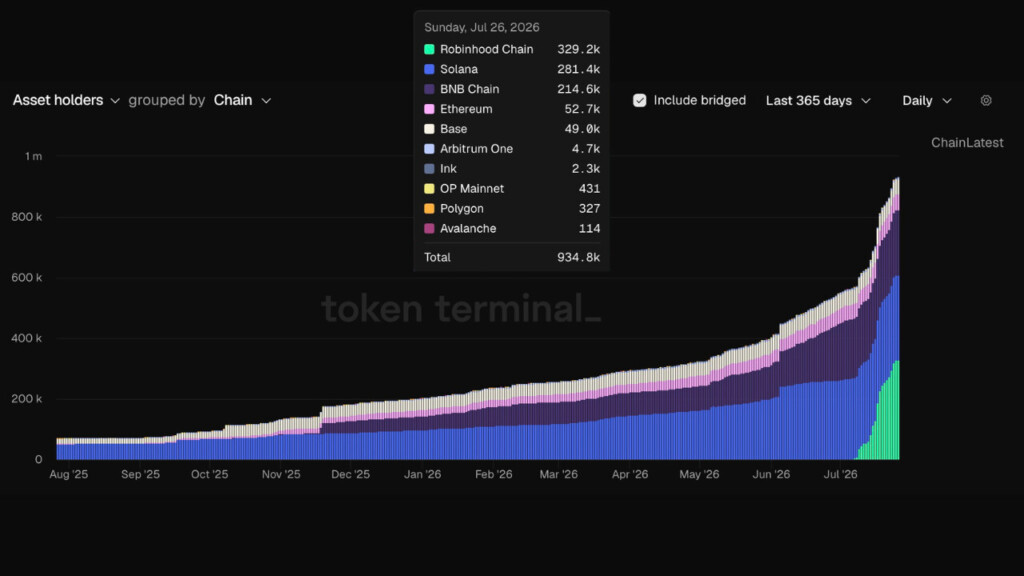
The number of tokenized stock holders has risen by about 68.5% since the start of the month, climbing from 554.9K to 934.8K. Much of that increase can be attributed to the launch of Robinhood Chain, which now has more tokenized stock holders than any other network.
Latest data from Token Terminal shows Robinhood Chain with 329.2K asset holders, ahead of Solana at 281.4K and BNB Chain at 214.6K. Robinhood Chain’s mainnet went live on July 1, and in less than four weeks it has overtaken Solana, a network that held the top position in this category for most of the past year.
Source: Token Terminal
The holder chart above shows where the growth came from. Solana led the sector throughout last year and, alongside BNB Chain and Ethereum, helped steadily expand the tokenized stock holder base. Then July arrived and a green block appeared almost vertically. Robinhood Chain now accounts for nearly a third of the entire sector by holder count, despite starting from zero.
Distribution Won This, Not The Chain
Robinhood Chain’s rapid growth did not come from shipping better infrastructure than other existing networks. It took the lead by owning the front door. In this context, the front door refers to the large existing user base under the Robinhood umbrella. Tokenized equities were introduced inside an established brokerage app that already had around 28 million users, most of whom did not need to think about a wallet, a bridge, or a gas fee in order to end up holding one.
That matters because tokenized stock adoption is still being shaped by access and familiar interfaces as much as by onchain design. Other networks in the tokenized stock market must persuade a broad base of existing crypto users to buy stocks. Robinhood, by contrast, only had to persuade stock users to click a button, and that decision is reflected directly onchain as a holder count.
A 35% Holder Share Sitting on $44 Million
The lead is broad, but it is also shallow. Robinhood accounts for about 35% of tokenized-stock holders, but only around $44 million in assets on the chain, according to data from DWF Labs. Ondo, by comparison, sits near $857 million with a fraction of the wallets.
The arithmetic is not flattering. Average holdings per wallet on Robinhood Chain work out to a little over $130. Retail accounts opening small positions in tokenized Tesla or Nvidia would produce exactly that pattern. Institutional and accredited flow, which is what Ondo has been building toward, tends to produce the opposite result. Holder count is a distribution metric, not a capital metric, and the two rarely move together at this stage.
Memecoins Still Take the Volume
Earlier this month, the chain’s story centered on memecoins and speculation, and that has not changed. Trading volume on Robinhood Chain still leans heavily toward memecoin activity, with tokenized equities growing on top of that base rather than replacing it.
Both dynamics are happening at once. The speculative layer brought the initial liquidity and attention, while the equity layer gives the chain a purpose beyond speculation. For tokenized stocks, that mix also helps explain why the holder tally can move quickly even while total assets remain comparatively modest.
What happens next depends on whether average balances rise. If holders remain near $130 per wallet, Robinhood will have built a very large but very shallow user base, and asset totals will continue to favor Ondo. If balances increase even modestly across 329,000 wallets, the ranking that matters could start to shift as well.

