Bitquery Ties 56 Robinhood Chain Memecoin Launches to $15.5 Million Rug-Pull Operation
Key Takeaways
- •Bitquery linked 56 memecoin launches on Robinhood Chain to a single group operating between July 10 and September 23, and revised estimated net proceeds to about $15.5 million, lower than analyst Wazz's earlier $18.43 million estimate covering 53 launches.
- •In the September 21 DEED launch, a single wallet funded the creation of 92 new addresses roughly 40 minutes before the token went live, and 25 tax-exempt wallets then bought about two-thirds of the supply in the next block.
- •Pons' 99% anti-sniping tax was largely neutralized because token creators can exempt chosen wallets from it, and the launchpad collected only 1.9 ETH in snipe tax across the 35 launches associated with the group.
- •Bitquery verified 467 other clusters on Pons using the same waiver-and-bundle approach with possible earnings of $11.6 million, while Pons reportedly generated $90 million in fees within a month.
- •A February 2025 SEC statement said meme coin transactions generally do not involve securities, leaving limited regulatory protection, and similar launchpad-driven patterns have emerged beyond Robinhood Chain, including on Circle's Arc platform.
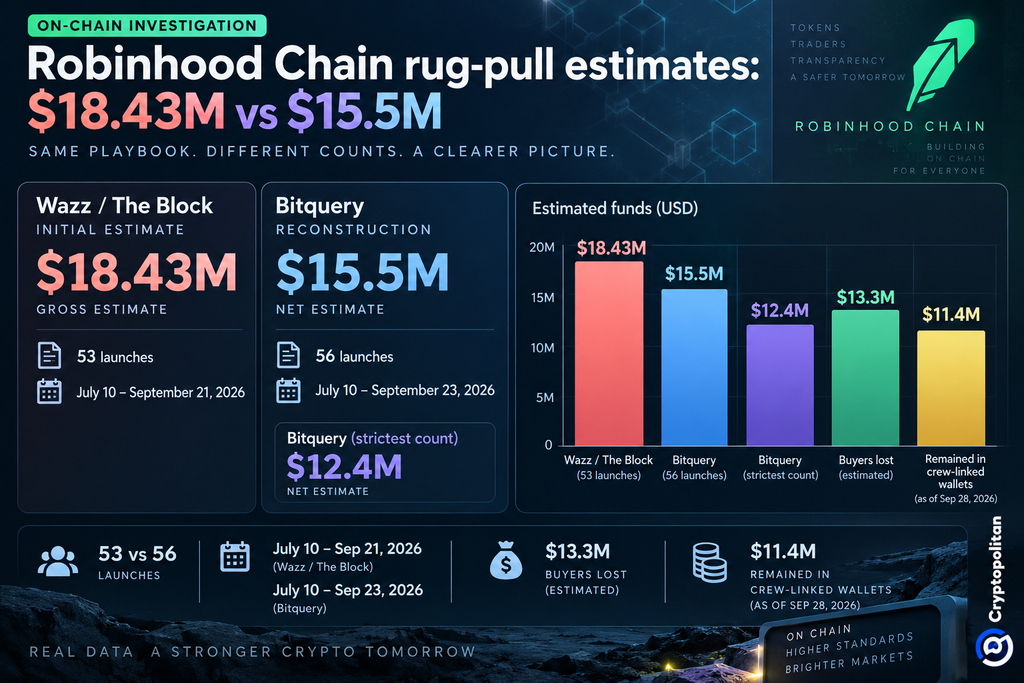
A blockchain investigation by analytics firm Bitquery has expanded the suspected rug-pull operation on Robinhood Chain to 56 memecoin launches, while revising the group's estimated take downward to $15.5 million. The firm published its findings on September 28, examining activity through September 23 — two beyond the cutoff date used for an earlier estimate of $18.43 million.
Beyond settling which estimate is more accurate, Bitquery's market analysis shows how the features used to launch new memecoins can give coordinated traders an edge over ordinary investors. Most of the traced activity took place on Pons, a token launchpad that runs on Robinhood Chain.
How a funded wallet buys the whole curve
Pons sells new tokens through a bonding curve, which gives the earliest buyers the lowest prices. To deter sniping, the platform charges a 99% tax on initial purchases, and the tax drops to zero within five seconds. Token creators can choose which wallets are exempt from the tax, according to The Block.
Bitquery tied one incident to the September 21 launch of DEED. About 40 minutes before the token went live, a single wallet linked to the group funded the creation of 92 new addresses. In the next block, 25 tax-exempt wallets bought roughly two-thirds of the entire supply.
“No one else got a single token at launch prices,” Bitquery wrote.
According to Bitquery, Pons collected only 1.9 ETH in snipe tax across the 35 launches associated with the group — a sign that the wallet exemptions largely stripped the tax of its power to prevent early sniping.
Two counts of the same operation
Wazz, a pseudonymous analyst, was the first to connect 53 launches between July 10 and September 21 to a single group, estimating that it made at least $18.43 million from the transactions. “The proceeds of one launch pay the key that funds the next,” Wazz posted on X.
The Block verified Wazz's observations by examining ten launches cited in the research and following the movement of a single fund, but it was unable to replicate the figures Wazz reported.
Bitquery then built its case on transaction data, counting 56 launches from July 10 to September 23, including UNREAL, which launched after Wazz's cutoff. Its estimate came in somewhat lower, at approximately $15.5 million net, or $12.4 million under its strictest accounting method. As of September 28, buyers had lost approximately $13.3 million, while the group's wallets accounted for close to $11.4 million in proceeds.
A launchpad-first pattern that travels
The group accounts for only part of the story. Bitquery has verified 467 other clusters on Pons using the same waiver-and-bundle approach, with total possible earnings of $11.6 million. That matters because launchpads are generating substantial activity: according to Cryptopolitan, Pons has already brought in $90 million in fees within a month.
The pattern is not confined to Robinhood Chain. Memecoin launchpads on Circle's Arc platform contributed approximately 82% of the $410.8 million in decentralized exchange volume on their first day, as reported by Cryptopolitan.
The regulatory backstop is limited as well. A February 2025 SEC statement said transactions involving meme coins that match its description generally do not involve securities, while stressing that different facts can lead to a different conclusion.
That leaves traders facing a problem that is more structural than isolated: the same tools that make token launches fast and accessible can also make coordinated early capture cheap and repeatable. Bitquery's reconstruction suggests the bigger warning is not one crew's $15.5 million haul, but how easily the same playbook can be run again.

