Robinhood Chain Assets Top $600 Million as Weekly On-Chain Activity Rises 50%
Key Takeaways
- •Assets deposited into Robinhood Chain applications rose to more than $600 million, according to Token Terminal data.
- •The amount locked in the network increased by about 50% over the past week.
- •The growth suggests stronger user engagement, higher capital inflows, and increasing developer interest in the ecosystem.
- •Robinhood Chain is part of Robinhood’s broader effort to expand beyond brokerage services into blockchain infrastructure.
- •Analysts say long-term adoption will depend on continued growth in users, applications, and network performance.
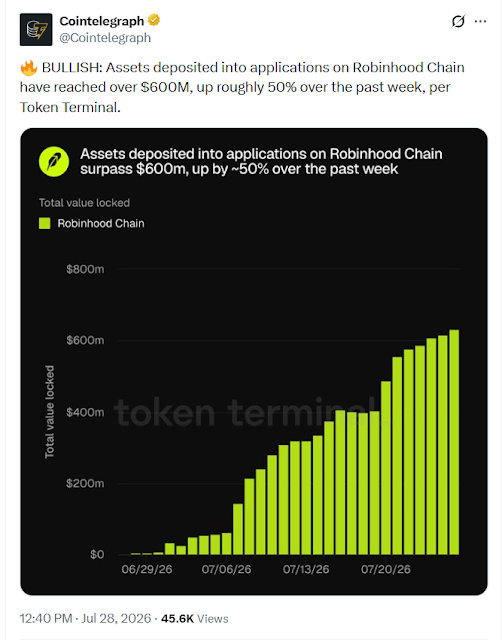
Robinhood Chain has crossed $600 million in assets deposited into applications built on the network, marking a notable rise in on-chain activity as interest in the emerging blockchain ecosystem grows.
According to data from Token Terminal, assets locked within Robinhood Chain applications increased by about 50% over the past week, signaling faster adoption and greater capital movement across decentralized applications.
The development was highlighted by Cointelegraph via its official X account, drawing attention from cryptocurrency investors and blockchain analysts. The sharp increase comes at a time when blockchain networks are being evaluated not just for speculation, but for their ability to support user activity, application growth, and real financial use cases.
Robinhood Chain Gains Momentum in the Blockchain Market
The growth in assets deposited into Robinhood Chain applications points to rising confidence among users and developers in the ecosystem.
Blockchain networks are often assessed through several adoption indicators, including:
- Total value locked (TVL)
- User activity
- Transaction volume
- Developer participation
- Capital inflows
A sharp rise in deposited assets generally suggests that users are actively interacting with decentralized applications and allocating funds to blockchain-based financial products.
The latest milestone places Robinhood Chain among a growing group of blockchain networks competing for users, developers, and liquidity, where early traction can help determine whether an ecosystem keeps attracting applications over time.
What Is Robinhood Chain?
Robinhood Chain is part of Robinhood’s broader effort to move beyond traditional brokerage services and become more involved in blockchain technology.
Robinhood, which is best known for retail trading services, has increasingly explored digital assets as consumer demand for cryptocurrency products has expanded.
A dedicated blockchain infrastructure can give platforms more direct access to decentralized applications and digital asset services.
The development also reflects a wider industry shift in which traditional financial companies are increasingly exploring blockchain-based solutions.
$600 Million Milestone Signals Rising User Interest
Crossing the $600 million mark is an important milestone for the Robinhood Chain ecosystem.
The roughly 50% weekly increase suggests that capital is moving rapidly into applications operating on the network.
Growth of this scale may indicate several factors:
- More users interacting with decentralized applications
- Higher demand for blockchain-based financial services
- Increased confidence from investors
- Greater developer activity
At the same time, analysts typically assess blockchain growth over longer periods to determine whether adoption is sustainable. Short-term gains can be affected by market conditions, incentives, new applications, or broader crypto sentiment.
DeFi Expansion Continues to Drive Blockchain Adoption
One of the main drivers of blockchain adoption has been the growth of decentralized finance, commonly known as DeFi.
DeFi applications allow users to access financial services without relying entirely on traditional financial institutions. These services include:
- Decentralized exchanges
- Lending platforms
- Yield opportunities
- Asset management tools
- Blockchain-based financial products
As more users look for alternative financial solutions, networks with strong application ecosystems often attract additional liquidity. Robinhood Chain’s recent growth reflects continued competition among blockchain networks to become major destinations for decentralized applications.
Interest in Blockchain Infrastructure Remains Strong
The rise in Robinhood Chain activity comes during a period of growing interest in blockchain infrastructure from both retail users and institutions.
Traditional financial companies have increasingly explored blockchain technology because of its potential advantages, including:
- Faster transactions
- Lower operational costs
- Improved transparency
- Digital asset innovation
- Tokenization opportunities
Companies that once viewed cryptocurrency mainly as a speculative market are now examining blockchain as a foundational technology.
Robinhood Expands Its Crypto Strategy
Robinhood has steadily expanded its role in the cryptocurrency industry.
The company initially became popular among retail investors for commission-free stock trading before moving into digital assets.
Over time, Robinhood has added more cryptocurrency features and increased its focus on blockchain development.
The launch and growth of Robinhood Chain represent a strategic step toward becoming more involved in the infrastructure that supports digital finance.
Competition Among Blockchain Networks Intensifies
The blockchain industry has become more competitive, with networks vying for users, developers, and liquidity.
Major blockchain ecosystems continue to invest heavily in:
- Scalability improvements
- Developer tools
- Decentralized applications
- User incentives
- Security upgrades
For newer networks, attracting significant capital remains one of the biggest challenges. The rapid growth of Robinhood Chain assets suggests the ecosystem is gaining attention in an increasingly crowded market where sustained participation matters as much as initial deposits.
Why Total Value Locked Matters
Total value locked is one of the most widely used metrics for evaluating blockchain activity.
TVL measures the amount of assets deposited into decentralized applications across a network. Rising TVL often indicates stronger user engagement and greater confidence.
Analysts also look at other factors, including:
- Number of active users
- Transaction activity
- Developer growth
- Revenue generation
- Security performance
A healthy blockchain ecosystem typically requires growth across multiple areas rather than relying on one metric alone.
Broader Crypto Recovery Supports Growth
The increase in Robinhood Chain activity also comes as the wider cryptocurrency market has seen renewed interest.
After periods of uncertainty, investors have increasingly returned to digital assets and have looked for opportunities in emerging blockchain technologies.
Periods of market recovery often encourage users to explore new platforms and applications, which can add liquidity across blockchain ecosystems.
Developers Continue Searching for New Opportunities
Developer activity plays a key role in blockchain network success.
A strong developer community can lead to:
- More applications
- Better user experiences
- Greater innovation
- Long-term ecosystem growth
Blockchain projects compete by offering attractive environments for developers to build new products. The growth of Robinhood Chain applications suggests that developers and users are beginning to explore opportunities within the network.
Potential Impact on the Broader Crypto Industry
The rise in Robinhood Chain assets could have effects beyond the network itself.
The growth shows continued demand for blockchain-based financial applications and highlights the growing connection between traditional finance companies and decentralized technology.
As more financial platforms enter the blockchain space, competition could drive further innovation across the industry. Users may see improved products, lower costs, and wider access to digital financial services.
Risks Remain Despite Strong Growth
Despite the recent gains, blockchain ecosystems still face a number of challenges.
Potential risks include:
- Market volatility
- Smart contract vulnerabilities
- Regulatory uncertainty
- Competition from established networks
- User adoption challenges
Rapid growth does not guarantee long-term success. Projects must continue improving security, usability, and functionality to maintain momentum.
The Road Ahead for Robinhood Chain
The next phase of Robinhood Chain’s development will likely depend on whether it can sustain user growth and attract more applications.
Key factors to watch include:
- Future capital inflows
- Developer participation
- New application launches
- Network performance
- Regulatory developments
If the ecosystem continues to expand, Robinhood Chain could become a more significant player in the blockchain industry.
Conclusion
Robinhood Chain has reached a major milestone after assets deposited into its applications surpassed $600 million, representing a roughly 50% increase in one week.
The rapid growth highlights rising interest in blockchain-based financial applications and shows how traditional financial companies are becoming more involved in decentralized technology.
While challenges remain, the surge in activity suggests that investors and developers continue to search for new opportunities across the expanding digital asset ecosystem. As blockchain adoption evolves, Robinhood Chain’s growth will be closely watched as a potential indicator of broader trends in crypto, DeFi, and the future of digital finance.

