Ripple Teams With Cicada and Clearpool to Build RLUSD Lending Market on XRP Ledger
Key Takeaways
- •Ripple, Cicada Partners and Clearpool are launching an institutional lending initiative on the XRP Ledger using Ripple USD as the loan currency.
- •Clearpool will provide the lending infrastructure, while Cicada will handle credit origination, underwriting and servicing.
- •The proposed borrowers include fintech companies, payment providers and crypto businesses seeking working capital.
- •The lending system depends on draft XRPL amendments XLS-66 and XLS-65, which still need validator approval before they can be activated.
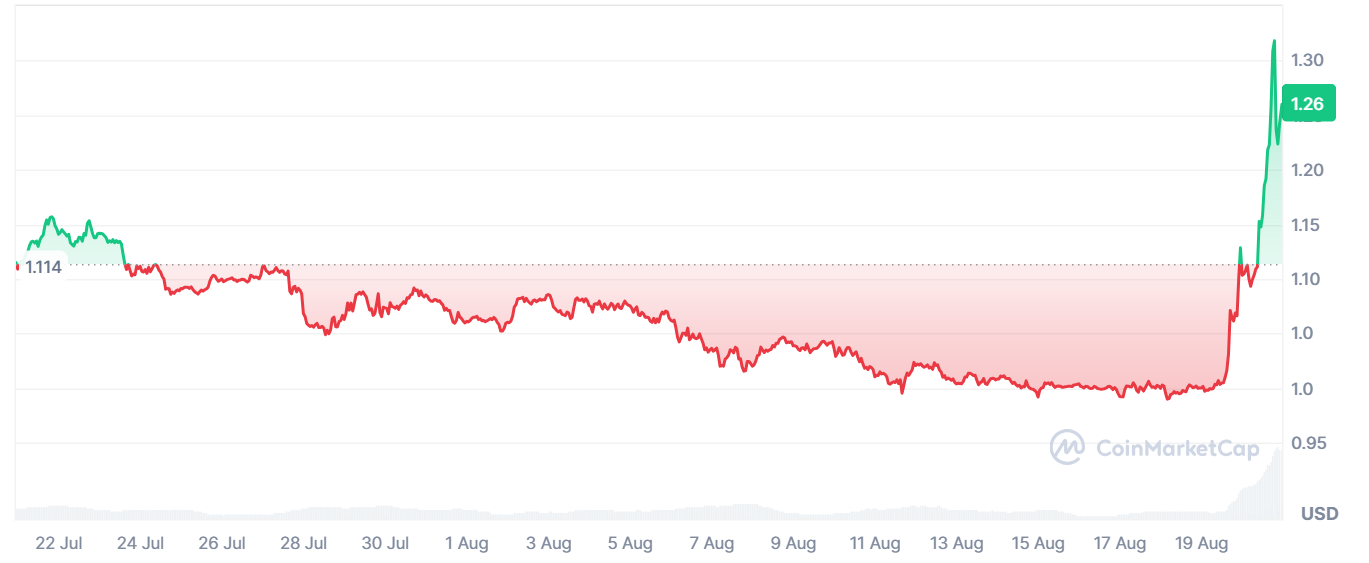
- •XRP has gained more than 12% in the past 24 hours and traded around $1.25, though it remains down 31% year-to-date.
Ripple is backing a new institutional lending initiative on the XRP Ledger, joining Cicada Partners and Clearpool to build credit markets denominated in Ripple USD (RLUSD). The announcement comes as XRP extends its recovery, with the token climbing more than 12% over the past 24 hours.
Ripple Backs Institutional Lending on XRP Ledger
Cicada Partners announced the initiative with Ripple and Clearpool on Aug. 20 (on X). Under the arrangement, Clearpool will provide the lending infrastructure while Cicada handles credit origination and servicing. Clearpool is an established on-chain credit protocol that already operates uncollateralized lending markets across multiple blockchains, and the new initiative extends that institutional credit model to the XRP Ledger.
Ripple will participate as a liquidity provider alongside other institutional investors, and the initiative will use Ripple USD, or RLUSD, as the underlying credit asset. RLUSD is the dollar-pegged stablecoin Ripple launched in December 2024, issued on both the XRP Ledger and Ethereum.
Target borrowers include fintech companies, payment providers and crypto businesses. These firms could use RLUSD loans for working-capital requirements once the infrastructure becomes operational.
The structure differs from conventional decentralized finance lending. Cicada will conduct offchain borrower underwriting, while the XRP Ledger records lending activity and settlement onchain. The initiative also reflects a broader industry push to bring institutional, uncollateralized credit on-chain, a niche that protocols such as Maple Finance and Goldfinch have pursued on other networks.
XRPL Lending Protocol Still Requires Approval
The project will rely on XLS-66, the proposed XRP Ledger Lending Protocol. The specification allows fixed-term, uncollateralized loans funded through pooled liquidity.
XLS-66 remains classified as a draft amendment. XRP Ledger documentation also shows that the LendingProtocol amendment is not enabled by default in the latest stable release. Under the ledger's amendment process, protocol changes activate only after a sustained supermajority of trusted validators — more than 80% support held for roughly two weeks — rather than at the discretion of any single company.
The protocol depends on XLS-65, which introduces Single Asset Vaults. These vaults aggregate assets from depositors and make liquidity available to protocols such as lending markets. XLS-65 also remains a draft standard.
That means Ripple, Cicada and Clearpool are preparing the market before the required amendments gain network consensus. The partnership therefore does not mean native XRPL lending is already fully operational, and validator approval remains an important technical milestone.
Ripple Says XRPL Can Support Institutional Credit
Ripple has positioned the XRP Ledger as infrastructure for institutional credit rather than purely retail decentralized finance.
The proposed lending architecture places loan terms, repayments and vault activity directly into XRP Ledger functionality. Ripple argues that this reduces dependence on separate smart-contract applications.
That design does not eliminate lending risk. XLS-66 still relies on offchain underwriting and risk management to evaluate borrower creditworthiness; the protocol instead moves execution and settlement onto the ledger. Credit managers would remain responsible for assessing borrowers and maintaining lending standards.
XRPL also includes compliance-oriented infrastructure such as Credentials and Permissioned Domains. These tools allow protocols to restrict participation based on approved credentials, and private vaults can therefore limit deposits to approved participants. That structure makes the proposed lending system more suitable for regulated financial institutions.
XRP Climbs Above $1 Amid Broader Market Recovery
Meanwhile, the partnership brings the highly anticipated native lending protocol on the XRP Ledger closer to reality. According to the Ripple announcement, the protocol will benefit the XRPL ecosystem in several ways. It noted that the setup would boost adoption of RLUSD, as every loan would be denominated in the stablecoin, while increased activity on XRPL will also boost XRP.
“XRP serves as the native settlement asset — every lending transaction on XRPL, from issuance to repayment to LP deposits, settles using XRP for fees and reserves, furthering its utility,” it said.
XRP is already seeing sizable gains, although they might not be related to the lending news. The broader market has been on an uptrend, and XRP is up more than 12% today, adding almost 25% in the past seven days.
The positive performance has led XRP to climb to around $1.25, its highest price level since June 2026. Despite the gains, XRP is still down 31% year-to-date.

