Ripple Takes On Banks in $256 Billion Leveraged ETF Market as XRP Trades Near $1.40
Key Takeaways
- •Ripple Prime, the brokerage Ripple formed through its $1.25 billion acquisition of Hidden Road, now provides swap financing to leveraged ETFs, an activity historically dominated by major banks.
- •The Tradr 2X Long SNDK Daily ETF pays Ripple the overnight bank funding rate plus 4 percentage points, which equaled roughly 8% of the fund's assets on an annualized basis as of Tuesday.
- •The United States hosts 593 leveraged ETFs managing more than $256 billion, including 426 single-stock funds, according to Morningstar Direct.
- •Ripple Prime launched a Delta One business in August 2026 offering total return swaps on U.S. stocks, indexes and digital assets, and raised $275 million through senior unsecured notes rated BBB by KBRA.
- •XRP traded near $1.40, down more than 5% over 24 hours, and the reported ETF financing deals have not been tied to XRP or Ripple's RLUSD stablecoin.
Ripple has entered the business of financing leveraged exchange-traded funds through its brokerage arm, Ripple Prime, stepping into prime brokerage — the trading, financing and clearing services that institutional investors such as hedge funds and ETF managers rely on — a corner of Wall Street long dominated by major banks and securities firms. The Wall Street Journal reported the move on Oct. 7.
The arrangement marks another step in Ripple's broader push into institutional finance, built around the prime brokerage it assembled through acquisition. Swap financing of this kind earns steady fees for the firms that provide it, and it casts the crypto payments company in a new role: fee-earning counterparty to traditional fund managers.
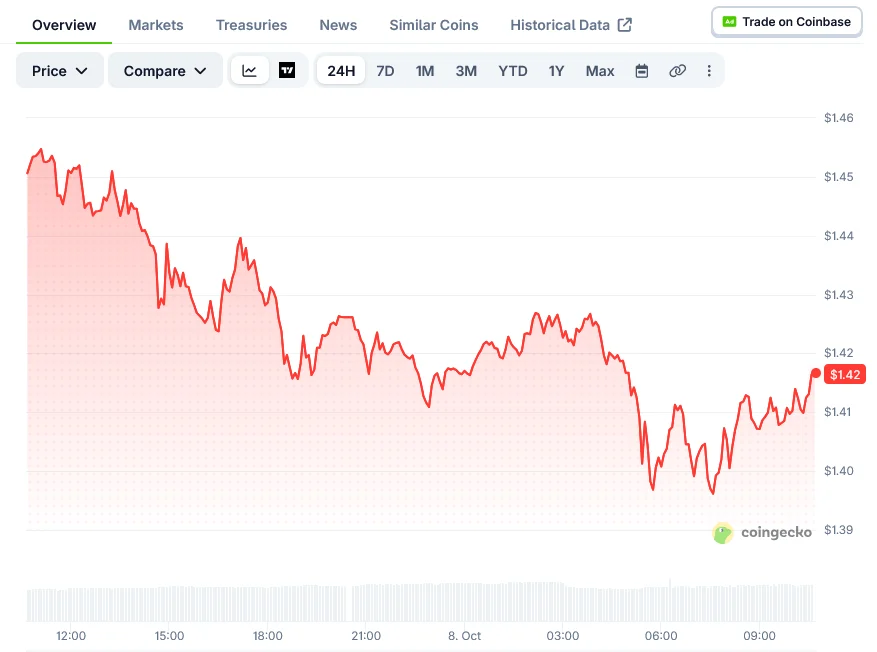
XRP showed little reaction to the news. The token traded near $1.40 at the time of writing, down more than 5% over the past 24 hours. XRP is the native token of the XRP Ledger, which Ripple uses in its payments business. Technical indicators leaned bearish, with seven sell signals against five buy signals.
How Ripple Prime's ETF Financing Works
Leveraged ETFs aim to deliver two or three times the daily return of a stock or an index. Rather than buying the full amount of underlying shares, their managers often use total return swaps. A broker sells the fund the swap for a fee and then hedges its exposure by buying stocks or other derivatives.
Because leveraged funds reset their exposure each day, reliable access to swap financing is central to how they operate.
One of Ripple's clients is the Tradr 2X Long SNDK Daily ETF, which tracks twice the daily move of Sandisk shares. According to a regulatory filing, the fund pays Ripple the overnight bank funding rate plus 4 percentage points. As of Tuesday, that fee worked out to roughly 8% of the fund's assets on an annualized basis. The cost is borne by the ETF's investors and is separate from the fund's management fee — a recurring charge that accrues for as long as the fund keeps its swaps in place.
The market is substantial. According to Morningstar Direct, there are 593 leveraged ETFs in the United States managing more than $256 billion, of which 426 are single-stock funds. Leveraged ETFs, particularly single-stock funds, have expanded quickly in recent years, and every fund doubling or tripling daily exposure needs a counterparty on the other side of its swaps.
“It's definitely a growing and meaningful part of our business,” said Noel Kimmel, president of Ripple Prime.
Nonbank firms such as Jane Street and Clear Street are also active in this market. Banks face stricter rules on risk, and many newer ETF issuers lack long-standing relationships with banks. That dynamic has created room for nonbank balance sheets, and Ripple Prime's arrival gives ETF issuers one more financing counterparty outside the banking system.
Hidden Road Deal and New Funding
Ripple entered prime brokerage through its $1.25 billion acquisition of Hidden Road. The deal was announced in April 2025 and closed in October 2025, when the firm was rebranded as Ripple Prime.
In August 2026, Ripple Prime launched a Delta One business offering total return swaps on U.S. stocks, indexes and digital assets; the leveraged ETF financing uses the same type of instrument. Delta One products provide synthetic exposure that tracks the performance of an underlying asset. In effect, the same swap infrastructure now serves crypto-exposed clients and traditional leveraged funds alike.
The brokerage raised $275 million in August through senior unsecured notes rated BBB by KBRA. That followed a $200 million financing facility from Neuberger Berman in May.
Ripple Prime serves more than 300 institutional clients and reported holding over $1 billion in regulatory net capital, a measure of the capital broker-dealers must maintain under securities rules. The reported ETF financing deals have not been tied to XRP or Ripple's RLUSD stablecoin.
On Oct. 6, Ripple Prime expanded its agreement with Brevan Howard, which manages about $35 billion. Under the arrangement, Ripple will provide the hedge fund with prime brokerage, clearing and financing across both traditional and digital markets.

