Ripple's $750M Buyback Lifts Valuation to Roughly $50Bn — But Not XRP Holders
Key Takeaways
- •Ripple’s $750 million share buyback values the company at about $50 billion, nearly double Circle’s valuation.
- •Ripple has expanded into a diversified financial holding company after acquiring several businesses, including Hidden Road, Rail, GTreasury, and Palisade.
- •The company does not disclose public financial statements, leaving the market without a clear revenue-based valuation metric.
- •XRP holders do not receive equity, cash-flow rights, or a claim on Ripple’s treasury from the company’s buyback or private valuation.
- •Ripple’s XRP holdings stopped being reported in May 2025, around the time its acquisition activity accelerated.
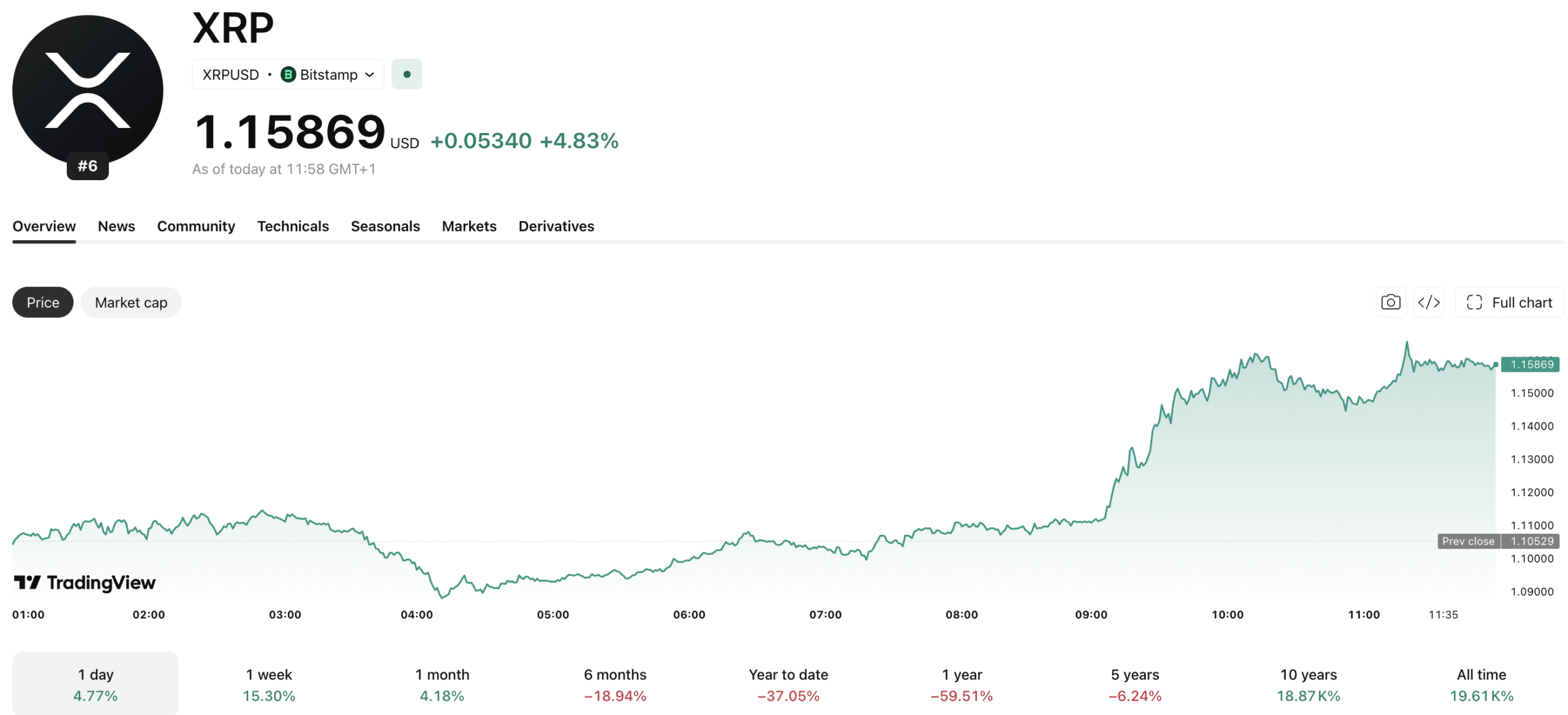
In the latest XRP news, Ripple has agreed to buy back $750M in shares from employees and early investors, a deal that values the privately held company at roughly $50Bn — up from about $40Bn in November 2025.
That figure makes Ripple worth nearly twice as much as stablecoin issuer Circle, even as the XRP token trades roughly 60% below its record high from last summer, according to CoinGecko.
The gap between a soaring corporate valuation and a battered token price is not a contradiction; it is the story. The tension is this: Ripple's balance sheet is thriving, but a larger Ripple share buyback and a higher Ripple valuation do not give XRP investors any equity, cash-flow rights, or a guaranteed price floor.
Quote of the Day:
Ripple's acquisition spree may not be over yet. Brad Garlinghouse has already signaled that Ripple could become more acquisitive again
— 𝗕𝗮𝗻𝗸𝗫𝗥𝗣 (@BankXRP), August 19, 2026
Why Ripple's Business Looks Stronger Than Its Token
Ripple is no longer just a company that happens to have created XRP. Following the resolution of its long-running case with the US SEC in 2025, the firm embarked on an acquisition spree that reshaped it into a diversified financial holding company.
"They're clearly in a better position than Circle," Gregoire le Jeune, CEO of stablecoin startup Darika Labs, told DL News. "They have a large treasury and a crazy capacity today but need to be perceived as very cheap versus Tether."
Ripple spent roughly $2.5Bn last year buying up the prime brokerage firm Hidden Road, the stablecoin infrastructure company Rail, the treasury management platform GTreasury, and the crypto custody provider Palisade — all of which are now folded under the Ripple Prime banner.
The company has also picked up two Australian firms this year, part of what Fiona Murray, managing director of Ripple's Asia Pacific business, called a "key market," and it now holds more than 75 licenses and registrations worldwide.
That enterprise push into cross-border payments is exactly why the company's payments and adoption footprint matters more to its valuation than XRP's spot price does. "If you're building a fintech company in 2026, the likelihood of you doing business with Ripple is very, very high," Le Jeune said.
The Revenue Question Nobody Can Answer
Buying out nearly $1Bn in shares in under a year signals confidence, but Ripple discloses no public financial statements, leaving analysts guessing at the real numbers behind the Ripple valuation.
"An easier proxy for valuation is gross revenue at the very least, which is a metric we can't find for now to understand the nuances around Ripple valuation," said Eliézer Ndinga, global head of research and founding venture partner at 21shares.
Ndinga described Ripple's trajectory as the building of a conglomerate structure similar to Digital Currency Group's, stitching together sister businesses that can leverage Ripple's in-house technology.
He also flagged a separate unresolved question: how much of Ripple's valuation still rests on its XRP holdings rather than operating revenue. "As per the token, more details are needed to assess whether there is a link to the equity or revenue," he added.
That opacity is compounded by timing. Ripple's treasury was worth a combined $27.5Bn as of March 2024, with the bulk of it locked in escrow, but the company stopped reporting its XRP holdings altogether in May 2025 — right around the time its acquisition binge accelerated.
Equity and the XRP Token Are Not the Same Asset
MASSIVE: Ripple CEO Brad Garlinghouse says Ripple's platforms now touch $16,000,000,000,000 in transactions, comparable to VISA. pic.twitter.com/9WnA9qisyA
— STEPH IS CRYPTO (@Steph_iscrypto), August 19, 2026
This is the distinction that gets lost every time a headline valuation like $50Bn circulates: a Ripple share buyback moves money between the company and its private shareholders, not between the company and XRP holders.
Owning XRP gives no claim on Ripple's revenue, its acquired businesses, or its treasury — a separation that the underlying regulatory framework around XRP has reinforced rather than blurred.
Talk of an eventual Ripple IPO has trailed the company for years, and a $50Bn private valuation with cash on hand to fund buybacks reduces any urgency to go public in the near term.
Until that changes, private-market gains stay locked inside Ripple's cap table, while the XRP price continues to trade on public exchange liquidity, sentiment, and regulatory headlines — the same forces that dragged it down 60% from its highs regardless of what Ripple's internal valuation says.

