Ricardo Salinas on Mexico's Future, Bukele and Bitcoin: 'We Need to Change Our Management'
Key Takeaways
- •Ricardo Salinas Pliego said Mexico requires a change in governance, pointing to 2030 elections that will renew the presidency, Congress, Senate, and 18 governorships after midterms in June 2027.
- •He praised Salvadoran President Nayib Bukele for making El Salvador the only country to adopt Bitcoin as legal tender, a law that took effect in September 2021.
- •He estimated that U.S. federal debt rose from roughly $25 trillion to $40 trillion over the past four years and warned that interest costs will crowd out defense and welfare spending.
- •He said the past 12 months have been punishing for Bitcoin holders, but argued that government borrowing and currency debasement leave Bitcoin's core investment thesis intact.
- •He linked Paraguay's central bank takeover of Ueno Bank and the Senate vote to remove President Santiago Peña to a structural flaw in banking: borrowing short while lending long.
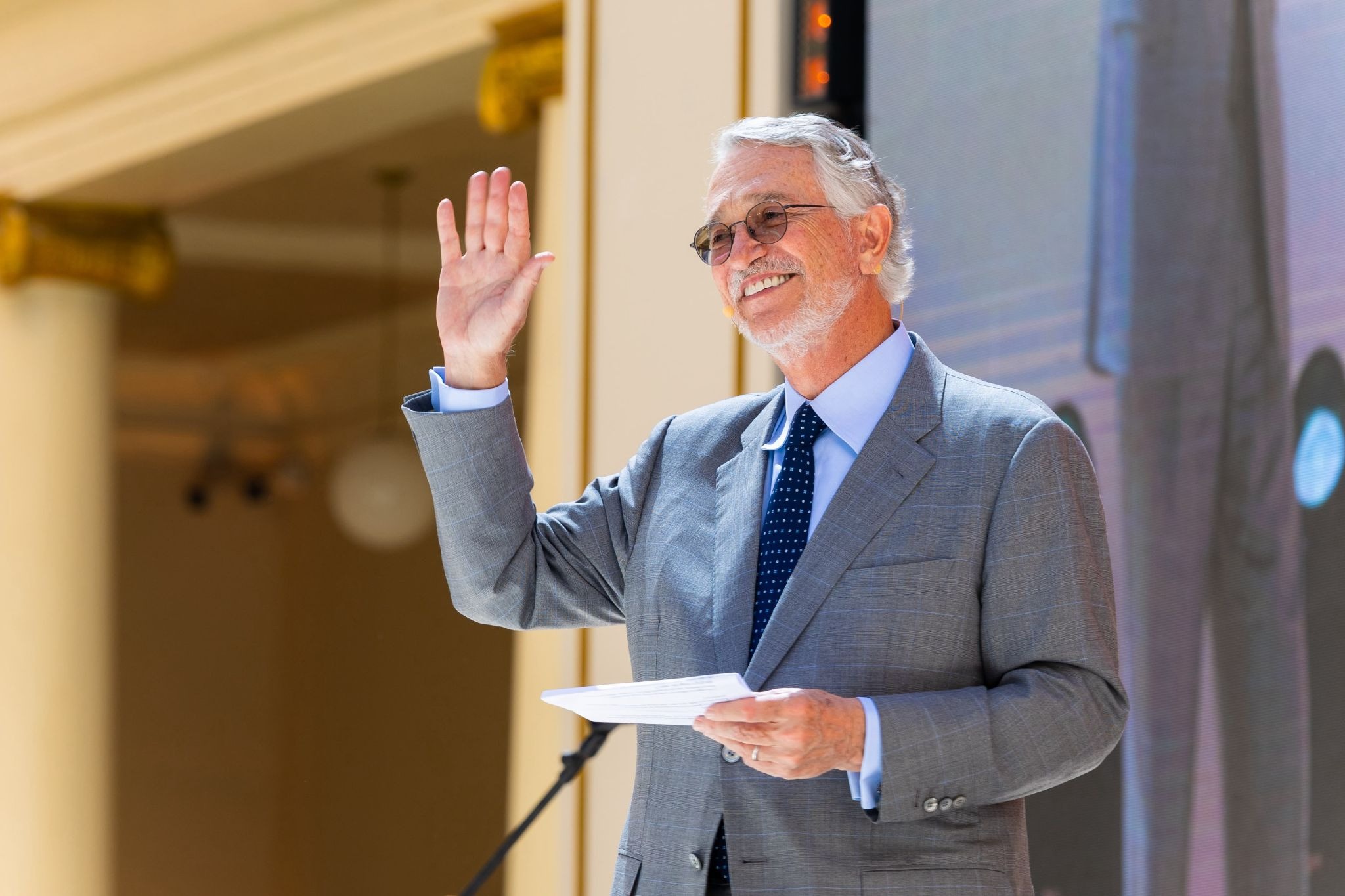
Mexican billionaire Ricardo Salinas Pliego — the man behind Grupo Salinas and one of Bitcoin's most vocal champions in Latin America — used an interview recorded at Bitcoin Histórico in El Salvador this week to deliver unvarnished verdicts on Mexico's political future, President Nayib Bukele's leadership, Washington's debt spiral, and the punishment Bitcoin holders have endured over the past year.
Grupo Salinas spans broadcasting, banking and telecommunications — TV Azteca and Banco Azteca are among its best-known holdings — which means his pronouncements on governance and money reach well beyond Bitcoin circles.
The conversation took place inside San Salvador's National Palace on the You're The Voice podcast, and Salinas did not temper his remarks.
Mexico's 2030 Window
Asked to identify Mexico's biggest challenge, Salinas began with the country's fundamentals. "We're 130 million Mexicans," he said, joined by another 40 million people of Mexican origin living in the United States who send home "$5 billion a month in remittances. We call that love." He also noted that half of Mexico's population is under 30.
The obstacle, in his view, is governance. "We have a problem: the terrible management that we have, the terrible government that we have. The political class is despicable. They're incapable. They're corrupt. They lie all the time. So we need to change our management. And I'm working on that."
Pressed on whether he plans to be part of that change, Salinas separated two arenas. Of "the battle of ideas, what we call the cultural battle," he said, "I'm all in." Elections are another matter: "The electoral battle has timing, it has windows, and it has rules, and I don't set them."
He then mapped out the calendar. In June 2027, Mexico votes for its entire lower house of Congress and 18 of its 32 governorships. In 2030, "we have everything up for grabs: the Congress, the Senate, the presidency, and the other 18 governors." Mexican presidents serve a single six-year term without re-election, so the 2030 cycle concentrates a full renewal of federal power into one vote — the backdrop that makes his "we need to change our management" remarks more than idle commentary.
"So it's going to be interesting in '30," he said. "But from here to there, it's a long time, huh? We'll take it one day at a time."
Bukele: "He Was the Only One That Did It"
The evening before the interview, Salinas joined fellow Bitcoin Histórico speakers for dinner with President Nayib Bukele. One lighthearted moment saw the Salvadoran leader mock his own haste: he had rushed to make El Salvador the first country to adopt Bitcoin as legal tender — a law that took effect in September 2021 — because he believed other nations were about to beat him to it. In hindsight, he found the rush amusing.
"And it didn't happen, right? He was the only one that did it," Salinas said. "So these things take time. There's a lot of entrenched interest in the financial world and in government circles that do not want to see the end of fiat. Because fiat, what I call the fiat fraud, is what enables all the spending, right? And if you live off of that, you don't want it to stop."
Salinas highlighted El Salvador's peculiar monetary position: the U.S. dollar serves as its currency, and it cannot be printed locally. "So Bukele was saying last night, 'I'm not in charge of the inflation.'"
He is optimistic about the country's trajectory. "They're growing very fast here," he said, adding that he expects El Salvador to "do much better, with the changes that Bukele has put in place." Critics of the country earned a shrug: "You have to take things from who they come from."
America's Welfare-Warfare State Is "Alive and Well"
In a 2022 interview with Max Keiser and Stacy Herbert, Salinas argued that fiat money is what makes the "big state" possible, financing both the warfare state and the welfare state. Four years on, he sees no change — and points to the United States as the clearest case.
"The United States is the maximum example of the welfare-warfare state. The exceptionalism of the United States is that they get to print the reserve currency of the world."
Invoking the Cantillon effect — the Austrian School observation that newly created money reaches some people before others — Salinas said those first in line are "all these defense contractors and the warfare state," with welfare programs such as Medicaid and hospitals following behind.
"So I think the welfare-warfare state is alive and well," he said. By his count, U.S. debt has climbed from roughly $25 trillion to $40 trillion over the past four years, "and there's no end in sight. They're not going to stop."
He characterized Washington as "borrowing like a drunken sailor" and warned that interest costs will crowd out everything else. "The amount of interest that the US government is going to have to pay on this debt is huge, and it's going to leave very little money for all the rest of the stuff, including defense and welfare."
"Is It Over for Bitcoin?"
Salinas was blunt about the past year. "The last 12 months have been hell for Bitcoiners," he said. "That's the title of my talk: 'Is It Over for Bitcoin?'"
His answer is no. "But you have to be able to take the blow. And not many people are able to take the blow, because it's much more psychological than financial."
Price swings, he argued, leave the core thesis intact. "Governments are borrowing much more than they should, they're spending much more than they should, and that's causing the debasement of the currency. And that's stealing from people's pockets. Period. And we're all being victims of this."
He also dismissed standard portfolio guidance. The classic 60% stocks, 40% bonds allocation for young investors is, in his words, "really bad advice. It's self-serving, by the financial industry." That gap, he said, "is where investing in Bitcoin comes in."
Paraguay and "the Original Sin of Banking"
The interview took place days after Paraguay's central bank took over the digital lender Ueno Bank, freezing depositors' access to their funds, and the country's Senate voted to remove President Santiago Peña from office over the crisis. Peña, who held shares in Ueno's parent company until last year, has denied wrongdoing.
For Salinas — whose Grupo Salinas owns Banco Azteca — the episode laid bare a defect shared by every bank on earth. "The original sin of banking, is borrowing short and lending long."
Depositors assume their money is available on demand, he explained, while the bank has committed it to car loans, mortgages, and office buildings carrying longer maturities. "All the banks in the world, in every country, operate the same way. They borrow short and they lend long, so they always have a liquidity problem. Always." The remedy would be full reserve banking, he noted, "but there are no full reserve banks in the world today."
Paraguay's collapse, he said, paired that structural weakness with bad decisions — and something more serious. "The more serious accusation is that the owners of the bank were using the assets of the bank for their own purposes, outside of the regulatory framework."
Salinas called Peña "a good leader," while saying he does not know how involved the president was. He flagged the political fallout: "All the left-wingers are celebrating the demise and the fall of Santiago Peña, and populism is increasing its calls for more government intervention, more spending."
On reports that pension money was held at the bank, he was unsparing about official assurances, which he said "are usually worth nothing." Pension pools, he added, are a tempting target for the state: "Governments love to put their hands on other people's money. It's a great target. And I think that's what happened in Paraguay."
"The Treason of the Intergenerational Pact"
In Salinas's telling, the youngest generations foot the bill for promises made to their elders. Before Mexico's 1997 pension reform, he said, the government was "taking taxes from young people to pay the pensions of the old people. That's a really bad deal for young people." The reform replaced that arrangement with privately managed individual retirement accounts, known as Afores.
He traces the problem to "this wrong idea that the government is like a parent." In Asia and Latin America, "the family is the life raft of people. Because you cannot trust the government." In Europe and the United States, "people have been made to believe that they can trust the government, and it's wrong."
A father of six and grandfather of ten, Salinas summarized his own commitment plainly: "I'm going to try to leave them a better place than the one I found."
He reached for a deliberately provocative comparison: "So what happens in a family where the mother is a prostitute and the father is a drunk? What kind of family is going to come out of that? Well, nothing good, right?" The West, he argued, has been "deceived into thinking that some bureaucrats are going to take care of these children. They're not."
"That is the treason of the intergenerational pact," he said. "It's very serious. And that manifests itself in taking on debt, wars, spending, student loans…"
His advice to young people begins with awareness: "Find out what they're doing to your future. Find out what they're doing to your money." Then comes what he calls "the tax bite." By his estimate, government takes roughly 47% of labor income in Mexico and 60% in France, against just 5% in Guatemala. "Don't let the government steal the product of your work."
Bukele in Haiti, Nuclear Plants in the Dominican Republic
Salinas also disclosed that he is weighing investments in the Dominican Republic, which he called "a well-managed country" with a successful focus on tourism and agriculture. Its neighbor on the island drew a harsher assessment: "Haiti is a basket case for governance and democracy."
Hope, he suggested, is arriving from El Salvador. Bukele recently dispatched more than 2,000 Salvadoran troops to Haiti, a move Salinas welcomed: "sending in 2,000 troops to put down the gangs. I think it's a great start in the right direction."
The Dominican Republic's central challenge, he said, is energy, which the country must import. One option he has explored is small nuclear power plants, though President Luis Abinader is wary of the impact on tourism. Salinas disagrees with that concern. "You can't have tourism if you don't have energy, right? You need a lot of energy."
"It's Not So Difficult"
Asked what sustains his optimism, Salinas described the cycle he believes drives prosperity: freedom breeds creativity, successful ideas get copied, and copying drives improvement. "Copy, improve. Copy, improve. And that is what leads to prosperity."
The standing obstacle, in his view, is the state. "They cut down on freedom. They cut down on innovation through regulation. They cut down on competition through all these protectionist and crony laws, right? And then they take the product from people's hands and mouths and spend it on stupid things."
His prescription is compact: "It's freedom, innovation, competition, prosperity. Small, very small government, for law and order and defense. That's it."
Libertarian principles, an Austrian economist's grasp of money, a Bitcoiner's conviction, and a patriarch's devotion to family: Salinas has stated his recipe openly. What Mexico learns by 2030 is whether he intends to serve it himself.
This article first appeared on Bitcoin Magazine and is written by Efrat Fenigson.

