T-REX Rebrands as Rexy, a Consumer App That Rewards Verified Online Activity
Key Takeaways
- •Rexy launched on August 24, 2026 as the rebranded version of T-REX, a community active since 2025, and is accessible through a browser extension and its website.
- •The platform uses zkTLS-based Sealed Proofs to verify a single fact from a user's app without exposing underlying data or moving session information off the device.
- •At launch, 320,000 users qualify for rewards and collectively hold 2.5 million Sealed Proofs, with 70,000 active daily and more than $100,000 in verified transactions clearing weekly.
- •Businesses fund offers tied to provable facts across trading, artificial intelligence, and travel sectors, paying rewards such as discounts, stablecoin or cash rebates, waitlist access, or tokens.
- •Rexy cites the 2026 Thales Bad Bot Report showing AI generates most web traffic, along with 2025 Visa and Mastercard toolkits for AI-agent-initiated payments, as context for its proof-based exchange model.
Hong Kong, Hong Kong, August 24, 2026, Chainwire — The platform says it allows anyone to prove facts from the apps and services they use without exposing anything else. It turns those proofs into offers a person qualifies for and rewards them when a business acts on one.
T-REX is now Rexy
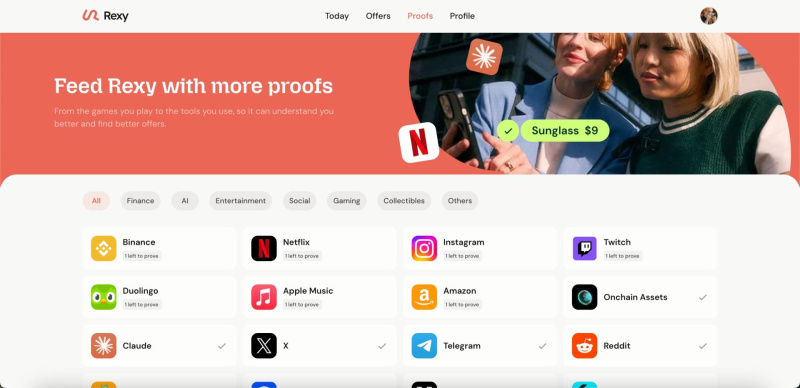
Rexy, a consumer app that rewards people for their proven online activity and matches each person to offers based on what they can prove, launched today. The activity, and the community that built it, have grown under the T-REX name since 2025, and the platform is now called Rexy. From launch, it reaches people in two ways: through a browser extension and directly from the platform.
The new name arrives at a time when, according to the platform, the internet has lost the ability to distinguish a real potential customer from a manufactured visitor. AI now generates the majority of web traffic, according to the 2026 Thales Bad Bot Report, and a model can produce an account, a history, and an intent that appear authentic at scale for almost nothing. The strain on conventional adtech signals predates the bot problem: privacy changes such as Apple’s App Tracking Transparency, introduced in 2021, curtailed cross-app tracking and pushed advertisers toward first-party data they could verify. Rexy says that whether a person or an artificial intelligence is on the other end matters less than it once did, since an agent acting for someone with a genuine record is also a counterparty worth acquiring. Payment networks have begun building for that agent-driven shift, with Visa and Mastercard each introducing toolkits in 2025 for payments initiated by AI agents on a user’s behalf. What businesses lack, according to Rexy, is a network that can show whether that counterparty is worth an acquisition offer, while the click, form, and sign-up no longer answer that question. The platform is built for that exchange between proofs and offers.
How proving works
Rexy is described as an agent that helps a person collect the record of what they have done from the online applications they use, then draws from it a list of offers they are eligible for. Each offer is tied to something specific and provable, such as a subscription kept for years or a spending history above a set size.
Each offer requires a fact the person can prove. To claim one, a person privately seals a single true fact from an app they use, such as that a trading account is more than ten years old or that an online shopping history exceeds a set amount, and registers it as a Sealed Proof so that only that one fact ever leaves the app. A Sealed Proof is built with zkTLS, a method that proves a single fact from the encrypted session behind the browser padlock. The app takes no part in the process, and the session data never leaves the device. A person can therefore confirm sensitive data such as an account’s age or the amounts spent on it without revealing the figures. Zero-knowledge proofs have been deployed at scale in blockchain networks in recent years, and zkTLS adapts them to credential verification, an area where multiple protocol teams have built tooling as interest in proof-based identity has grown.
How rewards are funded
Those proofs are what draw the offers displayed on Rexy. Each one comes from a business looking to reach a particular kind of customer, while each proof can also open a different set of offers. A single high-value proof can qualify a person for a premium opportunity, while proofs across more categories of consumer apps can open a wider range of relevant offers. Rexy says it helps a person prove the right fact for the right opportunity. When the person completes the action an offer requires, they seal a proof of it, and the network confirms the completed action and settles the transaction before Rexy pays the reward.
The company gives examples across several sectors. In trading, a platform funds an offer for people who can prove a volume above a threshold and pays when one of them opens and funds an account. In artificial intelligence, a company funds an offer for people who can prove a paid tier and daily use of a comparable tool, and pays for the subscription that follows. In travel and lifestyle, a hotel group funds an offer for people who can prove a status tier or a number of nights a year, and pays on the booking.
The reward itself is set by the business and may take the form of a discount, a cash rebate in stablecoins or ordinary money, a place on an invitation-only waitlist, or tokens.
The network at launch
Rexy says that exchange is already running at scale. To date, 320,000 people already qualify for those rewards, each carried forward with the permissioned credentials they built under the T-REX name since 2025. Those people hold 2.5 million Sealed Proofs, with 70,000 active every day and more than $100,000 in verified transactions clearing every week. Questions ahead include whether offer funding broadens beyond the trading, artificial intelligence, and travel categories the company names, and whether the carried-forward credential base keeps sealing proofs at that daily pace as more businesses join.
“For thirty years the largest industry of the internet, adtech, could learn everything about people thanks to their clicks, and monetize that data,” said Sunny Chan, co-founder of Rexy. “Rexy. With AI, a real life and online history has become the only scarce thing worth reaching for, and people finally can finally reap what they have acculated over the years.”
Rexy is available now at rexy.so.
About Rexy
Rexy is a consumer gateway to agentic commerce. It uses privacy-preserving proofs and blockchain settlement to turn verified online activity into targeted offers and rewards, without exposing the underlying data. Rexy carries forward the T-REX community and its credentials.
Sunny Chan: contact@rexy.so

