Revolut Secures Conditional OCC Approval for U.S. National Bank Charter, Targeting 2027 Launch
Key Takeaways
- •Revolut announced on September 3, 2026 that it received conditional OCC approval for a U.S. national bank charter, roughly six months after filing its application in March 2026.
- •The bank cannot launch until Revolut obtains FDIC approval, Federal Reserve sign-off, and final OCC authorization.
- •Revolut plans to launch the U.S. bank in the first half of 2027, headquartered in Stamford, Connecticut, with approximately $95 million in capital and about 160 employees.
- •Once approved, the bank is expected to offer loans, credit cards, FDIC-insured deposits, and access to stablecoins and cryptocurrencies.
- •Revolut serves more than 80 million customers globally, and a U.S. charter would provide direct access to payment rails like Fedwire and ACH, reducing dependence on partner banks.
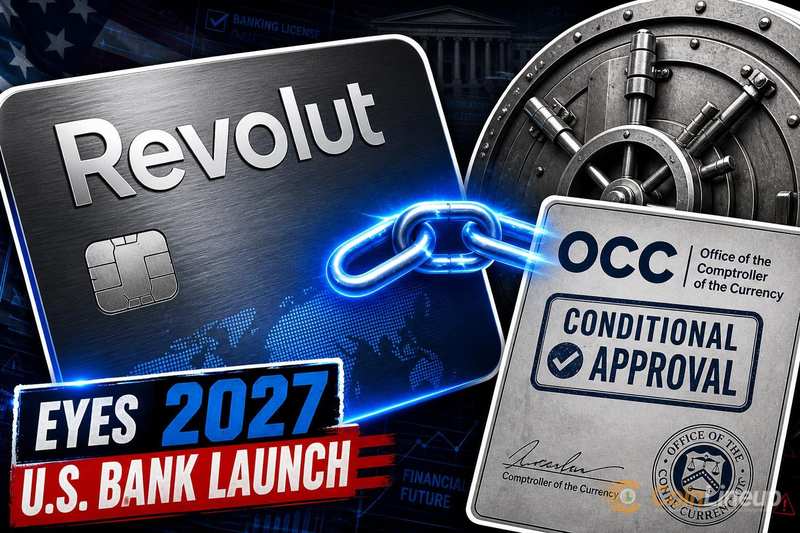
Revolut has received conditional approval from the U.S. Office of the Comptroller of the Currency (OCC) for a national bank charter, a significant regulatory step toward launching a full-scale American bank in 2027. The approval is not final, but it brings the fintech giant closer to offering loans, deposits, and crypto access in the United States.
What the conditional OCC approval means
On September 3, 2026, Revolut announced that it had received conditional approval from the OCC for a national bank charter, according to the company's newsroom. The OCC is the federal agency responsible for chartering and regulating national banks.
Conditional approval is effectively a "yes, but" from the regulator. It signals that the OCC is willing to grant the charter once Revolut satisfies a list of remaining requirements. It is not yet permission to begin operations.
A national bank charter is a single federal license to operate as a bank across the entire country. Revolut pursued this route because it allows a company to operate nationwide under one set of rules rather than obtaining licenses state by state.
Revolut stated that it still requires approvals from the Federal Deposit Insurance Corporation (FDIC) and the Federal Reserve, as well as final sign-off from the OCC, before the bank can launch. In practical terms, the announcement represents an important milestone rather than a completed bank.
The fintech industry's track record with national bank charters is mixed, which is useful context for weighing this milestone. Varo Bank became the first U.S. consumer fintech to obtain a full national bank charter in 2020, after a multi-year process that required multiple withdrawn and resubmitted applications. Other fintechs, including SoFi and Square (now Block), eventually secured their chartets through industrial loan company (ILC) or other routes after lengthy regulatory reviews. Revolut reaching conditional approval relatively quickly, roughly six months after filing, is notable in that light.
Revolut co-founder Nik Storonsky described the decision as an important first step. U.S. CEO Cetin Duransoy said the milestone keeps the company on track for a 2027 launch.
Revolut currently serves more than 80 million customers globally, a scale that underscores the ambition behind its U.S. banking push.
Why Revolut is targeting a 2027 launch
Revolut said the proposed bank remains on track for a planned 2027 launch. Reuters reported the target window as the first half of 2027, based on the company's plans.
The gap between approval and launch reflects the substantial work that remains. Revolut must obtain sign-off from the FDIC and the Federal Reserve, build out its systems, and meet the OCC's final conditions.
Reuters reported that Revolut plans to base the bank in Stamford, Connecticut, inject approximately $95 million in capital, and begin with roughly 160 employees. Those figures illustrate how much groundwork lies between a charter and a functioning bank.
Revolut first disclosed the application on March 5, 2026, filing with the OCC and FDIC under the name Revolut Bank US, N.A., the company said at the time. It described the charter as a way to operate nationwide under one federal framework and connect directly to payment rails such as Fedwire and ACH, the systems banks use to move money.
The United States is a major prize in Revolut's expansion strategy. The company has grown rapidly in Europe, where it recently began rolling out a euro stablecoin in the EU and launched its euro-backed token EURR. A U.S. charter would open the world's largest financial market to those same ambitions. Direct access to Fedwire and ACH would also reduce Revolut's reliance on partner banks, a model most U.S. fintechs use today and which has come under regulatory scrutiny when partner banks fail or exit the sector.
Potential implications for crypto and fintech users in the U.S.
For crypto holders, a bank charter matters because it signals trust. A regulated national bank must meet strict federal standards, which could make everyday users more comfortable holding money and digital assets in a single app.
Revolut said that once all approvals are received, the bank would offer loans, credit cards, FDIC-insured deposits, and access to stablecoins and cryptocurrencies. FDIC insurance means deposits are protected by the government up to legal limits, unlike most crypto balances.
The concept of a fintech blending banking and crypto fits a broader trend of traditional finance and digital assets converging, similar to UK broker Hargreaves Lansdown's recent move to open Bitcoin and Ether ETN trading.
Some caution is warranted. According to unconfirmed reports, Reuters said the U.S. bank itself may launch a stablecoin, but Revolut's official announcement only promised customer access to stablecoins and cryptocurrencies, not its own U.S. token.
For regular users, the practical takeaway is straightforward. Nothing changes today, and no U.S. products are live yet. The milestones to watch next are FDIC deposit insurance approval, Federal Reserve membership sign-off, and the OCC's final charter decision. For those who hold crypto or are curious about combining banking and digital assets, Revolut's charter is a milestone to watch rather than a product currently available for sign-up.
Disclaimer: This article is for informational purposes only and does not constitute financial or investment advice. Cryptocurrency and digital asset markets carry significant risk. Always conduct your own research before making decisions.
