Trump Accepts Ethics Deal as Senate Prepares for CLARITY Act Vote
Key Takeaways
- •The revised ethics provisions reportedly incorporate about 80% of the Tillis-Gallego proposal and cover federally elected officials, judges and their spouses.
- •BRCA protections were limited to Bank Secrecy Act and civil enforcement matters, excluding criminal cases such as Section 1960 prosecutions.
- •A proposed stablecoin circuit breaker would permit federal intervention over large transfers from community banks to stablecoins under Treasury Secretary Scott Bessent’s oversight.
- •The House Ways and Means Committee is scheduled to examine separate mining, staking and digital-asset tax legislation on Sept. 16.
Senate Republicans released a revised version of the CLARITY Act late Sunday, describing it as their “last, best and final” offer to Democrats ahead of the Sept. 15 cloture vote. The draft includes changes involving political ethics, stablecoin rewards, developer protections and digital-asset market structure.
President Donald Trump has accepted most of a bipartisan ethics proposal that had been one of the legislation’s main sticking points. The bill now faces a procedural vote on Tuesday, and Republicans need 60 votes to advance it, making Democratic support necessary. The vote would determine whether the legislation moves forward in the Senate; it would not by itself enact the bill.
Revised CLARITY Act Includes Ethics Provisions
The updated text contains an ethics proposal that Republican lawmakers say incorporates approximately 80% of the Tillis-Gallego proposal. It would require Trump to either divest “substantial” crypto-related financial interests or place them in a blind trust. The proposal would also give state attorneys general a role in enforcing the ethics provisions, a measure the White House had previously opposed.
Pro-crypto Senator Cynthia Lummis said on X:
“President Trump voluntarily agreed to new ethics provisions holding every federally elected official, judge, and their spouses to some of the toughest ethics restrictions in U.S. history. This new text includes more than 120 of Democrats’ demands.”
Lummis said that voting against the bill on Tuesday would amount to opposing ethics reforms targeting politicians’ personal investments. She also warned that rejecting the legislation could cause the United States to cede leadership in digital assets to foreign competitors and leave the country without protections for digital-asset markets.
The final CLARITY Act text was also released by Lummis, Senator Tim Scott and others in an official announcement: Lummis, Boozman and Scott release final CLARITY Act text.
Changes to BRCA, Stablecoin Yield and Market Structure
Under the revised Blockchain Regulatory Certainty Act (BRCA) provision, protections have been narrowed to the Bank Secrecy Act and civil enforcement. Language that would have extended those protections to criminal cases, including prosecutions under Section 1960, has been removed.
Stablecoin yield is another central issue in the revised legislation. The text includes “circuit breaker” language proposed by Tillis in July. The provision would allow federal regulators to intervene if there is evidence of large transfers from community banks to stablecoins. Treasury Secretary Scott Bessent would oversee the mechanism as the federal regulator.
The updated “Ag title” also establishes tighter rules concerning vertical integration, including affiliate trading and conflicts of interest involving digital commodity exchanges, brokers and dealers. The text clarifies that state consumer protection laws remain applicable. It also states that developer protections do not exempt entities from derivatives laws or affect prediction markets.
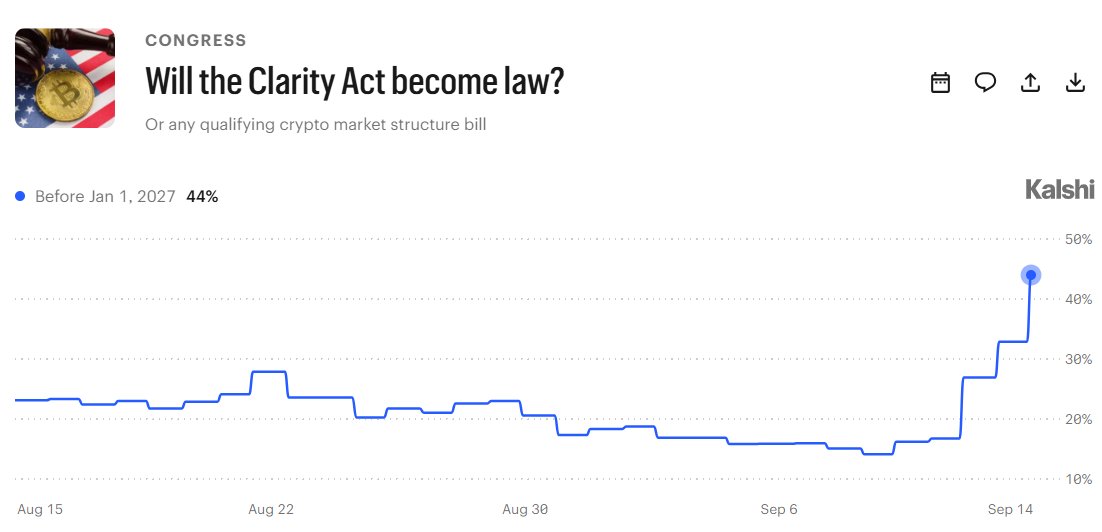
Data from prediction platform Kalshi show that the odds of the CLARITY Act becoming law this year rose to 44%, up from 14% the previous week.
House Panel to Review Two Crypto Tax Bills
Separately, the U.S. House Ways and Means Committee is scheduled to review two crypto tax bills on Sept. 16. That review would be a separate legislative track from the Senate’s CLARITY Act vote, adding another near-term point at which digital-asset policy proposals could be revised or advanced.
The Mining and Staking Tax Clarity Act would defer taxes on newly generated tokens until they are disposed of and would classify the resulting income as ordinary income. Republicans are reportedly considering removing the deferral provision or limiting it to five years.
The Applying Existing Tax Law Anti-Abuse Rules to Digital Assets Act would extend wash-sale and constructive-sale rules to digital assets. Assets earned through mining or staking, along with eligible U.S.-dollar-denominated stablecoins, would be excluded.
If approved, both bills would proceed to the House floor. Legislative proposals may change during negotiations and may not become law in their current form. This article is for informational purposes only and does not constitute legal, financial or investment advice.
Source: The Market Periodical

