Senate Republicans Release Revised CLARITY Act Text with Ethics and Law Enforcement Provisions
Key Takeaways
- •The revised CLARITY Act would bar senior federal officials and their spouses from issuing or promoting cryptocurrencies while in office until January 20, 2029.
- •Affected officials would need to divest crypto holdings or use a blind trust, with sales of $1,000 or more reported to the Government Accountability Office.
- •The bill gives the Department of Justice civil enforcement authority over the ethics rules, a structure Democrats have criticized for excluding state attorneys general.
- •New law enforcement provisions would fund training and tools for state and local agencies and create a cyber center focused on state-backed crypto attacks.
- •Controversial sections on stablecoin user rewards, the Blockchain Regulatory Certainty Act, and the Keep Your Coins Act remain unchanged in the revised text.
U.S. Senate Republicans released a revised version of the CLARITY Act on July 22, 2026, reviving stalled negotiations over comprehensive cryptocurrency market structure legislation. The 616-page proposal introduces new ethics restrictions for senior federal officials and strengthens law enforcement provisions, while retaining several contested sections on stablecoin rewards and software developer protections. The bill is part of a broader effort to establish a unified federal framework for digital asset regulation, an area where U.S. crypto firms have long cited uncertainty as a barrier to operations and institutional adoption.
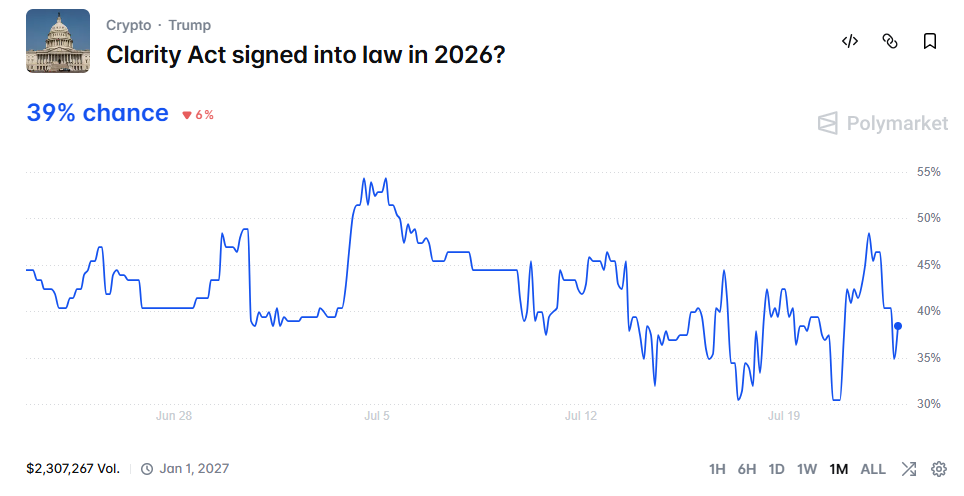
The bill continues to face resistance from Senate Democrats and would require bipartisan support to clear a likely 60-vote procedural threshold in the Senate. On Polymarket, traders placed the probability of the CLARITY Act being enacted during 2026 at approximately 38% as of July 24. The prediction market had dropped to 32% on July 17 before recovering following reports of an ethics agreement between key negotiators. The full bill text is available on Senator Lummis's website.
Ethics Provisions Target Senior Officials
A central update in the revised text is the inclusion of an ethics provision, which has been a major point of contention throughout the legislative process. The new version would ban the president, vice president, members of Congress, federal judges, and other senior public officials from issuing or promoting cryptocurrencies while in office. The prohibition would also extend to their spouses.
Notably, these restrictions carry a sunset date of January 20, 2029, meaning they would lapse once President Donald Trump leaves office. The provision reflects heightened scrutiny of financial conflicts involving digital assets at the highest levels of government, an issue that has drawn attention across party lines.
The ethics rule requires all affected officials to divest their crypto assets and investments in crypto-related companies, or alternatively place them in a blind trust outside their control. Disclosure requirements apply to any sale of crypto assets valued at $1,000 or more, with impacted officials required to report such transactions to the Government Accountability Office.
The revised text grants the Department of Justice (DOJ) authority to enforce the ethics rule through civil proceedings. According to crypto journalist Eleanor Terrett (X post), this enforcement structure is likely to draw opposition from Democrats.
Terrett reported that the ethics rule, in its current form, reflects negotiations between the White House and Republican Senators Cynthia Lummis and Bernie Moreno. Democrats have not yet contributed to the drafting but have already expressed objections to granting the DOJ sole enforcement authority, advocating instead for state attorneys general to share enforcement responsibilities.
Law Enforcement Provisions Added
The revised bill introduces a new section aimed at enhancing the ability of law enforcement agencies to investigate cryptocurrency-related crimes. It provides funding, training, and investigative tools for state and local law enforcement, and establishes a cyber center dedicated to countering crypto attacks by state-backed actors.
The section also mandates that stablecoin issuers comply with lawful orders to freeze or reissue stablecoins. The inclusion of these provisions follows the Major County Sheriffs of America (MCSA) dropping its earlier opposition to the bill.
Contested Sections Remain Unchanged
Several controversial components of the CLARITY Act remain unaltered in the revised text. The stablecoin yield provision continues to allow companies to pay rewards tied to user activity while prohibiting interest payments on idle stablecoin balances. Despite opposition from the banking industry, which has argued that such rewards blur the line between payment instruments and securities products, the Senate appears to be maintaining its position on this provision. According to Terrett, speculation that Senator Thom Tillis would introduce "circuit breaker" language into the provision did not come to fruition.
The Blockchain Regulatory Certainty Act (BRCA) and the Keep Your Coins Act (KYCA) are also unchanged. The BRCA has been a focal point of controversy regarding its protections for non-custodial software developers, shielding them from classification as money transmitters while criminalizing the knowing facilitation of illicit transactions. Some law enforcement groups and the Alliance to End Human Trafficking have opposed the BRCA, arguing it could enable illicit cryptocurrency activity.
Path Forward in the Senate
With Democratic input still anticipated, the bill's prospects in the Senate remain uncertain. The legislation requires bipartisan support to advance past the expected 60-vote threshold. Odds on Polymarket have risen slightly to 39% from a recent low of 33%.
However, Congress is scheduled to begin its August recess on August 7, and observers have suggested the bill must make meaningful progress before that date to maintain legislative momentum. With the midterm electoral cycle intensifying, the window for substantive bipartisan legislating on digital asset regulation may narrow further heading into the fall.

