Meet the 'Mini Erin Brockoviches' Fighting Eminent Domain—and Amazon's Shadow—Over a $10,000 Data Center Incentive
Key Takeaways
- •NorthPoint Development's Project Hazelnut in Hazle Township proposed a $165 million, 1,300-acre campus with 15 buildings, offering residents $10,000 per eligible household—an incentive that was largely rejected.
- •Records obtained through right-to-know requests in January confirmed Amazon's involvement in the project, which the company had asked to keep confidential, though Amazon says it has no definitive agreement with NorthPoint.
- •Residents formed the Alliance to Stop the Line and filed about 20 protests against PPL Electric Utilities' proposed 11.2-mile high-voltage power line, which threatens 28 properties with eminent domain, prompting judges to temporarily halt the proceedings.
- •In May, a Luzerne County judge denied the data center's appeal for lacking required zoning approval, though NorthPoint retains options to pursue approval.
- •Governor Josh Shapiro, who had fast-tracked AI infrastructure permitting in 2024 and announced a $20 billion Amazon investment, signed an executive order in August eliminating fast-track permitting and requiring local review as national opposition to data centers grows.
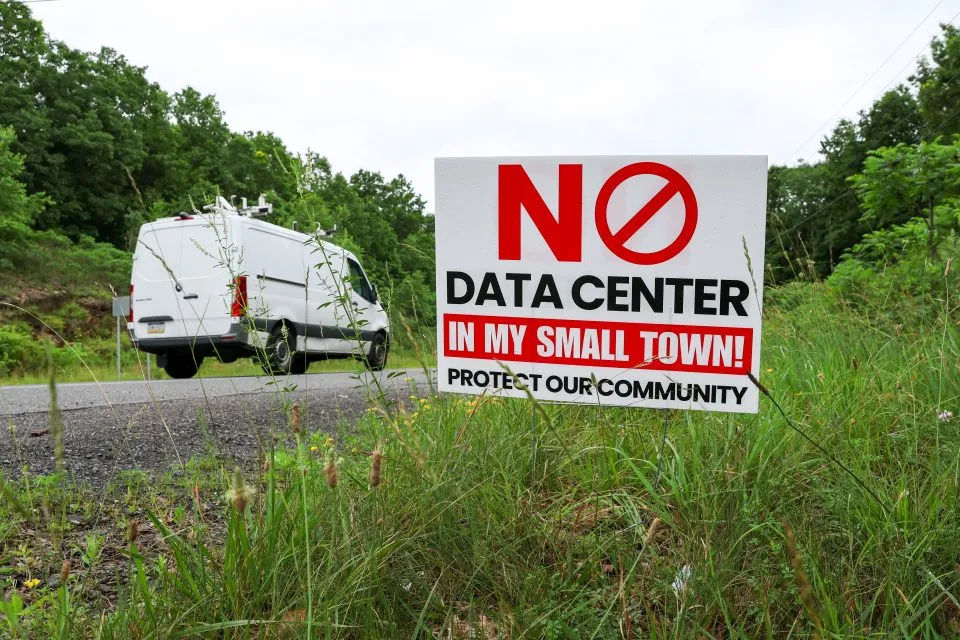
Erika Cook knew about NorthPoint Development's plans for a 1,300-acre data center years before residents of Hazle Township received a letter in the mail in June outlining a potential $10,000 payday for eligible households willing to accept the project's construction. Collecting the money was contingent on residents of the rural Pennsylvania community at the foot of the Poconos allowing the developer to build a 15-building campus, dubbed Project Hazelnut.
NorthPoint's proposal to Hazle Township amounted to a $165 million investment in the area. Beyond the payout for "eligible households" in the township of roughly 4,500 properties, the offer also included funding for a local police department, according to the letter to residents viewed by Fortune. The $10,000 incentive—which would be paid only once the first building of the campus was complete—was first reported by The Wall Street Journal, and it was largely rejected by the township's residents.
In fighting Project Hazelnut, locals told Fortune they discovered how far the effort reached—potentially all the way to Amazon, whose name is conspicuously absent from all Hazelnut and NorthPoint branding.
Local officials and NorthPoint refused to confirm whether Amazon would be the campus's end user. But residents began filing right-to-know requests, and Amazon's role was confirmed when records between the company and Pennsylvania's Department of Community and Economic Development were released in January. The emails, viewed by Fortune and previously reported by local outlets, showed that while state officials tried to disclose Amazon's involvement in the project, the company wanted its role kept covert due to broad "contractual issues."
An Amazon spokesperson told Fortune the company is "evaluating multiple sites across the Commonwealth" and is in discussions with NorthPoint, but does not have a definitive agreement in place. In a blog post published Friday, Amazon Web Services CEO Matt Garman said the company has committed to no longer entering into nondisclosure agreements with government agencies related to data-center projects.
Beyond the secrecy, locals said they were baffled by how little specificity or clarity the project's stakeholders could provide, according to the records.
"We really had no idea what was happening," Cook told Fortune. "And a hyperscaler data center of what they're proposing—1,300 acres—is not a small project. We've been trying to get information, and unfortunately, the only way we've been able to get it is by right-to-know requests."
NorthPoint did not respond to Fortune's request for comment.
Activated by eminent domain
Cook, an insurance agent who lives in neighboring Sugarloaf Township, has her own reasons for opposing the project. She owns one of the 28 properties facing eminent domain threats from local utility PPL Electric Utilities tied to the very same data center behind the five-figure checks, she said.
In 2024, the utility and a developer approached residents in Luzerne County, where Sugarloaf is located, handing out pamphlets asserting the right of eminent domain—the government's power to seize private property in the public's interest. PPL Electric Utilities proposed an 11.2-mile high-voltage power line running through the homes that would supply electricity to the campus.
The disdain for the $10,000 incentive, Cook said, is just the tip of the iceberg. Impacted residents and neighbors formed the Alliance to Stop the Line and have filed about 20 formal protests with the Public Utilities Commission challenging PPL's plans, arguing that a high-voltage line would decimate property values, emit noise pollution, and generate electromagnetic fields associated with health risks next to their homes.
Last month, PUC administrative law judges temporarily halted proceedings for the power line, determining it was too early to grant utility extensions while the data-center developments had yet to be approved and were still being contested in court.
The resistance extends well beyond Pennsylvania. In the first three months of 2026, at least 75 data center projects worth more than $130 billion collectively were delayed or canceled, while active opposition groups across 49 states grew from 396 at the end of last year to 833 by March, according to a Data Center Watch report published in June.
Hazle Township knows something about grassroots protest. The township completely encircles the City of Hazleton, which became the face of an anti-immigrant movement two decades ago, when then-Mayor Lou Barletta passed the controversial Illegal Immigration Relief Act, fining landlords who rented to undocumented immigrants and withholding permits from businesses that employed them. Barletta capitalized on a period of deindustrialization and demographic change to draw in working-class white supporters. He ran for Pennsylvania governor in 2022, losing in the Republican primary, while Hazleton went on to become a heavily Hispanic city—confounding commentators as many of those residents chose to vote Republican.
Residents of these northeastern Pennsylvania towns today see their campaign as a small but vital part of a national opposition movement to the AI infrastructure buildout, with its associated rising costs and widespread environmental risks. The widely cited statistic is that nearly 70% of Americans oppose a data center being built in their area, according to surveys by both Gallup and NBC News. "The data-center rebellion, with its local origins and compounding grievances," The Atlantic's George Packer recently noted, "is thoroughly American."
According to local protester Annie Vinatieri, today's data-center protests are a nonpartisan movement driven primarily by Americans with little prior experience in environmentalism, with demographics that are "mostly white working and middle/upper class." A minority of Dominican Americans, "almost all of whom are immigrants," have also shown interest, she said.
"Many of us are pro se, mini Erin Brokoviches actually getting somewhere," Cook said. "We're having these small victories here and there, and it's all adding up."
Project Hazelnut's detractors and supporters
Pennsylvania Gov. Josh Shapiro announced Project Hazelnut in November 2024 as the first test case of an executive order signed the day before that fast-tracked the permitting process for AI infrastructure. Months later, in July 2025, Shapiro announced that Amazon would invest $20 billion in an AI buildout in Pennsylvania—the largest capital investment in the commonwealth's history.
The investment plan accounts for just a handful of the 4,767 data centers in the U.S., part of a ballooning AI boom expected to reach $7 trillion in spending by 2030.
At first, the announcements didn't raise many eyebrows among area residents, according to Vinatieri, another Sugarloaf resident. The buildouts were pitched not as data centers, but as "innovation and technology campuses."
"When you say technology campus, that's very vague. It sounds very academic," Vinatieri told Fortune. "When it became apparent what was happening, people really got concerned and started to understand what it meant."
Despite the data centers having yet to gain approval, hundreds of acres of land were cleared. Vinatieri spoke with neighbors who claimed they saw triple the deer and wildlife in their backyards as a result of habitat displacement. Residents like Cook were particularly concerned about the construction's proximity to some of Pennsylvania's Superfund sites—land requiring long-term cleanup due to hazardous waste pollution—since building could damage toxic containment barriers.
Tensions increased in earnest when Amazon began snapping up land in neighboring areas. In July 2025, Brewster Development Company sold about 350 acres of land in Kline Township, Pennsylvania, to Amazon Data Services for roughly $180 million.
Victories for data center opposition
The records released through the right-to-know requests fueled public dissent over the data center and scrutiny of the campus's potential use of natural resources. In May, a Luzerne County judge denied an appeal for the Project Hazelnut data center on the grounds that the project lacked required zoning approval—in part because data centers were not included in the local zoning ordinance, and because the initial approval process did not provide adequate opportunities for public input. NorthPoint still has options for gaining approval. The ruling left zoning approval and the related power-line proceedings as separate public processes to watch as the project moves forward.
Shapiro, meanwhile, has walked back some of his support for data center construction. In August, he signed an executive order eliminating fast-track permitting and requiring local review—rather than that of the state-level Department of Environmental Protection—for prospective data center projects. He recently cited concerns similar to those raised in Hazle and surrounding townships: that companies were withholding information from the public in part because they didn't yet have answers to key questions.
"What I was finding after listening to the neighbors about their concerns, and then talking with some of these developers, is those developers who were wreaking havoc on the communities, they actually didn't have any access to power," Shapiro told CBS News Philadelphia last week. "They actually didn't have a technology company that wanted to, you know, use their development, and so they were kind of speculating. And in the process of speculating, they were wreaking havoc on the community."
Cook would like to see her and her neighbors prevail over PPL's eminent domain case, and she would consider it a victory for NorthPoint to abandon Project Hazelnut. Even then, she has concerns: NorthPoint is exploring data center development in other parts of the state, including a 1,400-acre project in Banks Township.
"My fear is that they're just going to go somewhere else, right?" she said.
This story was originally reported by Fortune.

