Nvidia-Backed Reflection AI Unveils Beam, Its First Open-Source Model, to Challenge China's AI Lead
Key Takeaways
- •Reflection, a New York-based startup backed by Nvidia and valued at $25 billion, has launched Beam, its first open-source AI model intended to compete with Chinese-led open models such as Moonshot's Kimi K3 and DeepSeek's V4.
- •In Reflection's internal benchmark tests, Beam achieved scores similar to Beijing-based Z.ai's GLM-5.2, which was released in July and later succeeded by GLM-5.3.
- •Reflection claims Beam is three to four times as efficient as competing open models from Western companies, delivering competitive coding and agentic performance at a fraction of the token cost and inference-time compute.
- •Ahead of the launch, Reflection secured a May partnership to supply models to two U.S. government departments, a $6.3 billion compute deal with SpaceX, and a $1 billion deal with Nebius, totaling more than $7 billion in capacity over two months.
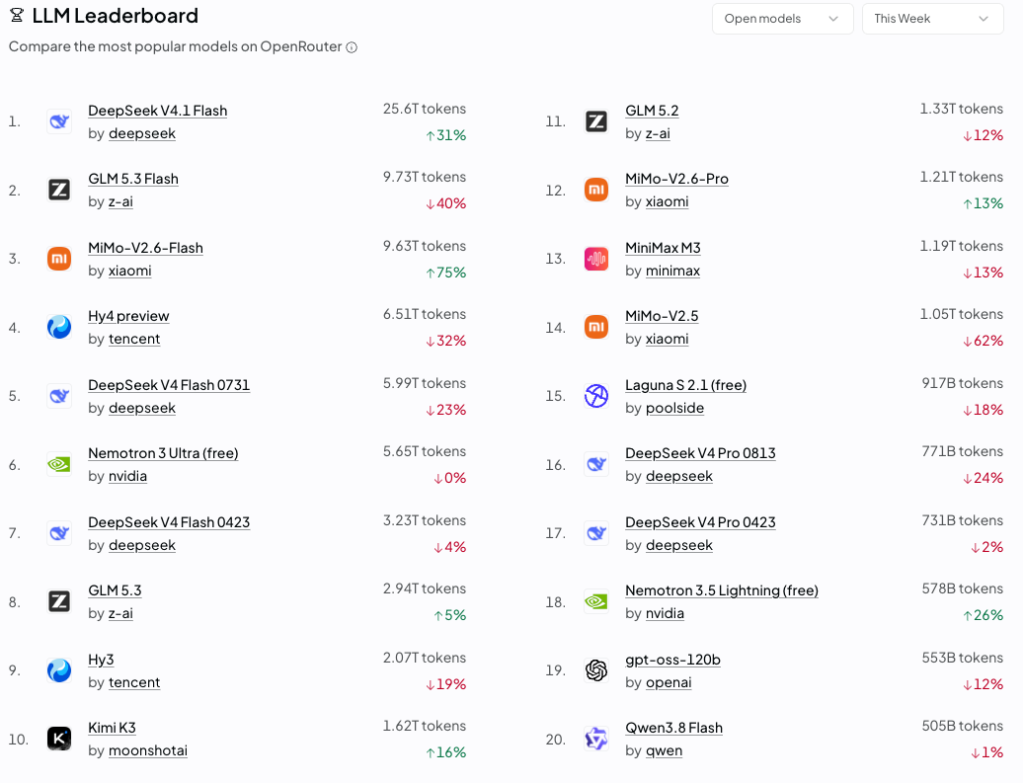
- •Independent usage rankings on OpenRouter currently place Chinese vendors and Nvidia at the top of the open-model leaderboard, while Reflection says it is already training the next, larger model on its road map.
The United States has gained a new contender in the race to build the world's best open-source AI model—a competition currently dominated by China, whose popular releases include Moonshot's Kimi K3 and DeepSeek's V4.
Reflection, a New York City–based AI company, has unveiled Beam, its first model, which the company told Fortune "advances the frontier for the Western open ecosystem."
In benchmark tests the company conducted, Beam achieved scores similar to those of GLM-5.2, an open model from Beijing-based Z.ai that was released in July. That model was succeeded by GLM-5.3, which Z.ai debuted in August.
Reflection said Beam is cheaper to run than many competing models. "Through high-compute reinforcement learning, we were able to make Beam extremely efficient at reasoning—delivering competitive performance on coding and agentic tasks at a fraction of the token cost and inference time compute," the company said. It added that Beam is three to four times as efficient as rival open models from Western companies, and it is positioning Beam as a "workhorse" for enterprises, the public sector, and developers. The economics are central to that pitch: because organizations deploying open models bear the computing costs themselves, savings in token cost and inference-time compute translate directly into operating expenses.
The launch follows a string of high-profile partnerships and compute deals. In May, the company entered into a partnership to supply its models to the U.S. Department of Energy and the U.S. Department of War. In June, it signed a $6.3 billion compute deal with SpaceX for access to Nvidia GB300 chips at the company's Colossus 2 data center, CNBC reported. In July, it added another $1 billion compute deal through cloud provider Nebius, Bloomberg reported. The two compute agreements together total more than $7 billion in capacity secured over a two-month span.
Reflection was founded in March 2024 by former Google DeepMind researchers Misha Laskin, now its CEO, and Ioannis Antonoglou, the startup's president and chief technology officer. The Nvidia-backed firm carries a $25 billion valuation, Laskin told CNBC in April.
The best-known AI companies—OpenAI, Anthropic, and Google DeepMind—have primarily produced models that customers can access only through an interface known as an API, submitting a prompt and receiving a response. Open-source models, by contrast, can be downloaded in their entirety by users, run on their own hardware or cloud infrastructure, and fine-tuned or modified in a variety of ways. Increasingly, large enterprises are gravitating to these open models because of the control over data security and costs they provide, even though the models often lag proprietary systems in performance.
"Open systems evolve faster, attract broader participation, and foster ecosystems of research and innovation that no single organization can achieve alone," reads the company's mission statement on its website. "They're also safer: When systems are open to inspection, more can identify vulnerabilities, improve safeguards, and contribute to their long-term resilience."
The Western company most comparable to Reflection may be Thinking Machines Lab, founded by OpenAI's former CTO Mira Murati. It unveiled its first model, Inkling, in July. Nvidia also makes an open model, called Nemotron, and OpenAI, Google, and Meta all offer open models as well.
Nvidia's Nemotron is the top-ranked U.S.-based model on OpenRouter's Large Language Model (LLM) leaderboard, coming in at No. 6 as of this writing. OpenRouter is a gateway that connects users to multiple routers and tracks which ones get the most use. When the leaderboard is filtered by open models, the top entries are made by DeepSeek, Z.ai, Xiaomi, Tencent, and Nvidia. OpenAI's gpt-oss model is the next top U.S.-based model, ranked No. 19. Unlike Reflection's internal benchmarks, those rankings are based on real-world usage, making them an independent reference point as Beam reaches users.
Reflection said it is "already training the next, larger model on our road map."
This story was originally featured on Fortune.com.

